Can I use it?
Can You Use Baking Soda, Vinegar or Bleach in a Hot Tub?
One of them is genuinely the same chemical you would otherwise pay spa prices for. The rest are a false economy, and two of them create a problem that costs more than the chemicals would have.
By Scooter M. · Published · How we pick
How this page is funded: the buy buttons below are Amazon affiliate links. If you buy through one we earn a commission at no extra cost to you. It does not change what we recommend, and where the better answer is a retailer we earn nothing from, we say so. The full version.
The verdict, up front. Baking soda: yes — it is sodium bicarbonate, which is exactly what a tub of alkalinity increaser contains, and buying it as baking soda is the one honest saving on this page. Washing soda: yes, for the same reason — it is soda ash, the pH increaser. Vinegar, bleach, borax, dish soap and hydrogen peroxide: no. Each one either cannot hold the job or actively makes work, and the two that make the most work are dish soap and vinegar.
This page is about things people add to the water. Soaking a filter in vinegar or bleach is a different question with a different answer, and it has its own page: vinegar vs bleach vs the dishwasher. Wiping the shell or the cover with a household cleaner is covered on surface cleaners and cover care. Epsom salt, bath salts and bath bombs are their own page too: bath additives in a hot tub.
How we judged each one
Three tests. They are the reason the answers differ so much between products that all look like “cheap alternative” from the outside.
- Is it literally the same compound? Some spa chemicals are commodity chemicals in a smaller bag. Where that is true, the grocery version is the same product and the only question is dosing.
- Does the job need a measurable residual? Balancing is a one-off adjustment you verify with a strip. Sanitizing is a residual that has to be there, continuously, which is what the CDC’s hot tub guidance is about.[source] A substitute that cannot hold a residual is not a substitute.
- Does it add organic carbon? This is the test people miss. Hot tub water’s central ongoing problem is organic load from skin, oils and products. Anything organic that you pour in is food — it consumes sanitizer and feeds the biofilm you are trying not to have.
Every household substitute, and the verdict
| Household item | What it is | In the water? | Buy this instead |
|---|---|---|---|
| Baking soda | Sodium bicarbonate | Yes | Nothing. It is alkalinity increaser |
| Washing soda | Sodium carbonate (soda ash) | Yes | Nothing. It is pH increaser |
| White vinegar | Dilute acetic acid — weak, volatile, organic | No | Dry acid (sodium bisulfate) pH decreaser |
| Household bleach | Sodium hypochlorite solution, unstabilized | No | Dichlor granules |
| Borax | Sodium tetraborate — raises pH, mild buffer | No | pH increaser, dosed against a reading |
| Dish soap / detergent | Surfactant | Never | Nothing. If it is in there, see the cleanup below |
| Hydrogen peroxide (3%) | Oxidizer with no residual at spa temperature | No | MPS non-chlorine shock, plus a real sanitizer |
| Table salt / water-softener salt | Sodium chloride, usually with additives | No | Only the salt your salt system specifies, if you have one |
| Lemon juice | Citric acid plus sugars — organic | No | Dry acid pH decreaser |
The pattern in that table is worth saying out loud, because it predicts the answer for anything not listed. Inorganic commodity chemicals cross over fine. Anything organic does not. Vinegar and lemon juice are acids that work, chemically — they are just acids made of carbon, and carbon is food.
Baking soda: the one real yes
Total alkalinity increaser is sodium bicarbonate. That is not a simplification; it is the ingredient. A 2 lb spa tub and a grocery box of baking soda contain the same compound, and the differences are container size, purity grade and whose dosing table is printed on the side.
Best for: anyone whose alkalinity runs low, which on soft or well water is most people. Our alkalinity increaser roundup lists a 50 lb industrial bicarbonate bag next to the spa tubs for exactly this reason, and it is the cheapest way to own this chemical.
Two cautions, and the first one is the mistake almost everybody makes.
- Baking soda is not the right fix for low pH. It raises total alkalinity strongly and pH only slightly. If what you need is pH up, the chemical is soda ash — washing soda — not bicarbonate. Dosing bicarb at a pH problem is how tubs end up at 200 ppm alkalinity with pH still low, which is a harder state to unwind than where you started. The distinction is the whole of the pH increaser page.
- Dose by your gallons. A grocery box prints no spa table at all, so work from the spa figure for bicarbonate and your tub’s actual volume, add half of what you calculate, run the jets and retest. Alkalinity is easy to overshoot and only a water change takes it back down.
Vinegar: the acid that feeds your tub
Vinegar does lower pH. It is also the wrong tool for three compounding reasons, and this is the substitution we would argue hardest against.
- It is weak and dilute. Household vinegar is a few percent acetic acid. Moving pH in a few hundred gallons of alkaline fill water takes a volume of it that is absurd next to a spoon of dry acid, and because it is a weak acid it fights the water’s own buffering rather than overcoming it.
- It is organic carbon. Acetate is food. You are dosing a nutrient into a warm vessel you are simultaneously trying to keep free of biofilm — see hot tub biofilm. Expect sanitizer demand to rise after a vinegar dose, which is the opposite of what the person pouring it wants.
- It does not survive. Acetic acid is volatile and gets oxidized by your sanitizer, so the pH move is temporary. Dry acid’s effect is permanent until something else changes it.
Best for: nothing in the water. Vinegar has a genuine place in hot tub ownership — it is a reasonable filter soak and a reasonable descaling agent on parts out of the tub, both covered on vinegar vs bleach vs the dishwasher. Inside the water, use dry acid.
One specific version of this question deserves its own answer: vinegar to lower alkalinity. Any acid lowers alkalinity and pH together, and the technique for taking alkalinity down while letting pH come back up is concentrated acid followed by aeration. That needs an acid strong enough to work in a measured dose, which vinegar is not.
Household bleach: a label problem before it is a chemistry problem
Bleach is sodium hypochlorite, the same family as liquid pool chlorine, so the chemistry is not absurd. Three things stop it being the answer.
The label. A product used to sanitize water is a registered pesticide and its label states where it may be used. The EPA is unambiguous: the label is the law, and every pesticide label carries the statement that it is a violation of federal law to use the product in a manner inconsistent with its labeling.[source] Most jugs of laundry bleach carry no water-sanitizing directions at all, and some contain thickeners or fragrance that have no business in a spa.
The strength drift. Hypochlorite solutions decay in storage, faster when warm. The jug in the cupboard is weaker than the jug you bought, with no way to tell by how much, so each dose is a guess. Dichlor granules are stable and measurable.
The pH push. Hypochlorite is strongly alkaline. Every dose drives pH up, in a vessel whose jets are already stripping carbon dioxide and driving pH up. You end up chasing pH down with acid you would not otherwise have needed, which is a strange way to save money.
Best for: nothing in a hot tub. The chlorine you want is dichlor granules, dosed against the CDC’s at-least-3-ppm figure for hot tubs.[source]
Borax, hydrogen peroxide and salt
Borax comes up because the pool world uses it as a pH and alkalinity buffer. It does raise pH, and it is not dangerous. The problem is that nothing you own measures borate, so you cannot tell how much is in there or what it is doing to your other readings — and a spa, unlike a pool, gets drained every few months anyway, which is most of what a borate program is trying to avoid. Use a pH increaser you can dose against a number.
Hydrogen peroxide at drugstore strength is an oxidizer with effectively no persistence at 102°F. It will consume some organics the moment it goes in and then be gone, leaving no residual to protect anyone — and it will knock down the chlorine or bromine reading while it does it. If you want the weekly oxidation without adding chlorine, the product for that is MPS non-chlorine shock, which is covered on shocking a hot tub. Peroxide-based spa systems do exist, but they are complete programs with their own test regime, not a bottle from the bathroom cabinet.
Table or water-softener salt only belongs in a tub whose manufacturer rates it for salt, and then only the salt the system specifies. Softener pellets and table salt carry anti-caking agents and iodine that a spa does not want, and adding salt to a tub with no chlorine generator gives you a corrosive brine with no sanitizer. The whole question is on hot tub salt water systems.
If dish soap already went in
This is the only row of the table that creates an emergency, and it is usually not deliberate: someone washed the filter with detergent and rinsed badly, or a swimsuit came out of the laundry with residue in it.
- Dose a defoamer to get the lid back on. Defoamer suppresses the suds; it does not remove the surfactant. Treat it as first aid, not a fix — clarifiers and defoamers explains the difference.
- Then drain it. Surfactant does not break down on its own and will foam again every time the jets run. A water change is the actual answer, and if the soap went through the plumbing, run a line flush first — flushing the plumbing lines.
- Replace or deep-clean the filter. Detergent clings to pleats and re-releases for weeks. The method is on how to clean a hot tub filter.
Why foam happens at all, and the difference between a soap foam and a biofilm foam, is on why your hot tub foams.
So what does the DIY route actually save?
Honestly: the price of bicarbonate and soda ash, which is the smallest line in the cupboard. The expensive items are the sanitizer, the shock and the test strips, and those are exactly the three where there is no household substitute — because they are the three jobs that require a registered product, a measurable residual, or a calibrated reagent.
If the goal behind the question is spending less overall, the levers that work are a cover that is not waterlogged, a filter you clean on schedule, and not over-shocking. The arithmetic is on what hot tub maintenance actually costs, and the shortest honest shopping list is on what hot tub chemicals do you need.
And if the goal is fewer chemicals rather than cheaper ones, that is a different and more answerable question — salt vs mineral vs traditional and mineral sanitizers cover the routes that reduce the chlorine you add without pretending the residual is optional.
What fixes it
The products for this job
Named because they do the specific job this page describes, not because they are the only options. Specifications are the manufacturer’s published figures.
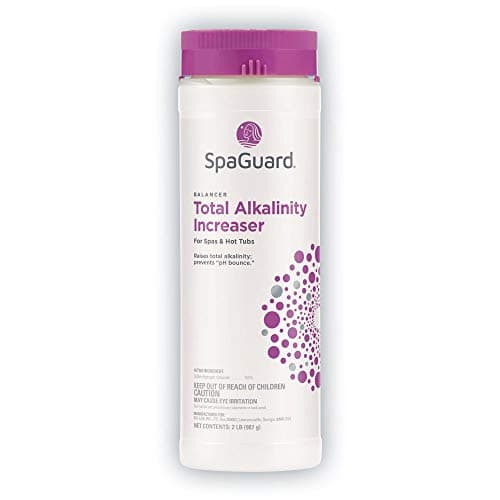
#1 · Best for stopping ph drifting
SpaGuard Total Alkalinity Increaser
SpaGuard · scored 8.9/10
The product most people should buy before they buy any pH adjuster at all.
Total alkalinity is the buffer that stops pH moving. If your pH will not stay put no matter how much acid or soda ash you add, the actual problem is almost always that TA is too low, and this is the fix.
Raise it in stages and retest between them. Bicarbonate is forgiving on the way up and unforgiving on the way down, because the only route back from over-corrected alkalinity is acid plus aeration plus patience.
What the maker states
- Chemistry
- Sodium bicarbonate
- Typical target
- 80-120 ppm total alkalinity
- Effect on pH
- Raises it slightly
- Dose
- By tub volume, per the label
How it scored
- Predictability
- 9.0
- Ease of dosing
- 8.5
- Container size fit
- 9.0
- Cost per month
- 9.0
- Availability
- 9.0
Skip this one if: your alkalinity is already in range. Overshooting TA locks pH high and is genuinely tedious to undo.
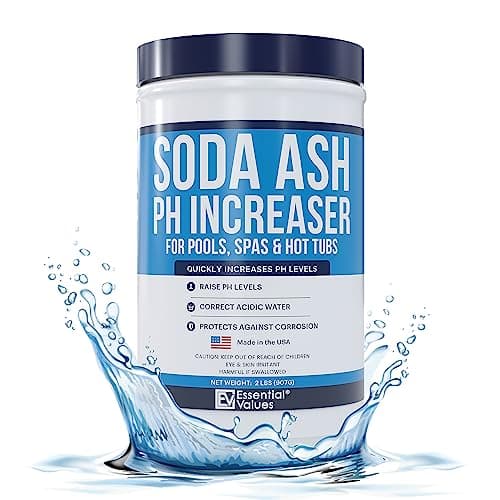
#2 · Best for knowing exactly what is in the tub
Soda Ash pH Increaser for Hot Tub and Spa, 2 lb
Generic · scored 7.6/10
A 2 lb container that names soda ash on the label rather than leaving you to infer it.
Worth listing because it says soda ash on the front. Once you know pH increaser is sodium carbonate, you can compare any container against any other on price per pound instead of on branding, and this is the listing that makes that obvious.
It is not the cheapest here and it is dual-labeled for pools and spas, so check the dosing table applies to a few hundred gallons before you scoop. Transparency about the chemical is the reason to pick it, not performance.
What the maker states
- Chemical
- Soda ash powder, per the listing
- Size
- 2 lb, per the listing
- Labeled for
- Hot tubs, swimming pools and spas, per the listing
- Job
- Raises pH, per the listing
How it scored
- Label clarity
- 9.0
- Dosing guidance
- 7.0
- Value per pound
- 6.5
- Availability
- 7.5
- Container practicality
- 8.0
Skip this one if: you want the cheapest spa option. Naming the chemical does not make it work differently.
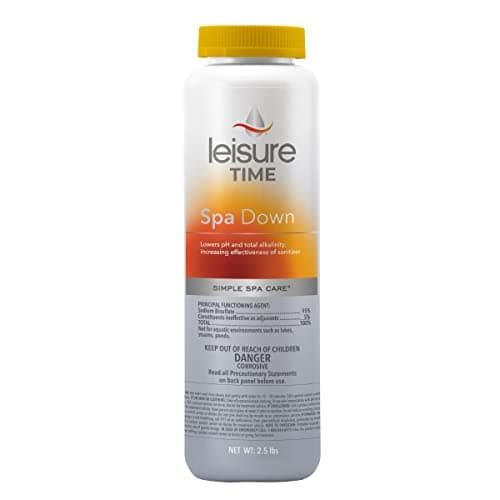
#3 · Best for most hot tub owners
Leisure Time 22338A Spa Down, 2.5 lb
Leisure Time · scored 8.4/10
A spa-labeled 2.5 lb container from the brand most spa dealers stock, at a sensible price per pound.
The default recommendation for most people: a spa-labeled container, spa-scale dosing on the back, a size that lasts without dominating a shelf, and wide availability through both dealers and general retail.
Nothing here is special chemistry and we would not pretend otherwise. You are paying a modest premium over a pool container for a label that matches your water volume, which for a product that moves pH quickly is a defensible thing to pay for.
What the maker states
- Part
- 22338A, per the listing
- Size
- 2.5 lb, per the listing
- Labeled for
- Spa use, per the listing
- Job
- Lowers pH
How it scored
- Label clarity
- 8.5
- Dosing guidance
- 8.5
- Value per pound
- 8.0
- Availability
- 8.5
- Container practicality
- 8.5
Skip this one if: you only need to nudge pH once. A 22 oz container is plenty and costs a third of this.
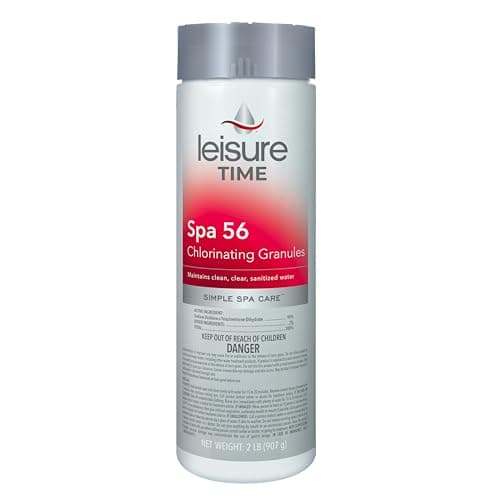
#4 · Best for chlorine users and fast recovery
Leisure Time Spa 56 Chlorinating Granules
Leisure Time · scored 8.1/10
Dichlor granules: dissolve fast, act fast, gone fast. The right tool after a heavy soak.
Dichlor is the granular chlorine hot tubs are dosed with, because it dissolves at spa temperature without pre-mixing and it is close enough to pH-neutral not to wreck your balance every time you add it. After a soak with four people in the tub, a measured dose of dichlor is the fastest way to get free chlorine back where the CDC says it should be.
The catch is cyanuric acid. Dichlor is stabilized, so every dose adds CYA that never leaves except by draining. Across a full water cycle that CYA accumulates and progressively blunts your chlorine, which is one of the real arguments for changing the water on schedule rather than topping up forever.
What the maker states
- Chemistry
- Sodium dichlor granules
- Dissolving
- Fast, no pre-mixing required per the label
- Target residual
- CDC gives at least 3 ppm free chlorine in hot tubs
- Adds cyanuric acid
- Yes, dichlor is stabilized
How it scored
- Stability at 104F
- 6.0
- Ease of dosing
- 8.5
- Odor and skin feel
- 8.0
- Cost per month
- 8.5
- Availability
- 9.5
Skip this one if: you only use the tub every couple of weeks. Dichlor burns off quickly at spa temperature, so an unattended chlorine tub goes unsanitized far sooner than a bromine one.
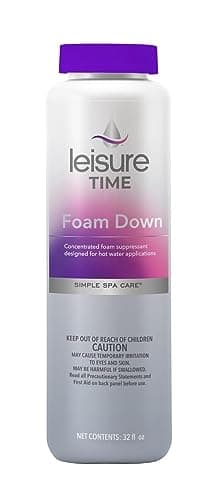
#5 · Best for killing foam right now
Leisure Time Foam Down
Leisure Time · scored 6.9/10
Works in seconds and treats nothing. Useful, and widely misused as a solution.
There is a legitimate use for defoamer: guests are arriving in ten minutes and the tub looks like a bubble bath. It handles that perfectly, and there is no shame in owning a bottle for exactly that.
What it does not do is remove the surfactants causing the foam. Those are still in the water, and every dose of defoamer adds silicone that eventually loads your filter. If you are reaching for it weekly, the tub is telling you it wants fresh water.
What the maker states
- Type
- Silicone-based defoamer
- Action
- Collapses surface foam on contact
- Treats the cause
- No
- Dose
- Drops, per the label
How it scored
- Immediate effect
- 9.5
- Duration
- 4.0
- Treats the cause
- 1.5
- Value
- 8.5
- Availability
- 9.0
Skip this one if: the foam comes back within a day. Recurring foam is a water-age or surfactant problem, and defoamer is a way to postpone dealing with it.
Questions people actually ask
Frequently asked questions
Can you use baking soda in a hot tub?
Yes. Alkalinity increaser is sodium bicarbonate, which is the same compound as baking soda, and buying it by the sack is the cheapest way to own it. Dose from your tub’s actual gallons rather than a grocery box with no spa table, add half the calculated amount first, and retest after a full circulation cycle.
Can you use baking soda to raise pH in a hot tub?
Not effectively. Baking soda raises total alkalinity strongly and pH only slightly. The chemical that raises pH is soda ash, sold in the grocery store as washing soda. Dosing bicarbonate at a pH problem leaves you with very high alkalinity and pH still low, which is harder to unwind than the original problem.
Can you use vinegar to lower pH or alkalinity in a hot tub?
No. Vinegar is a weak, dilute acid, so the volume needed is absurd next to a spoon of dry acid; it is organic carbon, so it feeds biofilm and raises sanitizer demand; and it is volatile and gets oxidized, so the pH move does not last. Use sodium bisulfate (dry acid) instead.
Can you use bleach in a hot tub instead of chlorine?
No. Most household bleach carries no water-sanitizing directions on its label, and the EPA is clear that a pesticide label defines where a product may be used. Beyond that, hypochlorite loses strength in storage so every dose is a guess, and it is strongly alkaline, so it pushes pH up in a tub whose jets are already doing that.
Can you use borax in a hot tub?
You can, but there is little point. Borax raises pH and buffers mildly, and nothing a hot tub owner owns measures borate — so you cannot tell how much is in the water or what it is doing. A spa is drained every few months anyway, which removes most of the reason pools run borates.
What happens if soap gets in a hot tub?
It foams every time the jets run, and the surfactant does not break down on its own. Defoamer suppresses the suds so you can put the cover back on, but the fix is a water change — plus a line flush if it went through the plumbing, and a deep clean or replacement of the filter, because detergent clings to the pleats and re-releases for weeks.
Can you run a hot tub with no chemicals at all?
Not safely. The CDC’s hot tub guidance is built around holding a disinfectant residual in the water, and a warm, heavily loaded vessel with no residual is a health question rather than a preference. What you can do is reduce how much you add, with a mineral cartridge, an ozonator or enzymes — all of which lower demand and none of which replace the sanitizer.
Where the numbers come from
Sources
- EPA, Introduction to Pesticide Labels - the source for 'the label is the law', for the federal-law violation statement every pesticide label carries, and for the label defining where a product may be used
- CDC, Model Aquatic Health Code (2023, 4th edition) - the source for the pH 7.2-7.8 range and the hot-tub disinfectant levels quoted on this site
- CDC, Controlling Legionella in Hot Tubs - the primary reference for the health and disinfection guidance quoted here
Read next
Related on Float & Filter
- Vinegar vs bleach vs the dishwasher
The same substitutes, for cleaning the filter rather than dosing the water.
- Can you use pool chemicals in a hot tub?
The pool-shed version of this question, product by product.
- The best hot tub alkalinity increasers
Including the bulk bicarbonate bag, if baking soda is your answer.
- The best hot tub pH increasers
Soda ash vs bicarbonate, which is the mistake this page is really about.
- Why your hot tub foams
What to do when something soapy has already gone in.