Guide
When to Replace a Hot Tub Filter
A cartridge that comes out of a proper soak looking clean and still gives you weak jets is finished. No further cleaning changes that.
By Scooter M. · Published · How we pick
How this page is funded: the buy buttons below are Amazon affiliate links. If you buy through one we earn a commission at no extra cost to you. It does not change what we recommend, and where the better answer is a retailer we earn nothing from, we say so. The full version.
The short version: if a cartridge comes out of a proper chemical soak looking clean and still produces weak jets or cloudy water, it is finished. Media that has lost its structure cannot be restored, and every further cleaning attempt is time spent on a part that has already failed.
Six signs it is done
- The pleats no longer spring back. Squeeze a section and let go. Healthy media returns to shape. Fatigued media stays compressed, and compressed pleats hold debris no rinse will reach.
- The end caps are deformed or cracked. This is the most consequential failure and the least obvious, because the cartridge still fits. A cap that no longer seals lets water bypass the media completely.
- The media is torn, frayed or shedding. Usually from a comb used too hard, from pressure washing, or from a bleach soak. Any tear is a bypass.
- A proper soak no longer restores flow. If the jets are weak before the clean and weak after it, the restriction is in the media structure rather than in the loading.
- Discoloration that does not shift. A permanent gray or brown stain after a full soak means the media has absorbed contaminants into the fiber rather than holding them on the surface.
- You are cleaning it constantly. A cartridge needing attention every few days used to need it monthly. That change is the filter telling you its usable area has collapsed.
How long should a cartridge last?
As a planning figure, roughly twelve months on a rinse-weekly, soak-monthly routine with normal household use. That is a planning number rather than a rule, and three things move it:
| Factor | Effect on lifespan |
|---|---|
| Rinse only, no chemical soak | Roughly halves it |
| Two-cartridge rotation | Extends both, often well past a year each |
| Heavy bather load | Shortens it, sometimes considerably |
| Hard water and scale | Shortens it, and adds an acid cleaning step |
| Bleach or dishwasher cleaning | Can end it in weeks |
What running a dead filter actually costs
More than the cartridge. A filter that has stopped filtering means suspended solids stay in suspension, which means you shock more, use more sanitizer, and change the water sooner. It also means less of your volume meets the sanitizer per cycle, which works directly against holding the residual the CDC’s hot tub guidance depends on.[source]
There is also a pump cost. A badly restricted cartridge makes the pump work against resistance it was not designed for, and in the worst cases that is a heater or pump problem rather than a filter problem.
Before you replace it, rule out the cheaper answers
- Has it had a real chemical soak, not just a rinse? If not, do that first — see how to clean a hot tub filter.
- Is the problem oil or scale? An oil-loaded cartridge soaked in vinegar comes out looking exactly as clogged as it went in.
- Is it seated properly? A cartridge that is not fully seated behaves like a failed one.
- Is the water problem actually the filter? Cloudy water has four common causes and only one of them is filtration. Work through why your hot tub water is cloudy before spending money.
When you do replace it
Buy two. The rotation is what stops the replacement dying as early as its predecessor did, and two aftermarket cartridges frequently cost less than one premium one. Use the filter finder to confirm the part number from the cartridge you are removing, and the cartridge roundup to decide which of the cross-referenced equivalents to order.
And note the date somewhere. A cartridge with a known fit date is much easier to judge than one that has been in there for an unknown length of time, and it turns replacement from a guess into a decision.
What fixes it
The products for this job
Named because they do the specific job this page describes, not because they are the only options. Specifications are the manufacturer’s published figures.
#1 · Best for buying the safe option
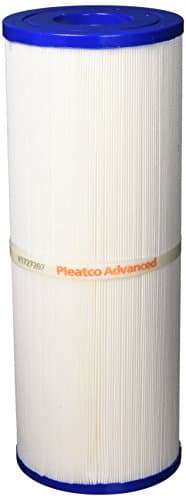
Pleatco PRB50-IN replacement cartridge
Pleatco · scored 8.6/10
The reference line. If a cartridge exists for your tub, Pleatco almost certainly makes it.
Filter cartridges are one of the few categories where the brand matters less than the part number, because fit is dictated by your tub. Pleatco earns its place by having the broadest catalog and a numbering scheme that cross-references cleanly to the other two majors.
Where the money goes is the end caps and the pleat count. Cheap cartridges usually fail at the cap rather than the media, by deforming after a few hot cleaning cycles, and a deformed cap lets water bypass the pleats entirely.
What the maker states
- Range
- Catalog covers most OEM spa cartridges
- Media
- Pleated polyester, antimicrobial in the M lines
- Part numbering
- P-prefixed, cross-referenced to Unicel and Filbur
- Fit
- Determined by your tub, not by brand
How it scored
- Build quality
- 9.0
- Catalog coverage
- 9.5
- Cleanability
- 8.5
- Value
- 6.5
- Availability
- 9.5
Skip this one if: your tub does not take this size. This is the PRB50-IN / C-4950 class, the most common spa cartridge but far from the only one -- confirm your part number on the filter finder before ordering.

#2 · Best for buying two at a time
Guardian Filtration 413-212-01 cartridge
Guardian Filtration · scored 8.0/10
Aftermarket equivalents that make sense when you want a spare in rotation.
The strongest argument for aftermarket cartridges is not the unit price, it is that cheap multipacks make a two-cartridge rotation affordable. Swapping a clean cartridge in while the dirty one soaks overnight is the single biggest improvement most owners can make to their filtration.
Expect a shorter service life than the majors. That is the trade, and in a rotation it matters much less than it does when one cartridge has to survive a whole year.
What the maker states
- Range
- Aftermarket equivalents to major part numbers
- Sold as
- Singles and multipacks
- Cross-reference
- Listed against Pleatco, Unicel and Filbur numbers
- Fit
- Determined by your tub
How it scored
- Build quality
- 7.0
- Catalog coverage
- 7.5
- Cleanability
- 8.0
- Value
- 9.5
- Availability
- 8.5
Skip this one if: your tub does not take this size. This is the PRB50-IN / C-4950 class, the most common spa cartridge but far from the only one -- confirm your part number on the filter finder before ordering.
Questions people actually ask
Frequently asked questions
How often should you replace a hot tub filter?
Roughly every twelve months on a rinse-weekly, soak-monthly routine with normal household use. Rinsing without ever soaking roughly halves that; running a two-cartridge rotation extends both well past a year each.
How do I know if my hot tub filter is bad?
Squeeze a section of pleats: if they do not spring back, the media is fatigued. Also check for deformed or cracked end caps, torn media, discoloration that survives a full soak, and jets that stay weak after a proper chemical clean. Any of those means replacement rather than another wash.
Can you clean a hot tub filter too many times?
Not by cleaning it correctly, but yes by cleaning it badly. Pressure washing, hot water, bleach and dishwashers all shorten media life, and a comb used forcefully tears pleats. Correct cleaning extends life rather than consuming it.
What happens if you do not replace a hot tub filter?
Suspended solids stay in suspension, so you shock more, use more sanitizer and change the water sooner. Less of your volume meets the sanitizer per circulation cycle, and a badly restricted cartridge makes the pump work against resistance it was not designed for.
Where the numbers come from
Sources
Read next
Related on Float & Filter
- Hot tub filter finder by size
Confirm the part number before ordering the replacement.
- How to clean a hot tub filter
Rule out a cheap answer before buying a new cartridge.
- What hot tub maintenance actually costs
Where cartridge replacement sits in the annual figure.
- Why your hot tub water is cloudy
Filtration is only one of four common causes.
- How many hot tub filters do you need?
A rotation roughly doubles how long each cartridge lasts.
- Bullfrog spa filter replacements
Flat panels replace far more often than cartridges do.
- Softub filter replacements
Why a 35 square foot cartridge runs on a much shorter interval.