Guide
Draining and Refilling a Hot Tub
Purge before you drain, wipe while it is empty, and fill through the filter housing. Those three details are what separate a good water change from a wasted afternoon.
By Scooter M. · Published · How we pick
How this page is funded: the buy buttons below are Amazon affiliate links. If you buy through one we earn a commission at no extra cost to you. It does not change what we recommend, and where the better answer is a retailer we earn nothing from, we say so. The full version.
A water change is an afternoon, most of which is waiting. Three details make the difference between doing it properly and doing it twice: purge the plumbing before you drain, wipe the shell while the tub is empty, and fill through the filter housing to avoid an airlock.
Before you start
- Pick your weather. Not a freeze, and ideally not the hottest day either — you will be working outside.
- Plan where the water goes. Several hundred gallons has to end up somewhere that is not your foundations or a neighbor's garden. Check what is acceptable locally for treated water.
- Have the refill chemicals ready. Nothing is worse than a full tub of unbalanced water and a shop that has closed.
- Have a clean filter cartridge. After a purge you want a fresh one, not the one that just caught everything.
Step 1: purge the plumbing
With the tub still full. Remove the filter cartridge, add a plumbing purge product at the label dose, and run every jet on every setting for the stated time, cycling the air controls so flow reaches the branches that normally sit still.
On a tub that has never been purged, the result is genuinely unpleasant. That is the product working. Which product to use depends on whether this is a rescue job or routine maintenance — see the line flush roundup and the full flush procedure.
Step 2: turn the power off
At the breaker, not just the control panel. A heater that runs dry is a dead heater, and it is one of the more expensive mistakes available during a water change.
Step 3: drain
Either through the built-in drain valve, which is slow, or with a submersible pump, which is not. A pump turns most of an afternoon into about twenty minutes, and removing that friction is the single biggest reason people manage to change water on schedule rather than stretching it.
Watch it as the level drops. Utility pumps do not like running dry, and the last inch is a wet-vac or a sponge job regardless.
Step 4: clean the empty shell
This is the step that gets skipped and it is the only time you have access. Everything the purge released is now sitting on the surfaces.
- Wipe the whole shell with a non-abrasive cloth and a spa-safe cleaner.
- If grit has settled in the footwell, this is the moment to lift it out. A spa vacuum is easiest here, because the water level and the chemistry stop mattering once you are draining anyway.
- Pay particular attention to the waterline, where the scum ring is.
- Wipe the jet faces and the housings behind them.
- Clean the filter housing itself, not just the cartridge.
- Wipe the underside of the cover while you are at it.
Do not use household abrasives or bleach on acrylic. A spa-safe cleaner or a mild dish soap thoroughly rinsed is enough, and rinsing thoroughly matters because residue foams on the refill.
Step 5: refill through the filter housing
Put the hose down into the filter housing rather than pointing it at the water surface. Filling from the bottom up pushes air out of the plumbing ahead of the water, which is what prevents an airlock — the situation where the pump runs but nothing comes out of the jets.
If your fill water is hard or comes from a well, this is the moment for a hose pre-filter. Keeping metals and sediment out is far easier than treating them once they are in, and it is covered on calcium hardness.
Fill to the manufacturer’s mark, which is usually mid-way up the skimmer opening. Under-filling starves the pump; over-filling means the skimmer cannot skim.
Step 6: power on and check for an airlock
Restore power and start the pump. If jets are weak or silent, you have an airlock. The usual fix is to loosen the union on the pump slightly until water appears and air stops hissing, then retighten — but check your manual first, because procedures differ between tubs and some have a bleed valve for exactly this.
Step 7: rebalance from scratch
Let the tub come up to temperature before dosing, because chemicals behave differently in cold water, then work through the sequence in order: alkalinity, pH, calcium hardness if needed, sanitizer, shock. Targets are pH 7.2 to 7.8 and the published hot tub sanitizer level.[source]
The full version, with the reasoning for the order, is on first chemicals after a refill. Do not follow the order printed on the individual bottles; several will tell you to adjust pH before alkalinity, which is backwards.
Step 8: do the cover while you are there
The cover is off and you are already outside. Clean and condition it now rather than promising yourself you will do it later, because that is the habit that delays a several-hundred-dollar replacement. Products are on the cover care roundup.
Things that go wrong
- Running the heater dry. Power off at the breaker before draining, every time.
- Draining in a freeze. An empty tub with residual water in the pipes is a burst-pipe risk.
- Skipping the purge. You have just installed fresh water into dirty pipework.
- Filling from the top. Airlock, and an unnecessary hour of troubleshooting.
- Dosing cold water. Balancers behave differently and your readings will chase you for days.
- Refitting the old cartridge after a purge. It is holding everything the purge released.
None of that is difficult, but all of it is easier to get right the first time than to correct afterwards. And the reason for the whole exercise is the same as always: fresh water holds a sanitizer residual far more easily than old water does.[source]
What fixes it
The products for this job
Named because they do the specific job this page describes, not because they are the only options. Specifications are the manufacturer’s published figures.
#1 · Best for not waiting three hours
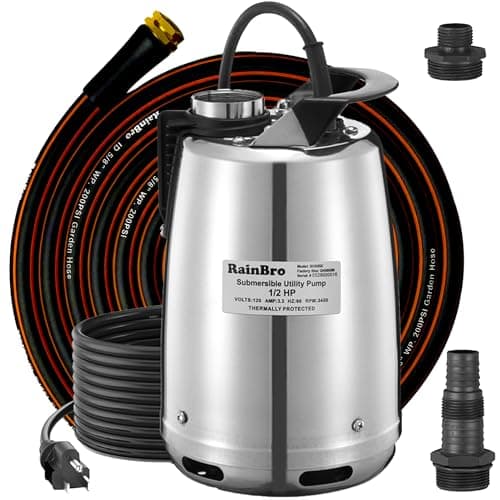
RainBro 1/2 HP submersible drain pump
RainBro · scored 8.5/10
Turns a half-day drain into twenty minutes. The most boring worthwhile purchase here.
The single biggest reason people stretch a water change from four months to seven is that draining through the built-in valve takes most of an afternoon. Removing that friction is worth more to your water quality than most chemicals.
Watch it as the water gets low. Utility pumps do not like running dry, and the last inch is a wet-vac job anyway.
What the maker states
- Flow
- 2,300 GPH, per the listing
- Max lift
- 23 ft, per the listing
- Included
- 10 ft hose, 3/4 in GHT adapter, 25 ft cord, per the listing
- Minimum suction
- Not stated in the listing
How it scored
- Drain speed
- 9.5
- Build quality
- 7.0
- Ease of use
- 8.5
- Value
- 8.5
- Availability
- 9.0
Skip this one if: your tub has a gravity drain that runs somewhere useful and you are not in a hurry.
#2 · Best for filling from well or hard water
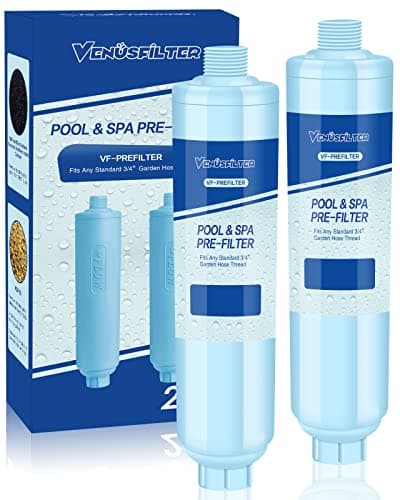
Garden hose pre-filter
Generic · scored 7.7/10
Filters the water going in, which is much easier than treating it once it is in.
Every problem you keep out of the tub at fill time is one you do not have to chase with chemistry for the next four months. On well water in particular, a pre-filter is the cheapest single improvement to water quality available.
It slows the fill noticeably. On a 400-gallon tub that is a real cost in time, and it is the main reason people stop using one.
What the maker states
- Type
- In-line hose filter
- Targets
- Sediment and metals, per the maker
- Fits
- Standard garden hose thread
- Life
- Rated by gallons, per the maker
How it scored
- Metal removal
- 8.0
- Sediment removal
- 8.5
- Fill speed impact
- 5.5
- Value on hard water
- 8.5
- Availability
- 8.5
Skip this one if: your municipal water is soft and metal-free. Then it is a cartridge cost for no measurable benefit.

#3 · Best for a first purge on a tub with history
Ahh-Some Hot Tub Cleaner
Ahh-Some · scored 8.5/10
Pulls biofilm out of the plumbing in a way that is genuinely alarming to watch.
Biofilm lives on the inside of the pipework, not in the water, which is why a tub can test perfectly and still smell. A purge product circulates through the plumbing and lifts that layer off, and on a tub that has never had one done the result is visibly unpleasant and very convincing.
Plan the whole job in one session: purge, run the jets for the stated time, drain, wipe the shell and the waterline, then refill. Doing the purge and leaving the water in defeats the entire point.
What the maker states
- Type
- Gel plumbing purge
- Used
- Before draining, with jets running
- Contact time
- Per the label
- After use
- Drain, wipe the shell, refill
How it scored
- Biofilm removal
- 9.5
- Ease of use
- 7.5
- Value
- 8.5
- Odor
- 7.0
- Availability
- 8.5
Skip this one if: you cannot drain afterwards. This is a pre-drain product: what comes out has to go somewhere, and it is not staying in your water.
Questions people actually ask
Frequently asked questions
How do you drain a hot tub quickly?
With a submersible utility pump rather than the built-in drain valve. A pump turns most of an afternoon into around twenty minutes. Watch the level as it drops, because utility pumps do not like running dry, and finish the last inch with a wet-vac or a sponge.
Should you flush hot tub lines before draining?
Yes, always. The purge product needs water in the tub to circulate through the plumbing, so it goes in before you drain. Draining first means refilling clean water into dirty pipework.
How do you fill a hot tub without getting an airlock?
Put the hose down into the filter housing rather than pointing it at the water surface. Filling from the bottom up pushes air out of the plumbing ahead of the water, which is what prevents the pump running with no flow at the jets.
How long does it take to drain and refill a hot tub?
An afternoon, most of it waiting. Roughly: an hour for the purge, then twenty minutes to drain with a pump, twenty minutes to clean the shell, an hour or so to refill, and then several hours for the water to reach temperature before you balance it.
Can you leave a hot tub empty?
Briefly, and never in a freeze, because residual water in the pipes can burst them. If you are leaving it empty for any length of time, that is a proper winterization job rather than simply draining and switching off.
Where the numbers come from
Sources
- CDC, Model Aquatic Health Code (2023, 4th edition) - the source for the pH 7.2-7.8 range and the hot-tub disinfectant levels quoted on this site
- CDC, Controlling Legionella in Hot Tubs - the primary reference for the health and disinfection guidance quoted here
- PHTA, Find a Standard - the index confirming which ANSI standard actually covers water quality in public pools and hot tubs or spas
Read next
Related on Float & Filter
- First chemicals after a refill
The chemistry sequence for the fresh fill.
- Flushing hot tub plumbing lines
Step one of this job, in full detail.
- How often to change hot tub water
When to do all this, worked out for your tub.
- The best cover conditioners and cleaners
The cover is off and you are outside. Do it now.
- The best hot tub surface cleaners
What to clean the empty shell with, and what to avoid.
- Hot tub leak repair
If the water was going down before you drained it, find out why first.
- The best hot tub drain pumps
Choosing the pump for this job, and the spec most listings leave out.