Guide
Hot Tub Calcium Hardness
There is no calcium reducer. The only route down from an over-corrected reading is draining, which makes this the one balance number to get right first time.
By Scooter M. · Published · How we pick
How this page is funded: the buy buttons below are Amazon affiliate links. If you buy through one we earn a commission at no extra cost to you. It does not change what we recommend, and where the better answer is a retailer we earn nothing from, we say so. The full version.
Calcium hardness is the amount of dissolved calcium in your water, and it is the balance reading people most often ignore. The target for an acrylic spa is roughly 150 to 250 ppm, which is an industry consensus range rather than a CDC figure — the CDC’s published targets for hot tubs cover pH and disinfectant level.[source]
It matters for a reason that is easy to miss: water with too little calcium in it is aggressive. It will pull calcium out of whatever it can reach, which in a hot tub means grout, seals, and heater components. Water with too much deposits it, usually on the heater element where the temperature is highest.
Which problem do you have?
- Soft water, low reading — below about 150 ppm, and common on softened or naturally soft supplies
- Hard water, high reading — above about 250 ppm, common on wells and hard municipal supplies
- Visible scale already forming — chalky white deposits at the waterline or on fittings
Soft water, low reading
Raise it with calcium chloride to the bottom of the range and stop there. Dose in stages, because dissolving calcium chloride is exothermic and the label will tell you to add it slowly for that reason. Run the jets, wait a full circulation cycle, and retest before adding more.
A specific note if you are filling from a water softener: softened water is deliberately stripped of calcium, so it will read very low and will stay very low. Some owners fill from an outside tap upstream of the softener for exactly this reason. If that is not possible, plan on adding calcium at every fill and budget for it.
The consequence of ignoring this is not dramatic in week one. It is a slow attack on the components that are expensive to replace, and it shows up as seal failures and heater problems years later.
Hard water, high reading
There is no calcium reducer. The only route down is dilution, which means a partial drain and refill with softer water, or a full water change. That is why this page exists as a warning as much as a guide.
If a full change is not practical, two things help. A sequestrant holds the dissolved calcium in solution so it is less likely to deposit, which manages the symptom without lowering the number. And filling through a hose pre-filter reduces what goes in next time, which is much easier than treating it once it is in.
Keeping pH at the lower end of the 7.2 to 7.8 range also reduces the tendency to scale, because scale forms more readily as pH rises. That is a genuine second reason to keep on top of pH and alkalinity.
Visible scale already forming
Chalky white deposits at the waterline or around fittings mean calcium is coming out of solution. Two things are usually true at once: hardness is high, and pH is sitting near the top of the range.
The realistic fix is a water change with a sequestrant added at fill, plus keeping pH lower thereafter. Scale already deposited on surfaces needs mechanical removal or a scale-specific cleaner used on a drained tub; nothing you add to full water will lift it off the heater. If you are draining anyway, do a plumbing flush at the same time — see draining and refilling.
Test at fill, and mostly leave it alone
Calcium hardness moves slowly. It is not a weekly reading like sanitizer or pH: it changes when you add water, when you top up after evaporation, and when you drain. Testing at every fill and occasionally in between is enough.
What it deserves is care on the one occasion you adjust it. Dose to the bottom of the range, not the middle, because topping up after evaporation concentrates what is already there and the number drifts upward on its own over a water cycle.
The honest position on hardness products
Calcium hardness increaser and stain-and-scale sequestrants are the two products on this site that are either essential or a waste, with nothing in between, and the difference is a number you can measure in fifteen seconds. On a well, you probably need both. On soft municipal water you need the increaser and not the sequestrant. On hard municipal water you may need neither.
That is why neither appears in the five-item list on what you actually need, and why we would rather you tested first than bought first. Where an industry consensus standard is the right reference for spa water parameters, it is the water-quality standard for public pools and hot tubs.[source]
What fixes it
The products for this job
Named because they do the specific job this page describes, not because they are the only options. Specifications are the manufacturer’s published figures.
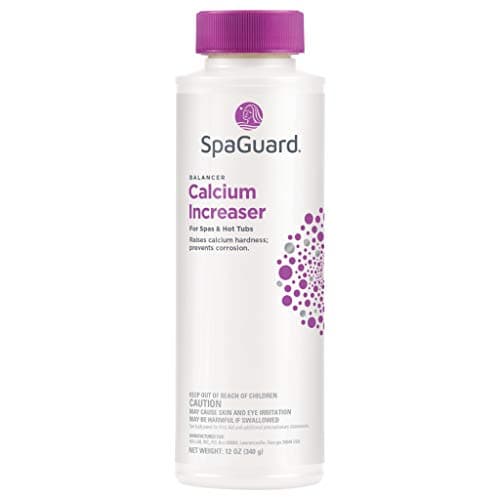
#1 · Best for soft or well water
SpaGuard Calcium Hardness Increaser
SpaGuard · scored 8.4/10
Only buy this if a test says you need it. Plenty of municipal water does not.
Soft water is aggressive. With too little calcium in it, water pulls calcium out of whatever it can reach, which in a hot tub means grout, heater components and seals. That is the real reason a hardness floor exists, and it is why this is worth owning if your fill water is soft.
It only moves one way. There is no calcium reducer, so the only route down from an over-corrected hardness reading is a partial or full drain. Test first, dose to the bottom of the range, and leave it there.
What the maker states
- Chemistry
- Calcium chloride
- Typical target
- 150-250 ppm in an acrylic spa
- Dissolving
- Exothermic, add slowly per the label
- Removable by
- Draining only
How it scored
- Predictability
- 8.5
- Ease of dosing
- 8.0
- Container size fit
- 8.5
- Cost per month
- 9.0
- Availability
- 8.5
Skip this one if: you have not measured your calcium hardness. Adding calcium you do not need is the quickest route to scale on the heater element, and there is no calcium reducer.
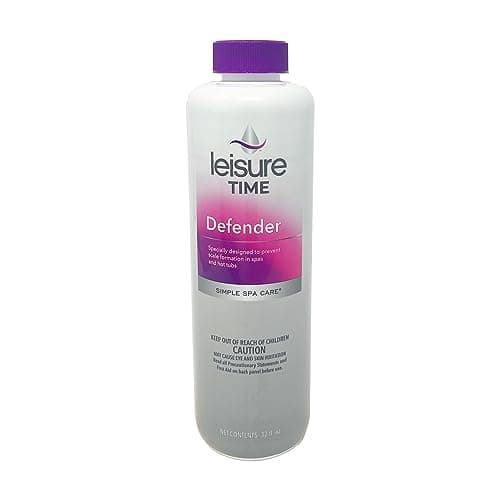
#2 · Best for hard or metal-bearing fill water
Leisure Time Defender
Leisure Time · scored 7.6/10
A sequestrant, not a cleaner. Genuinely useful on well water, pointless on soft municipal water.
Sequestrants hold dissolved metals and hardness minerals in solution so they cannot deposit on the shell and the heater. On a tub filled from a well, or from a supply with visible hardness, that is worth doing at every fill.
On soft municipal water it does nothing you need. This is the clearest example on the site of a product that is either essential or a waste depending entirely on a number you can measure for a few cents.
What the maker states
- Job
- Sequesters metals and scale-forming minerals
- Best added
- At fill, before the water heats
- Re-dose
- Per the label, typically monthly
- Not a
- Sanitizer, clarifier or stain remover
How it scored
- Predictability
- 7.5
- Ease of dosing
- 9.0
- Value on hard water
- 8.5
- Value on soft water
- 3.0
- Availability
- 8.5
Skip this one if: your calcium hardness is already in range and your fill water carries no metals. You would be paying for a problem you do not have.
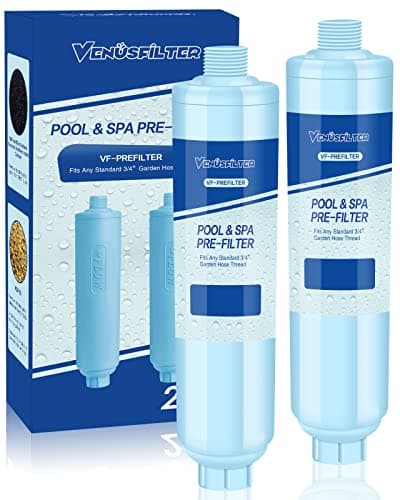
#3 · Best for filling from well or hard water
Garden hose pre-filter
Generic · scored 7.7/10
Filters the water going in, which is much easier than treating it once it is in.
Every problem you keep out of the tub at fill time is one you do not have to chase with chemistry for the next four months. On well water in particular, a pre-filter is the cheapest single improvement to water quality available.
It slows the fill noticeably. On a 400-gallon tub that is a real cost in time, and it is the main reason people stop using one.
What the maker states
- Type
- In-line hose filter
- Targets
- Sediment and metals, per the maker
- Fits
- Standard garden hose thread
- Life
- Rated by gallons, per the maker
How it scored
- Metal removal
- 8.0
- Sediment removal
- 8.5
- Fill speed impact
- 5.5
- Value on hard water
- 8.5
- Availability
- 8.5
Skip this one if: your municipal water is soft and metal-free. Then it is a cartridge cost for no measurable benefit.
Questions people actually ask
Frequently asked questions
What should calcium hardness be in a hot tub?
Roughly 150 to 250 ppm in an acrylic spa. That is an industry consensus range rather than a CDC figure; the CDC's published hot tub targets cover pH and disinfectant level.
How do you lower calcium hardness in a hot tub?
By dilution only. There is no calcium reducer, so the routes down are a partial drain and refill with softer water, or a full water change. A sequestrant manages the symptom by holding calcium in solution but does not lower the reading.
Can I fill a hot tub with softened water?
You can, but softened water is deliberately stripped of calcium, so it will read very low and stay low. Water with too little calcium is aggressive toward grout, seals and heater components, so you will need to add calcium at every fill. Filling from a tap upstream of the softener avoids the problem entirely.
Why is there scale in my hot tub?
Calcium coming out of solution, usually because hardness is high and pH is sitting near the top of the range at the same time. Keeping pH lower reduces the tendency, and a sequestrant added at fill helps. Scale already on surfaces needs removing from a drained tub.
Where the numbers come from
Sources
- CDC, Model Aquatic Health Code (2023, 4th edition) - the source for the pH 7.2-7.8 range and the hot-tub disinfectant levels quoted on this site
- PHTA, Find a Standard - the index confirming which ANSI standard actually covers water quality in public pools and hot tubs or spas
- CDC, Controlling Legionella in Hot Tubs - the primary reference for the health and disinfection guidance quoted here
Read next
Related on Float & Filter
- Hot tub pH and total alkalinity
Keeping pH lower is half the answer to scale.
- Hot tub chemical dosage and levels chart
All the target ranges in one table.
- Draining and refilling a hot tub
The only way down from an over-corrected hardness reading.
- When to replace a hot tub filter
Scale shortens a cartridge's life as surely as oil does.
- Hot tub scale and hard water stains
What high hardness actually leaves on the shell.
- Filling a hot tub from a well
Where aggressive fill water turns into a staining problem.
- The best calcium hardness increasers
Which calcium chloride to buy, and the granule mistake that etches a shell.
- The best hot tub descalers and scale control
What to do when hardness is already too high rather than too low.