Roundup
The Best Cover Conditioners and Cleaners
Clean, dry, then protect. Applying protectant over dirt seals the dirt in, and household cleaners strip the plasticizer that keeps vinyl flexible.
By Scooter M. · Published · How we pick
How this page is funded: the buy buttons below are Amazon affiliate links. If you buy through one we earn a commission at no extra cost to you. It does not change what we recommend, and where the better answer is a retailer we earn nothing from, we say so. The full version.
The short answer
Top pick
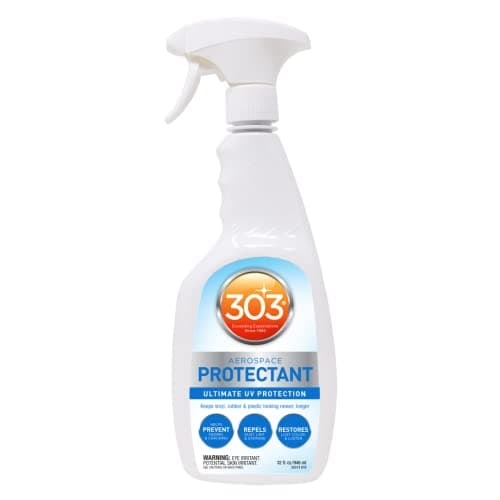
303 Aerospace Protectant
The one product on this page that meaningfully extends a cover's life. Use it quarterly.
Quick picks
Tap a row to jump to the full write-up. Prices come from the live price layer, never from memory.
| # | Product | Best for | Score | Price |
|---|---|---|---|---|
| 1 | 303 Aerospace ProtectantThe one product on this page that meaningfully extends a cover's life. Use it quarterly. | UV protection on vinyl | 8.5out of 10 | $23.90 · View on Amazon#ad how this is funded · price as of October 18, 2026 |
| 2 | 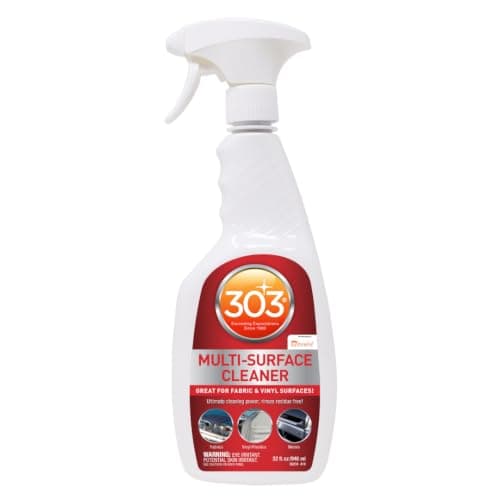 303 Marine Vinyl CleanerA vinyl-safe cleaner, which is the point. Household cleaners are not. 303 Marine Vinyl CleanerA vinyl-safe cleaner, which is the point. Household cleaners are not. | The clean before the protect | 7.8out of 10 | $11.89 · View on Amazon |
| 3 | 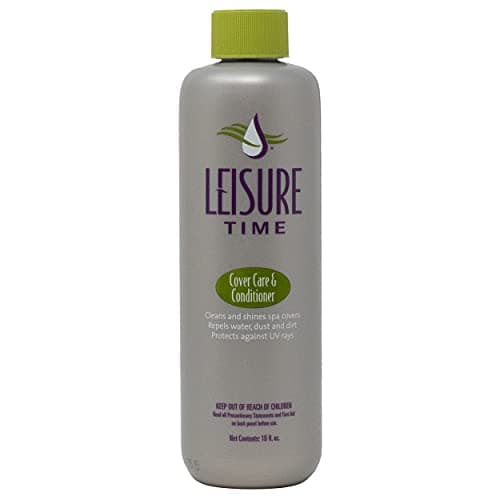 Leisure Time Cover Care and ConditionerCleans and conditions in one pass. Convenient, slightly less thorough than doing it properly. Leisure Time Cover Care and ConditionerCleans and conditions in one pass. Convenient, slightly less thorough than doing it properly. | One bottle instead of two | 7.8out of 10 | $18.50 · View on Amazon#ad how this is funded · price as of October 18, 2026 |
| 4 | 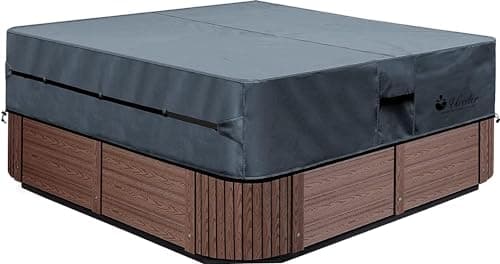 Hot tub cover capThe cheapest thing on this page and, per dollar, the most effective. Hot tub cover capThe cheapest thing on this page and, per dollar, the most effective. | Extending a hard cover's life | 7.2out of 10 | $53.23 · View on Amazon#ad how this is funded · price as of October 18, 2026 |
Scores are our own, from the published scoring method on how we pick. They are an editorial judgment of published specifications, not a test result, and they are deliberately kept out of the page’s structured data.
Hot tub covers die from the top down. Sunlight degrades the vinyl skin until it goes chalky and cracks, water gets through the cracks into the foam, the foam gains weight, the seal fails, and heat starts leaving. A UV protectant applied a few times a year interrupts that chain at step one, which is the only step where interrupting it is cheap.
The two-step routine
- Clean. A vinyl-safe cleaner, rinsed and dried. Not a household degreaser.
- Protect. A UV protectant onto the clean, dry surface, per the label.
Skipping the clean makes the protect step worse than useless, because you are sealing dirt under a protective film and you will spend longer removing it later than the cleaning would have taken. Combined clean-and-condition products exist and are a reasonable trade if they are what you will actually use.
Why household cleaners are the wrong tool
Vinyl stays flexible because of plasticizer in the material. Household degreasers strip it, and vinyl without plasticizer goes brittle and cracks — which is the exact failure you are trying to prevent. A cleaner sold for marine or outdoor vinyl is formulated not to do that, and that is the entire reason to buy one.
Specifically avoid: bleach, ammonia-based glass cleaners, alcohol-based wipes and dish detergent. All of them will get the cover clean today and shorten its life.
Do the fold line and the underside too
The hinge fold is where a cover cracks first, because it flexes every time the cover opens and the vinyl there is under repeated stress. Give it deliberate attention rather than treating it as part of the general surface.
The underside is worth a look at the same time. It sits above hot, chemically treated water and takes a different kind of punishment, particularly if the tub is ever shocked with the cover closed. That is one of several reasons the cover comes off when you shock — see shocking a hot tub.
How often
Every few months, per the protectant label, and the natural moment is at each water change when the cover is off anyway. That is where it sits in the maintenance schedule: a quarterly job that takes fifteen minutes and delays a several-hundred dollar purchase.
In full sun, more often. UV exposure is the variable that matters most, and a tub in an exposed position genuinely needs more attention than one under a tree.
The cheapest intervention is not a bottle
A cover cap. It blocks UV and sheds standing water, which are the two things that start the failure chain, and it costs a small fraction of a replacement cover. The catch is behavioral: a cap that has to come off and go back on every evening will end up in a corner of the yard by spring. It suits tubs used a few times a week rather than daily.
What conditioning cannot do
It cannot reverse damage. A cover that is already cracked, or whose foam has already taken on water, is past the point where a protectant helps — you are conditioning the outside of a sponge. At that point the question is whether the foam core can be replaced or the whole cover needs to go, which is what replace or repair works through.
Nor does it change the physics. Heat leaves a hot tub mostly by evaporation off the water surface, so a well-conditioned but poorly sealing cover still costs you money. The seal is the thing; conditioning is how you keep it.
Every pick, in full
The picks in detail
Specifications below are the manufacturer’s own published figures, attributed as such. We have not tested these units and the scores are an editorial judgment of published data against the published method, not a test result.
#1 · Best for uv protection on vinyl
303 Aerospace Protectant
303 Products · scored 8.5/10
The one product on this page that meaningfully extends a cover's life. Use it quarterly.
Sunlight is what kills hot tub covers, and it kills them from the top surface down: the vinyl goes chalky, then it cracks, then water reaches the foam. A UV protectant applied a few times a year addresses the actual mechanism rather than the symptom.
Clean first. Applying protectant over dirt seals the dirt in, and you will spend longer removing it later than the cleaning step would have taken.
What the maker states
- Type
- UV protectant for vinyl, rubber and plastics
- Finish
- Matte, per the maker
- Application
- Onto a clean, dry surface
- Frequency
- Per the label, commonly every few months
How it scored
- UV protection
- 9.5
- Cleaning power
- 3.0
- Ease of use
- 9.0
- Coverage per bottle
- 8.0
- Availability
- 9.5
Skip this one if: the cover is already cracked. Protectant prevents UV damage; it does not repair a skin that has already failed.
#2 · Best for the clean before the protect
303 Marine Vinyl Cleaner
303 Products · scored 7.8/10
A vinyl-safe cleaner, which is the point. Household cleaners are not.
The reason to use a vinyl-specific cleaner rather than whatever is under the sink is plasticizer. Household degreasers strip it, and vinyl without plasticizer goes brittle and cracks.
This is a two-product routine by design: clean, dry, then protect. Skipping the clean makes the protect step worse than useless.
What the maker states
- Type
- Vinyl cleaner
- Safe for
- Marine and outdoor vinyl, per the maker
- Use before
- A protectant
- Not a
- Protectant itself
How it scored
- UV protection
- 1.0
- Cleaning power
- 8.5
- Ease of use
- 9.0
- Coverage per bottle
- 8.0
- Availability
- 9.0
Skip this one if: you only ever wipe the cover with a damp cloth and it stays clean. Then it is not needed.
#3 · Best for one bottle instead of two
Leisure Time Cover Care and Conditioner
Leisure Time · scored 7.8/10
Cleans and conditions in one pass. Convenient, slightly less thorough than doing it properly.
Combined products trade some performance for the fact that you will actually use them. On a cover that gets attention every couple of months anyway, that trade is usually the right one.
If the cover has gone visibly chalky, do one thorough clean-and-protect with dedicated products first, then keep it up with this.
What the maker states
- Type
- Combined cleaner and conditioner
- For
- Spa cover vinyl
- Application
- Spray and wipe, per the label
- Frequency
- Per the label
How it scored
- UV protection
- 7.0
- Cleaning power
- 7.0
- Ease of use
- 9.5
- Coverage per bottle
- 7.5
- Availability
- 8.5
Skip this one if: the cover is badly weathered. A neglected cover wants a dedicated clean first.
#4 · Best for extending a hard cover's life
Hot tub cover cap
Generic · scored 7.2/10
The cheapest thing on this page and, per dollar, the most effective.
Vinyl hard covers fail two ways: UV cracks the top skin, then water gets into the foam and the cover gets heavy. A cap addresses the first cause, which is what makes it cheap prevention against an expensive replacement.
It buys time; it does not reverse damage. A cover already saturated with water needs a new foam core or a new cover, and no cap will help.
What the maker states
- Type
- Slip-over cap for a hard cover
- Purpose
- Blocks UV and sheds standing water
- Fixing
- Elasticated skirt or straps
- Sizing
- By hard cover dimensions
How it scored
- Weather protection
- 8.0
- Heat retention
- 1.5
- Fit accuracy
- 7.0
- Durability
- 6.5
- Value
- 9.5
Skip this one if: you take the cover off daily. A cap that has to come off and go back on every evening will end up in the corner of the yard by March.
Questions people actually ask
Frequently asked questions
How often should you condition a hot tub cover?
Every few months per the protectant label, and more often if the tub is in full sun. The natural moment is at each water change, when the cover is off anyway, which makes it a quarterly fifteen-minute job.
What should you not use to clean a hot tub cover?
Bleach, ammonia-based glass cleaners, alcohol wipes and dish detergent. All of them strip the plasticizer that keeps vinyl flexible, and vinyl without plasticizer goes brittle and cracks, which is the exact failure you are trying to prevent.
Does 303 Protectant work on hot tub covers?
It is a UV protectant for vinyl, rubber and plastics, which is what a spa cover skin is. Applied to a clean, dry surface at the interval on the label, it addresses the actual failure mechanism, which is UV degradation of the top skin.
Can you fix a cracked hot tub cover?
Vinyl repair patches will close a small tear and slow water ingress, but they do not restore a skin that has gone chalky and brittle across its surface. Once the foam has taken on water, the decision is a foam core replacement or a new cover.
Where the numbers come from
Sources
Read next
Related on Float & Filter
- Replace or repair a waterlogged cover
When conditioning is no longer the answer.
- The best hot tub covers
Protection versus replacement, and where each is sold.
- Covers for cold climates and snow load
Where cover care stops being cosmetic and becomes structural.
- The hot tub maintenance schedule
The quarterly slot this job belongs in.
- How to install a hot tub cover lifter
Fitting the thing that folds your cover at the same line every time.
- Are hot tub cover caps worth it?
The accessory that extends the life of the cover you own.