Can I use it?
Can You Use Pool Chemicals in a Hot Tub?
Some of it, and the split is not random. The balancers in the pool aisle are the same chemicals at a better price. The sanitizers and shocks are not, and two of them will cost you money.
By Scooter M. · Published · How we pick
How this page is funded: the buy buttons below are Amazon affiliate links. If you buy through one we earn a commission at no extra cost to you. It does not change what we recommend, and where the better answer is a retailer we earn nothing from, we say so. The full version.
The verdict, up front. Use pool balancers in a hot tub — pH up, pH down, alkalinity increaser and calcium hardness increaser are the same four chemicals in both aisles, and the pool-sized bag is cheaper per dose. Do not use pool sanitizers or shock: the pick for a chlorine hot tub is dichlor granules, the pick for weekly oxidation is a non-chlorine (MPS) spa shock, and the pick for reading the water is a test strip printed on the spa scale. Pool chlorine tablets, calcium hypochlorite pool shock and liquid pool chlorine all do damage in a vessel this small.
That is the whole answer. The rest of this page is the reasoning, one product at a time, because “pool chemicals” is a dozen different products and the answer genuinely differs for each.
How we judged each one
Four questions, applied to every row of the table below. They are the questions that decide whether a pool product is safe in a spa, and none of them is about the brand on the bottle.
- Is it the same chemical? Several pool and spa products are chemically identical and differ only in bag size and the dosing table. Where that is true, the pool version is a bargain.
- Can you dose it accurately at 400 gallons? A pool label is written for ten or twenty thousand gallons. A typical hot tub holds a few hundred. If the spa dose works out at a fraction of a capful, the product is unusable regardless of its chemistry.
- Does it accumulate? Anything that builds up and only leaves by draining is far worse in a tub you refill quarterly than in a pool you refill never.
- Does the label cover spa use? A sanitizer is a registered pesticide, and its label states where it may be used. The EPA puts this plainly: the label is the law, every label carries the statement that it is a violation of federal law to use the product in a manner inconsistent with its labeling, and the label defines where and how much may be used.[source] A pool-only label used in a spa is off-label use, whatever the chemistry says.
Every pool product, and the verdict
| Pool product | What it actually is | In a hot tub? | Buy this instead |
|---|---|---|---|
| Chlorine tablets / pucks (3 in.) | Trichlor — acidic, stabilized with cyanuric acid | No | Dichlor granules, or bromine tablets in a floater |
| Pool shock, granular | Usually calcium hypochlorite — strong, unstabilized, adds calcium | No | Dichlor for a contamination event, MPS for the weekly dose |
| Liquid chlorine / pool bleach | Sodium hypochlorite in solution — high pH, degrades in storage | No | Dichlor granules |
| Stabilizer / conditioner | Cyanuric acid, sold neat to raise CYA | Never | Nothing. A spa needs no added CYA at all |
| Pool test strips | Reagent pads calibrated for pool ranges | No | A spa strip, printed on the spa scale |
| Pool clarifier | Polymer coagulant, dosed per 10,000 gal | Technically yes, practically no | A spa clarifier with a spa dosing table |
| Pool flocculant | Drops suspended matter to the floor to be vacuumed | No | Nothing — a spa has no main drain to vacuum to |
| Pool algaecide | Quat or copper-based, often foaming | No | Sanitizer at the right level, and a shock |
| Dichlor granules sold as “pool” | Sodium dichloroisocyanurate — the same chemical as spa chlorine | Yes | It already is the right product. Check the label covers spas |
| Non-chlorine shock (MPS) | Potassium monopersulfate — identical in both aisles | Yes | It already is the right product |
| pH increaser | Soda ash (sodium carbonate) | Yes | Same chemical. Dose by your gallons, not the label |
| pH decreaser / dry acid | Sodium bisulfate | Yes | Same chemical |
| Alkalinity increaser | Sodium bicarbonate | Yes | Same chemical |
| Calcium hardness increaser | Calcium chloride | Yes | Same chemical |
| Filter cartridge | Pleated media in a plastic frame, pool dimensions | Only if the dimensions match | The cartridge your housing takes, by measurement |
Read the table as two halves. Everything in the balancer group is the same compound in both aisles, so the only question is dosing arithmetic. Everything in the sanitizer group is a different compound, chosen for a vessel with twenty to fifty times the water, and that is where the damage happens.
The four that are the same chemical, and worth buying big
Soda ash, dry acid, sodium bicarbonate and calcium chloride are commodity chemicals. There is no spa-grade version of sodium bicarbonate; it is baking soda in a sack, and our alkalinity increaser roundup already lists a 50 lb industrial bag alongside the 2 lb spa tubs for exactly this reason.
Best for: anyone who owns both a pool and a hot tub, or anyone tired of paying spa prices for bicarb. The one thing you must do is throw the label’s dosing table away and work from your own volume. A pool label that says “1 lb per 10,000 gallons raises alkalinity by 10 ppm” is telling you to add about half an ounce to a 350-gallon tub. Weigh it. Guessing a twentieth of a scoop by eye is how a tub ends up at 240 ppm alkalinity with pH that will not move.
The target ranges themselves do not change between a pool and a spa for pH: the CDC gives 7.2 to 7.8 for both.[source] What changes is how fast a hot tub leaves that range, which is covered on pH and total alkalinity.
Pool chlorine tablets: the one that bleaches shells
This is the most-asked version of the question and it has its own page, because the answer has several parts and all of them are bad: hot tub chlorine tablets vs granules. The short form is that a 3-inch pool puck is trichlor, it dissolves acidic, and it stacks cyanuric acid that nothing but a water change removes. In a few hundred gallons both effects arrive fast.
Two further things, specific to the pool puck. It is sized for an erosion feeder on a pool’s return line, so in a hot tub it ends up in a floater it does not fit or — worse — resting on the acrylic, where it bleaches a permanent pale patch. And the stabilizer it carries is the one additive a spa has no use for: the CDC-aligned position in the spa trade is that cyanuric acid has no role in a hot tub, because the UV protection it buys is irrelevant under a closed cover and the chlorine it blunts is chlorine you are paying for.
Pool shock: the calcium problem nobody mentions
Granular pool shock is usually calcium hypochlorite, and it fails in a hot tub for three separate reasons.
- It brings calcium with it. Every dose raises calcium hardness, which never falls on its own. On already-hard water you are dosing yourself toward the scale you are trying to avoid — see hot tub scale and calcium hardness.
- It is far stronger per scoop than a spa label expects. Shock dosing in a hot tub is a tablespoon-scale operation. A product formulated to lift a swimming pool by several ppm per pound is not something you can meter into 350 gallons with the enclosed scoop.
- It does not dissolve as cleanly. Undissolved cal-hypo granules settle on the shell and bleach it, the same failure mode as a loose tablet.
Best for: nobody with a hot tub. Use dichlor granules when you need chlorine shock after heavy use or a contamination event, and MPS for the routine weekly oxidation. Which one, and when, is worked through on shocking a hot tub.
Liquid pool chlorine and household bleach
Liquid chlorine is sodium hypochlorite in solution. The chemistry is legitimate — it is what a salt system generates in situ — but as a bottle you pour, it has three problems in a spa. It arrives with a high pH, so every dose pushes pH up in a vessel whose jets are already driving pH up. It is strong and gets weaker in storage, so the dose you worked out last month is not the dose today. And the volume you need for a few hundred gallons is a splash, measured against a label written in gallons per pool.
Household bleach is the same family with an extra objection: whether a particular bleach may be used to sanitize water at all depends on whether its EPA-registered label says so.[source] Most jugs under the sink carry no such directions. The household-cupboard question in general has its own page: can you use baking soda, vinegar or bleach in a hot tub.
Pool test strips: the scale is wrong, not the pad
The reagent chemistry on a pool strip is the same reaction. What differs is the printed scale. Pool strips top out around the range a pool is held at, and a hot tub is held higher — the CDC specifies at least 3 ppm free chlorine in a hot tub against 1 ppm in a pool.[source] A strip whose top block is below your target band tells you almost nothing useful.
Worse if you run bromine. Bromine and chlorine are measured by the same reaction, and a chlorine reading has to be multiplied by roughly 2.25 to give the bromine figure. A pool strip has no bromine scale printed on it, so you are doing arithmetic on a color match in bad light. Buy the strip for your chemistry; the test strip roundup sorts out which is which, and chlorine and bromine levels explains the reading.
Clarifier, flocculant and algaecide
A pool clarifier is a polymer that clumps fine particles so the filter can catch them, and the spa versions are the same idea at a spa dose. The only real obstacle is the dosing table, so this is the one “no” on our list that is a practical objection rather than a chemical one. If you already own a bottle of pool clarifier, the honest answer is that you can use a few drops of it — but you will guess, and a spa clarifier costs very little and prints the number for you.
A flocculant is a different product that people buy by mistake: it drops the haze to the floor so you can vacuum it out. A swimming pool has a main drain and a vacuum line for that. A hot tub has neither, so you are left with a layer of sludge on the seats and a filter that was never meant to pick it up. The distinction is worked through on clarifier vs flocculant vs shock.
Algaecide is the one where the mistake is conceptual. Algae in a hot tub is a symptom of no sanitizer residual, not an infestation to be treated — and many pool algaecides are quats, which foam enthusiastically when jets hit them. You get green water and a tub full of suds. The fix is on hot tub algae.
Can you put a pool filter cartridge in a hot tub?
This one is not chemistry at all, it is dimensions. A cartridge fits if its length, outside diameter and end-cap pattern match the housing, and plenty of cartridges are sold into both markets — the cross-reference numbers on the filter finder list pool-aisle part numbers next to spa ones because they are often the same part.
What will not work is a cartridge sized for a pool’s flow rate squeezed into a spa housing, or the reverse. Too little media and the tub cannot keep up; the wrong end cap and water bypasses the element entirely, which looks like a filtration problem and is actually a fit problem. Measure first: when to replace a filter covers what to check.
The reverse question: spa chemicals in a pool?
Mostly yes, and it is simply expensive. Dichlor works in a pool, MPS works in a pool, spa clarifier works in a pool — you will just be buying 2 lb tubs to treat 20,000 gallons. The one to think about is dichlor, because used continuously in a pool it stacks cyanuric acid there too, and a pool that is already at a sensible CYA level does not need more.
Best for: using up what you have. Finishing a tub of spa shock in the pool at the end of the season is sensible. Running a pool on spa chemistry year-round is not.
What this means for your cupboard
The practical shape of the answer: one set of balancers that can be pool-sized and cheap, and a short, specific sanitizer shelf that must be spa-labeled. The sanitizer shelf is the part worth getting right, because a residual in the water is what the CDC’s hot tub guidance is actually about.[source]
If you are starting from an empty cupboard rather than a pool shed, what hot tub chemicals do you need is the shorter list, and the best hot tub chemicals names one product per job.
What fixes it
The products for this job
Named because they do the specific job this page describes, not because they are the only options. Specifications are the manufacturer’s published figures.
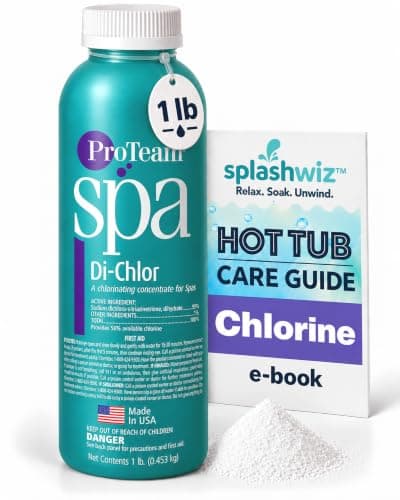
#1 · Best for dichlor with the percentage printed
ProTeam Spa DiChlor chlorine granules, 1 lb
SplashWiz · scored 7.0/10
Good granules with an unusually specific label — including a target residual we would not follow.
Credit where it is due: this listing publishes its available chlorine percentage and states plainly that it is not for bromine or salt systems. That is more specificity than most of this category offers, and the 1 lb size is right for an inflatable.
The reason it ranks last is the dosing guidance, not the chemical. The listing describes maintaining a 1.0 to 2.0 ppm chlorine residual. The CDC figure for hot tubs is at least 3 ppm free chlorine, and a hot, heavily loaded, constantly aerated inflatable is the last place to run a pool-grade residual. Buy it if you like, dose it to the CDC number, and score its beginner clarity accordingly.
What the maker states
- Form
- Dichlor granules
- Available chlorine
- 56%, per the listing
- Size
- 1 lb, per the listing
- Not for
- Bromine-only or salt-generator spas, per the listing
How it scored
- Covers the whole list
- 3.0
- Sized for a small tub
- 9.5
- Cost vs buying separately
- 8.0
- Beginner clarity
- 5.5
- Nothing wasted
- 9.0
Skip this one if: you intend to dose to the number on the bottle. Its stated 1 to 2 ppm target sits below the CDC figure for hot tubs, and the CDC figure is the one we use.
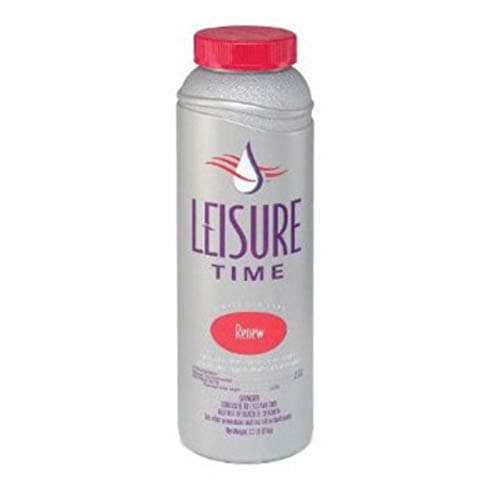
#2 · Best for the weekly oxidize
Leisure Time Renew Non-Chlorine Shock
Leisure Time · scored 8.6/10
The shock you can use and get back in the water quickly. Oxidizes; does not sanitize.
Non-chlorine shock does one job well: it oxidizes the organic load a soak leaves behind, which is what turns water dull and gives it that flat, used smell. On a bromine tub it does a second job for free, converting spent bromide back into active bromine.
Understand what it is not. MPS is an oxidizer, not a sanitizer. If the problem is biological rather than organic, this will not fix it and the tub will stay exactly as cloudy as it was.
What the maker states
- Chemistry
- Potassium monopersulfate (MPS)
- Job
- Oxidizes body oils, lotions and sweat
- Reactivates bromine
- Yes, on a bromine tub
- Wait before soaking
- Per the label, typically about 15 minutes
How it scored
- Oxidizing power
- 8.0
- Ease of dosing
- 9.5
- Odor and skin feel
- 9.0
- Cost per month
- 8.0
- Availability
- 9.0
Skip this one if: you are dealing with an actual contamination event. MPS burns off organics, it does not kill what a chlorine shock kills, and reaching for it instead is a common reason a cloudy tub stays cloudy.
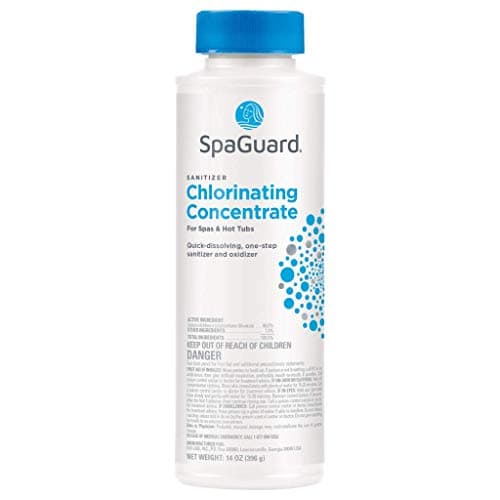
#3 · Best for a small first bottle of dichlor
SpaGuard Spa Chlorinating Concentrate, 14 oz
SpaGuard · scored 8.5/10
Dichlor granules in a size that suits one tub. The correct chlorine for a hot tub, in the correct format.
Dichlor is the chlorine a hot tub is supposed to get. It dissolves fast, it is close to pH-neutral so it does not drag your balance around every time you dose, and because it is a granule you control the amount instead of waiting for a tablet to erode.
The honest downside is the size. A 14 oz bottle is the right way to start, because it lets you find out how much your tub actually consumes before you commit to a bucket. Once you know, the larger sizes of the same product are considerably better value.
What the maker states
- Active
- Sodium dichlor, per the label
- Form
- Granules, broadcast into the water
- pH
- Near-neutral, unlike trichlor tablets
- Pack size
- 14 oz, per the listing
How it scored
- Right chemistry for a spa
- 9.5
- Dose control
- 9.0
- Cost per ounce
- 6.5
- Availability
- 8.5
- Label clarity
- 9.0
Skip this one if: you get through chlorine quickly. The 14 oz bottle is priced for convenience; the 2 lb and 5 lb sizes cost noticeably less per ounce.
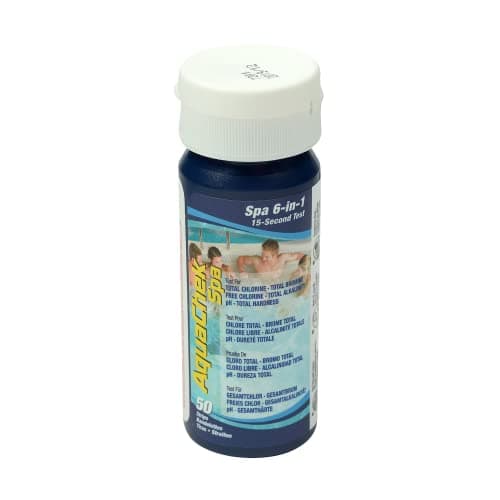
#4 · Best for the weekly check
AquaChek Spa 6-in-1 Test Strips
AquaChek · scored 8.4/10
Six readings in fifteen seconds. Not precise, but precise enough to catch drift early.
Strips get an unfair reputation because people compare them to a reagent kit and call them inaccurate. That is the wrong comparison. The right one is against not testing at all, which is what happens when the routine takes ten minutes. A strip you actually use weekly beats a reference kit in a cupboard.
Two habits make strips far more reliable: keep the container sealed and out of the humid room the tub is in, and read them in daylight rather than under a yellow bulb. Most strip complaints trace back to one of those two.
What the maker states
- Reads
- Hardness, total chlorine, free chlorine, bromine, pH, alkalinity
- Method
- Dip-and-read colorimetric strip
- Time
- Seconds, per the label
- Storage
- Sealed container, away from humidity
How it scored
- Accuracy
- 6.5
- Speed
- 10.0
- Parameters covered
- 9.0
- Cost per test
- 9.0
- Availability
- 9.5
Skip this one if: you need an exact free chlorine number to diagnose a problem. Strips read in color bands; a drop-based kit reads in numbers.
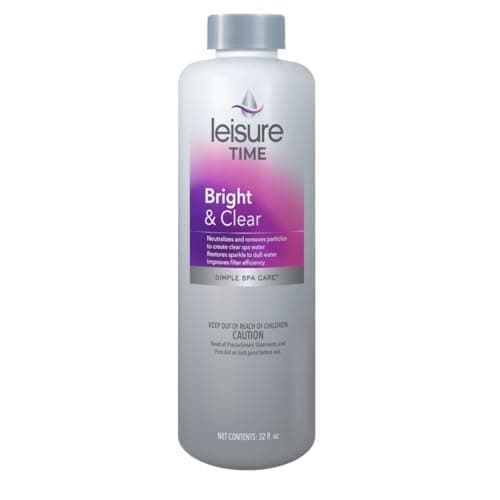
#5 · Best for fine particles the filter is missing
Leisure Time Bright and Clear
Leisure Time · scored 8.1/10
A clarifier clumps fine solids so the filter can catch them. It does not fix chemistry.
Clarifiers work by making small particles stick to each other until they are big enough for a cartridge to trap. That means the cartridge has to be clean and the pump has to run, or the clarified particles just circulate.
It is a finisher, not a fix. Balance the water and sort the sanitizer first, then use a clarifier to clear the last of the haze. Used in the other order it is money spent on a symptom.
What the maker states
- Type
- Polymer clarifier
- Job
- Agglomerates fine particles for the filter
- Filter must be
- Clean, or the clarifier has nowhere to put anything
- Dose
- By tub volume, per the label
How it scored
- Clarity gain
- 8.5
- Speed
- 8.0
- Filter load
- 6.0
- Value
- 8.5
- Availability
- 9.0
Skip this one if: your water is cloudy because your sanitizer is low. Clarifier on unsanitized water buys you a day and costs you a filter clean.
Questions people actually ask
Frequently asked questions
Can you use pool chemicals in a hot tub?
Balancers, yes: pH increaser (soda ash), pH decreaser (dry acid), alkalinity increaser (sodium bicarbonate) and calcium hardness increaser (calcium chloride) are the same chemicals in both aisles, and the pool-sized bag is cheaper. Sanitizers and shock, no: use dichlor granules for chlorine and an MPS non-chlorine shock for the weekly dose. Always dose from your tub’s actual gallons, not the pool label’s table.
Can you use pool shock in a hot tub?
No. Granular pool shock is usually calcium hypochlorite, which raises calcium hardness permanently, is far stronger per scoop than a few-hundred-gallon tub can be dosed with, and bleaches the shell if granules settle undissolved. Use dichlor granules for a chlorine shock and potassium monopersulfate for routine oxidation.
Can you use liquid pool chlorine in a hot tub?
It is not the right tool. Liquid chlorine is sodium hypochlorite: it arrives with a high pH in a tub whose jets already push pH up, it loses strength in storage so the dose moves, and the amount needed for a few hundred gallons is a splash against a label written per pool. Dichlor granules measure properly at spa scale.
Can you use pool test strips for a hot tub?
Not usefully. The reaction is the same but the printed scale is wrong: a hot tub is held at a higher free chlorine level than a pool, so a pool strip’s top block can sit below your target band. And pool strips carry no bromine scale, which leaves bromine owners converting a color match by a factor of about 2.25 in their heads.
Can you put a pool filter cartridge in a hot tub?
Only if the dimensions match — length, outside diameter and end caps. Many cartridges are genuinely sold into both markets under different part numbers. What fails is a cartridge sized for a pool’s flow forced into a spa housing, where water bypasses the element and looks like a filtration fault.
Can you use hot tub chemicals in a swimming pool?
Generally yes, and it is just expensive — you are treating 20,000 gallons with 2 lb tubs. The one to watch is dichlor: used continuously it adds cyanuric acid to the pool as well, so a pool already at a sensible stabilizer level does not want a steady diet of it.
Is pool chlorine the same as hot tub chlorine?
Sometimes. Dichlor granules sold in the pool aisle are the same chemical as spa chlorine and are fine, provided the label covers spa use. Trichlor pucks and calcium hypochlorite shock are different chemicals chosen for a pool’s volume and sunlight, and neither belongs in a hot tub.
Where the numbers come from
Sources
- EPA, Introduction to Pesticide Labels - the source for 'the label is the law', for the federal-law violation statement every pesticide label carries, and for the label defining where a product may be used
- CDC, Model Aquatic Health Code (2023, 4th edition) - the source for the pH 7.2-7.8 range and the hot-tub disinfectant levels quoted on this site
- CDC, Controlling Legionella in Hot Tubs - the primary reference for the health and disinfection guidance quoted here
Read next
Related on Float & Filter
- Hot tub chlorine: tablets vs granules
The full case against the pool puck, in detail.
- Baking soda, vinegar and bleach in a hot tub
The same question for the kitchen cupboard rather than the pool shed.
- What hot tub chemicals do you need?
The short shopping list, if you are starting from nothing.
- Shocking a hot tub
Which shock, when, and why the pool version is not it.
- Hot tub filter finder
Cross-reference numbers, including pool-aisle part numbers.