Comparison
What Hot Tub Maintenance Actually Costs
Electricity is the big line, and it is dominated by heat loss. We give you the formula rather than a number, because your rate and your climate are not ours.
By Scooter M. · Published · How we pick

How this page is funded: the buy buttons below are Amazon affiliate links. If you buy through one we earn a commission at no extra cost to you. It does not change what we recommend, and where the better answer is a retailer we earn nothing from, we say so. The full version.
The verdict, up front. Electricity is the largest cost by a distance, it is dominated by heat loss rather than by heating itself, and heat loss is dominated by the cover. Chemicals are a modest and fairly predictable line. Filters are annual. If you want to spend less, fix the cover; switching chemical brands moves a much smaller number.
We are not going to publish a monthly dollar figure, because we would be making it up. Your electricity rate, your climate, your tub’s insulation and how often you use it each move the answer by more than any average would tell you. What we can give you is the arithmetic, with every variable named, so you can put your own numbers in.
The four cost lines
| Line | Frequency | Driven by | How much you control it |
|---|---|---|---|
| Electricity | Continuous | Heat loss, then pump time | A lot, via the cover |
| Chemicals | Weekly | Bather load and water age | Some, via habits |
| Filter cartridges | Roughly annual | Cleaning routine | A lot, via rinse-and-soak |
| Water | Quarterly | Tub volume and local rates | Little |
Work out your own electricity figure
A hot tub’s heater uses energy to replace the heat the tub loses. Over a month the total is therefore heat loss plus whatever the pump draws, and the arithmetic is straightforward.
- Find your heater rating in kilowatts. The manual gives it, often as watts.
- Estimate the hours per day it actually runs. A smart plug or an energy monitor gives you a real figure and is worth the ten dollars. Guessing here is the biggest source of error.
- Monthly kWh = heater kW x hours per day x 30.
- Add pump kWh = pump kW x filtration hours per day x 30.
- Multiply by your rate per kWh, which is on your electricity bill.
Do that once and you have a number that is actually true for your tub, rather than an average someone published for a tub that is not yours. Do it again a month after fixing the cover and you will see the difference in a way no article can tell you.
Why the cover dominates
Most of the heat a hot tub loses leaves as evaporation off the water surface. Evaporation carries a large amount of energy per unit of water, which is why an uncovered tub cools so much faster than the temperature difference alone suggests. A cover that seals stops that; a cover that sags does not.
This is the single reason the covers section of this site exists. A waterlogged cover is not a cosmetic problem, it is a standing charge. Work through replace or repair, and if the cover is sound, add a floating thermal blanket underneath it, which attacks the evaporation term directly — see thermal blanket vs hard cover.
Where the chemical line actually goes
Sanitizer is most of it. Balancers are cheap and infrequent once the water is in range; shock is regular but small; the situational products should mostly not be bought at all unless a test says so, which is the argument on what chemicals you actually need.
Two things move the sanitizer line meaningfully. Bather load, because sanitizer is consumed by what people bring into the water. And water age, because old water with accumulated cyanuric acid needs more chlorine to achieve the same effective result. Changing the water on schedule is a chemical saving as well as a clarity one.
Where the savings genuinely are
- A cover that seals. The largest available saving, by a wide margin.
- A thermal blanket under it. Cheap, and it works on the dominant loss mechanism.
- Sensible filtration scheduling. Two turnovers a day rather than continuous running, unless your tub is designed for continuous. See filter cycle settings.
- Cleaning filters properly. Rinse weekly, soak monthly, and a cartridge lasts roughly twice as long.
- Showering before you get in. Less organic load means less shock and less sanitizer.
And where the savings are not: lowering the temperature by a couple of degrees between soaks sounds efficient but a tub reheating from cold uses the energy back, and the tub is unusable in the meantime. Keeping a well-covered tub at temperature is usually cheaper than cycling it.
What we will not do here
We will not tell you a hot tub costs a specific amount per month, because we would be inventing it. We will not quote another site’s average as though we had measured it. And we will not cite a standard that does not cover the vessel — a point worth making because it happens: ANSI/APSP/ICC-5 is frequently quoted on spa pages and its scope is residential inground swimming pools.[source] For water chemistry we cite the CDC, which covers hot tubs and is free to read.[source]
What fixes it
The products for this job
Named because they do the specific job this page describes, not because they are the only options. Specifications are the manufacturer’s published figures.
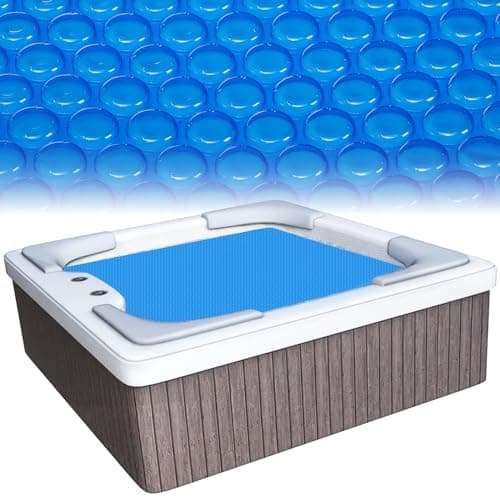
#1 · Best for cutting evaporation
Spa thermal blanket
Generic · scored 7.7/10
Bubbles down. It floats on the water under the hard cover and cuts evaporative loss.
Most of a hot tub's heat leaves as evaporation from the water surface, not through the cover. A floating blanket sits directly on the water and stops that, which is a different mechanism from the hard cover's insulation and is why the two work together rather than competing.
Trim it to the water line, not the tub rim, and pull it out before you get in. Left in place under a soak it wraps around people and jets.
What the maker states
- Type
- Floating bubble blanket
- Orientation
- Bubble side down, against the water
- Sizing
- Cut to fit the water surface
- Replaces
- Nothing. Used under the hard cover.
How it scored
- Heat retention
- 7.5
- Evaporation control
- 9.0
- Chemical saving
- 7.0
- Durability
- 6.0
- Value
- 9.0
Skip this one if: you think it replaces a hard cover. It does not: it has no structural strength and provides no safety barrier.
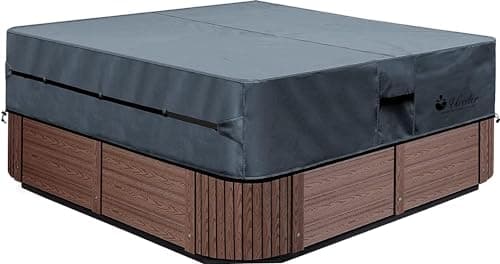
#2 · Best for extending a hard cover's life
Hot tub cover cap
Generic · scored 7.2/10
The cheapest thing on this page and, per dollar, the most effective.
Vinyl hard covers fail two ways: UV cracks the top skin, then water gets into the foam and the cover gets heavy. A cap addresses the first cause, which is what makes it cheap prevention against an expensive replacement.
It buys time; it does not reverse damage. A cover already saturated with water needs a new foam core or a new cover, and no cap will help.
What the maker states
- Type
- Slip-over cap for a hard cover
- Purpose
- Blocks UV and sheds standing water
- Fixing
- Elasticated skirt or straps
- Sizing
- By hard cover dimensions
How it scored
- Weather protection
- 8.0
- Heat retention
- 1.5
- Fit accuracy
- 7.0
- Durability
- 6.5
- Value
- 9.5
Skip this one if: you take the cover off daily. A cap that has to come off and go back on every evening will end up in the corner of the yard by March.
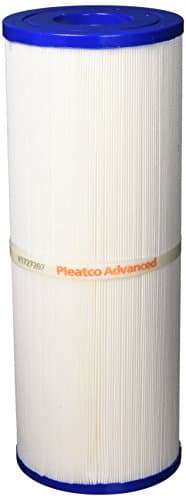
#3 · Best for buying the safe option
Pleatco PRB50-IN replacement cartridge
Pleatco · scored 8.6/10
The reference line. If a cartridge exists for your tub, Pleatco almost certainly makes it.
Filter cartridges are one of the few categories where the brand matters less than the part number, because fit is dictated by your tub. Pleatco earns its place by having the broadest catalog and a numbering scheme that cross-references cleanly to the other two majors.
Where the money goes is the end caps and the pleat count. Cheap cartridges usually fail at the cap rather than the media, by deforming after a few hot cleaning cycles, and a deformed cap lets water bypass the pleats entirely.
What the maker states
- Range
- Catalog covers most OEM spa cartridges
- Media
- Pleated polyester, antimicrobial in the M lines
- Part numbering
- P-prefixed, cross-referenced to Unicel and Filbur
- Fit
- Determined by your tub, not by brand
How it scored
- Build quality
- 9.0
- Catalog coverage
- 9.5
- Cleanability
- 8.5
- Value
- 6.5
- Availability
- 9.5
Skip this one if: your tub does not take this size. This is the PRB50-IN / C-4950 class, the most common spa cartridge but far from the only one -- confirm your part number on the filter finder before ordering.
Questions people actually ask
Frequently asked questions
How much does a hot tub cost to run per month?
It depends on your electricity rate, your climate, your tub's insulation and how often you use it, and any single figure would be invented. Work it out as heater kW x hours run per day x 30, plus pump kW x filtration hours x 30, multiplied by your rate per kWh. A smart plug gives you the hours figure accurately.
What is the biggest running cost of a hot tub?
Electricity, and within that, replacing heat lost from the water rather than heating it in the first place. Most of that loss is evaporation from the water surface, which is why the cover is the biggest single lever on the bill.
Is it cheaper to turn a hot tub down between uses?
Usually not, on a well-covered tub. Reheating from a lower temperature uses back the energy you saved, and the tub is unusable in the meantime. Keeping a properly covered tub at temperature is generally the cheaper approach.
How much do hot tub chemicals cost per month?
Sanitizer is most of the line and the rest is small. The two things that move it are bather load, because sanitizer is consumed by what people bring in, and water age, because accumulated cyanuric acid means more chlorine is needed for the same effect.
Where the numbers come from
Sources
- CDC, Model Aquatic Health Code (2023, 4th edition) - the source for the pH 7.2-7.8 range and the hot-tub disinfectant levels quoted on this site
- ANSI webstore, ANSI/APSP/ICC 5-2011 - scope confirms it covers residential INGROUND SWIMMING POOLS, which is why we do not cite it for spa water
- PHTA, Find a Standard - the index confirming which ANSI standard actually covers water quality in public pools and hot tubs or spas
- CDC, Controlling Legionella in Hot Tubs - the primary reference for the health and disinfection guidance quoted here
Read next
Related on Float & Filter
- Thermal blanket vs hard cover
The cheapest attack on the dominant loss mechanism.
- Replace or repair a waterlogged cover
A failed cover is a standing charge, not a cosmetic problem.
- When to replace a hot tub filter
The other recurring consumable in the annual figure.
- How often to change hot tub water
Old water costs more in chemicals than fresh water does.