Comparison
Hot Tub Chlorine: Tablets vs Granules
Granules, almost always. The chlorine tablets stacked next to them are a pool product, and a hot tub is the worst place to use one.
By Scooter M. · Published · How we pick
How this page is funded: the buy buttons below are Amazon affiliate links. If you buy through one we earn a commission at no extra cost to you. It does not change what we recommend, and where the better answer is a retailer we earn nothing from, we say so. The full version.
The verdict, up front. Use granules. Specifically dichlor granules, which is what every spa-labeled “chlorinating concentrate” is. The chlorine tablets sitting on the same shelf are almost always trichlor, they are formulated for swimming pools, and putting them in a hot tub causes two problems that are slow, invisible and annoying to reverse.
There is one tablet that belongs in a hot tub, and it is not a chlorine tablet at all — it is a bromine tablet. That is the real shape of this decision, and the reason the question keeps getting asked.
Side by side
| Dichlor granules | Trichlor tablets | |
|---|---|---|
| Designed for | Spas and hot tubs | Swimming pools |
| Effect on pH | Close to neutral | Strongly acidic — drags pH down every dose |
| Cyanuric acid added | Yes, some | Yes, considerably more per unit of chlorine |
| Dose control | Exact — you measure it | Poor — the tablet erodes at its own rate |
| Speed | Dissolves in seconds | Hours to days |
| Risk to the shell | None if broadcast with jets running | Bleaches acrylic on contact |
| Right for a hot tub? | Yes | No |
The two problems with trichlor in a hot tub
One: it is acidic, and a hot tub is small. Trichlor dissolves acidic. In a 20,000-gallon pool that is a manageable, gradual drift you correct occasionally. In a 350-gallon tub the same chemistry moves pH far faster, and low pH is corrosive to heater elements, seals and jet hardware. You end up chasing pH upward every few days to counteract the sanitizer you are adding, which is a treadmill rather than a routine. The targets you are fighting to hold are on pH and total alkalinity.
Two: cyanuric acid accumulates and does not leave. Trichlor carries a stabilizer, cyanuric acid, which protects chlorine from sunlight. A covered hot tub gets almost no sunlight, so the protection buys you nothing — but the CYA still builds up, dose after dose, and it does not evaporate, degrade or filter out. Past a certain concentration the chlorine in the water becomes progressively less effective at the same measured level, and the only way to reduce it is to drain and refill.[source]
That second problem is the one that catches people, because nothing goes visibly wrong. The water tests fine, holds a reading, and stops behaving — and the owner concludes the tub is haunted rather than over-stabilized. See how often to change hot tub water for what accumulates and why draining is the only exit.
Why granules win on the boring practical stuff too
- You control the dose. A measured scoop is a known quantity. A tablet releases at whatever rate the water temperature and flow decide, which in a tub that sits unused for four days and then hosts six people is exactly the wrong way round.
- They work immediately. Shocking after a heavy soak needs chlorine in the water now, not over the next two days.
- No contact risk. Broadcast granules across the surface with the jets running and they are gone before they touch anything. A tablet that lodges against the shell leaves a permanent pale mark.
- They are near pH-neutral. Your balance stays where you put it instead of being dragged by every dose.
So when is a tablet the right answer?
When it is a bromine tablet. Bromine is the sanitizer that suits the slow-release tablet format in a hot tub: it is stable at spa temperatures, it holds a residual between soaks without constant attention, and the tablets are designed for the small volumes and dispensers tubs use.
If what you actually want is “something I can drop in a floater and mostly forget about”, you do not want chlorine tablets. You want bromine, and the honest version of this comparison ends by pointing you at bromine vs chlorine to make that choice properly, and then at the bromine tablets themselves.
Choose dichlor granules if...
- You soak most days and want the sanitizer to respond same-day.
- You are willing to test and dose two or three times a week.
- You want exact control over what goes in the water.
- The tub sits unused for stretches and you would rather bring it up on demand than maintain a standing residual.
Choose bromine tablets if...
- You use the tub a few times a week and want it to look after itself between soaks.
- You would rather set a dispenser collar than measure a scoop.
- Chloramine smell has been a recurring complaint in your household.
Never choose trichlor tablets, unless...
There is no unless for a hot tub. The only legitimate use is a swimming pool, where the volume is large enough to absorb the acidity and the sunlight actually makes the stabilizer worth having. If a tablet you already own says trichlor, stabilized, or lists cyanuric acid on the label, it is a pool product regardless of which aisle it was in.
How to switch without wrecking your water
- Test cyanuric acid first if you have been running trichlor. A drop-based kit reads it; strips mostly do not. See test strips and test kits.
- If CYA is high, drain and refill. There is no chemical that removes it, and diluting is the entire remedy.
- Rebalance from scratch on the fresh fill — alkalinity, then pH, then sanitizer. The sequence is on start-up after a refill.
- Hold the targets. At least 3 ppm free chlorine, pH 7.2 to 7.8.[source][source]
The honest summary
Granules for chlorine, tablets for bromine, and nothing trichlor in a hot tub at all. The shelf puts these products side by side because they are all chlorine, and the packaging rarely says which water they were designed for. The difference is not marketing — it is pH and it is cyanuric acid, and both of them get worse quietly.
What fixes it
The products for this job
Named because they do the specific job this page describes, not because they are the only options. Specifications are the manufacturer’s published figures.
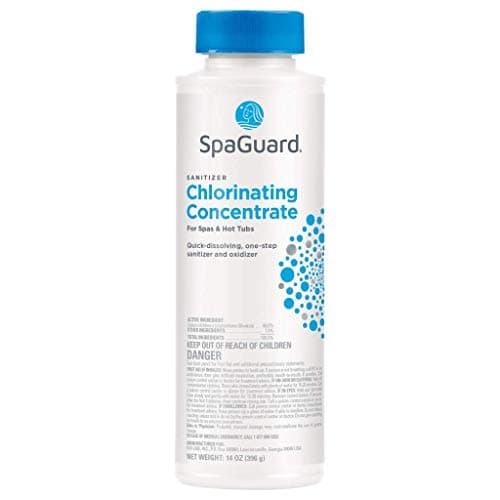
#1 · Best for a small first bottle of dichlor
SpaGuard Spa Chlorinating Concentrate, 14 oz
SpaGuard · scored 8.5/10
Dichlor granules in a size that suits one tub. The correct chlorine for a hot tub, in the correct format.
Dichlor is the chlorine a hot tub is supposed to get. It dissolves fast, it is close to pH-neutral so it does not drag your balance around every time you dose, and because it is a granule you control the amount instead of waiting for a tablet to erode.
The honest downside is the size. A 14 oz bottle is the right way to start, because it lets you find out how much your tub actually consumes before you commit to a bucket. Once you know, the larger sizes of the same product are considerably better value.
What the maker states
- Active
- Sodium dichlor, per the label
- Form
- Granules, broadcast into the water
- pH
- Near-neutral, unlike trichlor tablets
- Pack size
- 14 oz, per the listing
How it scored
- Right chemistry for a spa
- 9.5
- Dose control
- 9.0
- Cost per ounce
- 6.5
- Availability
- 8.5
- Label clarity
- 9.0
Skip this one if: you get through chlorine quickly. The 14 oz bottle is priced for convenience; the 2 lb and 5 lb sizes cost noticeably less per ounce.
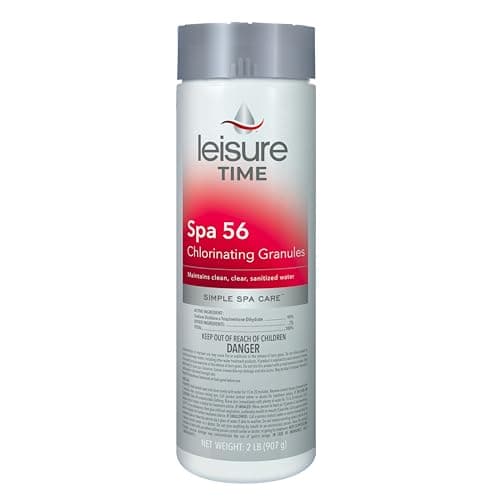
#2 · Best for chlorine users and fast recovery
Leisure Time Spa 56 Chlorinating Granules
Leisure Time · scored 8.1/10
Dichlor granules: dissolve fast, act fast, gone fast. The right tool after a heavy soak.
Dichlor is the granular chlorine hot tubs are dosed with, because it dissolves at spa temperature without pre-mixing and it is close enough to pH-neutral not to wreck your balance every time you add it. After a soak with four people in the tub, a measured dose of dichlor is the fastest way to get free chlorine back where the CDC says it should be.
The catch is cyanuric acid. Dichlor is stabilized, so every dose adds CYA that never leaves except by draining. Across a full water cycle that CYA accumulates and progressively blunts your chlorine, which is one of the real arguments for changing the water on schedule rather than topping up forever.
What the maker states
- Chemistry
- Sodium dichlor granules
- Dissolving
- Fast, no pre-mixing required per the label
- Target residual
- CDC gives at least 3 ppm free chlorine in hot tubs
- Adds cyanuric acid
- Yes, dichlor is stabilized
How it scored
- Stability at 104F
- 6.0
- Ease of dosing
- 8.5
- Odor and skin feel
- 8.0
- Cost per month
- 8.5
- Availability
- 9.5
Skip this one if: you only use the tub every couple of weeks. Dichlor burns off quickly at spa temperature, so an unattended chlorine tub goes unsanitized far sooner than a bromine one.
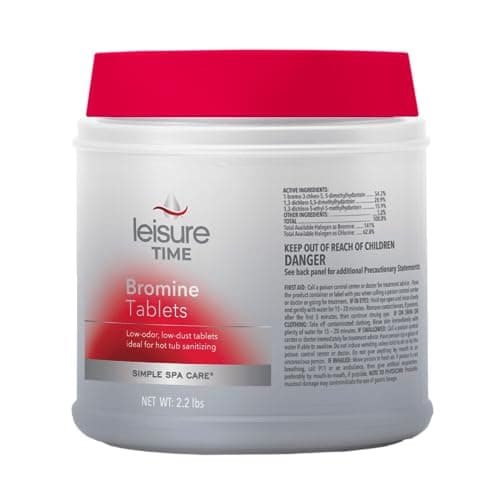
#3 · Best for set-and-forget sanitizing
Leisure Time Brominating Tablets
Leisure Time · scored 8.7/10
The default sanitizer for most tubs, and the one that survives 104F best.
Bromine is the chemistry most hot tubs are set up around, and the reason is thermal: bromine keeps working at spa temperatures where chlorine burns off fast. In a floating dispenser the tablets dissolve slowly and hold a residual for days rather than hours, so a tub used twice a week does not need daily attention.
Two things to know before you buy. Bromine tablets alone will not sanitize a brand-new fill, because you need a bromide bank established first, which is what a sodium bromide starter or a bromine startup kit is for. And bromine is not destroyed by shocking: a non-chlorine shock reactivates spent bromide back into free bromine, which is why bromine owners can shock weekly without a chemistry penalty.
What the maker states
- Chemistry
- 1-inch bromine tablets (BCDMH)
- Delivery
- Floating dispenser or in-line feeder
- Target residual
- 3-8 ppm bromine, per the label
- Needs a bromide bank
- Yes, on a fresh fill
How it scored
- Stability at 104F
- 9.5
- Ease of dosing
- 9.0
- Odor and skin feel
- 7.0
- Cost per month
- 7.5
- Availability
- 9.5
Skip this one if: you want the sanitizer gone within an hour of getting out, or bromine bothers your skin. Bromine holds a residual for days, which is the point, but it also means you cannot flip to a fresh-feeling tub on demand the way a dichlor user can.
Questions people actually ask
Frequently asked questions
Can you use chlorine tablets in a hot tub?
Not the usual ones. Chlorine tablets are almost always trichlor, which is formulated for swimming pools: it dissolves acidic and it adds cyanuric acid. In a hot tub’s small volume that drags pH down fast and stacks stabilizer that only draining removes. Use dichlor granules instead.
Are chlorine granules better than tablets for a hot tub?
Yes, for a hot tub. Dichlor granules are near pH-neutral, dissolve in seconds so you can shock and use the tub the same evening, and let you measure an exact dose rather than leaving it to however fast a tablet happens to erode.
What happens if you put pool chlorine tablets in a hot tub?
Two things, both slow. pH falls with every dose, which is corrosive to the heater and seals, and cyanuric acid accumulates until the chlorine stops working properly at the level you are reading. Neither is dramatic on day one, which is why it usually goes unnoticed for months.
Can you put chlorine granules straight into the water?
Yes — broadcast them across the surface with the jets running and the cover off, so they disperse instead of settling. That is the correct method, and it is one of the practical advantages granules have over any tablet.
Which tablets can you use in a hot tub?
Bromine tablets. They suit the slow-release format at spa temperatures, hold a residual between soaks, and are made for the floating dispensers and in-line feeders hot tubs use. They still need a sodium bromide bank established on a fresh fill before they will hold a reading.
Where the numbers come from
Sources
- CDC, Model Aquatic Health Code (2023, 4th edition) - the source for the pH 7.2-7.8 range and the hot-tub disinfectant levels quoted on this site
- CDC, Preventing Hot Tub Rash - the source for the 4-8 ppm bromine figure, the prevention steps, and the guidance on when to see a healthcare provider
- PHTA, Find a Standard - the index confirming which ANSI standard actually covers water quality in public pools and hot tubs or spas
Read next
Related on Float & Filter
- Bromine vs chlorine for a hot tub
The bigger decision this one sits inside.
- The best hot tub bromine tablets
The tablet that does belong in a hot tub.
- Hot tub pH and total alkalinity
What trichlor drags around every time you dose.
- Shocking a hot tub
Where granules earn their place outright.
- Bromine granules vs tablets
The same format question on the bromine side, with a different answer.