The checklist
What Hot Tub Chemicals Do You Need?
Five products, in this order: alkalinity increaser, pH adjuster, sanitizer, shock, test strips. Everything else waits until a test says otherwise.
By Scooter M. · Published · How we pick

How this page is funded: the buy buttons below are Amazon affiliate links. If you buy through one we earn a commission at no extra cost to you. It does not change what we recommend, and where the better answer is a retailer we earn nothing from, we say so. The full version.
You need five things. In the order you will use them: an alkalinity increaser, a pH adjuster, a sanitizer, a shock, and a way to test. That is the entire list for a first fill, and for most owners it stays the entire list for a long time afterwards.
The list, in order
- Total alkalinity increaser (sodium bicarbonate). First, because alkalinity is the buffer that decides whether your pH correction holds. Target 80 to 120 ppm.
- A pH adjuster — usually a decreaser (sodium bisulfate) to start with, because most fill water sits high. Target 7.2 to 7.8.[source]
- A sanitizer — bromine tablets in a floating dispenser, or dichlor granules. On bromine you also need a sodium bromide bank on a fresh fill.
- A shock — non-chlorine (MPS) for weekly oxidizing, dichlor for a genuine contamination event.
- Test strips matched to your chemistry. Without these the other four are guesswork.
A start-up kit covers most of this in one order, which is the one time a kit is genuinely the right purchase — see the starter kit comparison for what should be in the box.
Why alkalinity comes first, and not pH
This is the single most useful thing on this page. Total alkalinity is a buffer: it resists changes in pH. If alkalinity is low, pH moves easily, and every correction you make gets undone within days. People experience this as a tub that will not hold pH no matter how much acid they add, and they respond by adding more acid, which lowers alkalinity further, which makes pH move even more easily.
Fix the buffer first and the pH usually settles on its own. If you have adjusted pH three weekends in a row, stop adjusting pH and go read your alkalinity. The mechanics are on hot tub pH and total alkalinity.
What the shop will also try to sell you
Calcium hardness increaser. Real product, real problem, and completely unnecessary if your fill water already has calcium in it. Soft water genuinely does need it, because water with too little calcium pulls calcium out of grout, seals and heater components. Test before buying. There is no calcium reducer, so over-correcting means draining. Details on hot tub calcium hardness.
Stain and scale control (a sequestrant). Essential on well water or a supply carrying metals. Pointless on soft municipal water. A test strip settles it in fifteen seconds.
Clarifier. Useful as a finisher after the chemistry is right and the filter is clean. Useless before that, and it loads the cartridge for nothing. It should not be part of a first purchase.
Fragrance and aromatherapy. These add organic load to water whose main ongoing problem is organic load. If you want them, use them sparingly and expect to shock more often.
Algaecide. Algae in a hot tub means the sanitizer has failed. Fixing the sanitizer fixes the algae, and a separate product does not address the cause. We cover why on hot tub algae.
The order to add them in, on a fresh fill
- Fill, and let the tub come up to temperature. Chemicals behave differently in cold water.
- Test the raw fill water. This is the reading everything else is relative to.
- Correct total alkalinity to 80-120 ppm. Wait a full circulation cycle.
- Correct pH to 7.2-7.8.[source] Wait a cycle, retest.
- Correct calcium hardness only if the test says so.
- Establish the sanitizer. On bromine, the bank first, then tablets.
- Shock, then wait the time the label states before getting in.
Do not follow the order printed on the individual bottles. Several of them will tell you to adjust pH before alkalinity, which is backwards for the reason above. The full version with quantities is on first chemicals after a refill, and the target numbers are on the dosage chart.
One accessory that earns its place
A floating dispenser, if you are running tablets. Tablets dropped loose into a tub dissolve wherever they settle, usually against the acrylic, and that is how bleached patches happen. A floater keeps them moving and lets you meter the dissolve rate. Start with the vent nearly closed and open it gradually across a week while you watch the readings.
What all of this is for
Holding a sanitizer residual. That is the core of the CDC’s guidance on controlling Legionella in hot tubs,[source] and it is the reason the five-item list is five items rather than one. The balancers exist so the sanitizer works; the shock exists so the sanitizer is not consumed by things it should not be dealing with; the strips exist so you know whether any of it is happening.
Where you see an industry standard cited for spa water, check which vessel it covers. ANSI/APSP/ICC-5 covers residential inground swimming pools,[source] not spas, and the right consensus reference for hot tubs is the water-quality standard for public pools and hot tubs.[source]
What fixes it
The products for this job
Named because they do the specific job this page describes, not because they are the only options. Specifications are the manufacturer’s published figures.
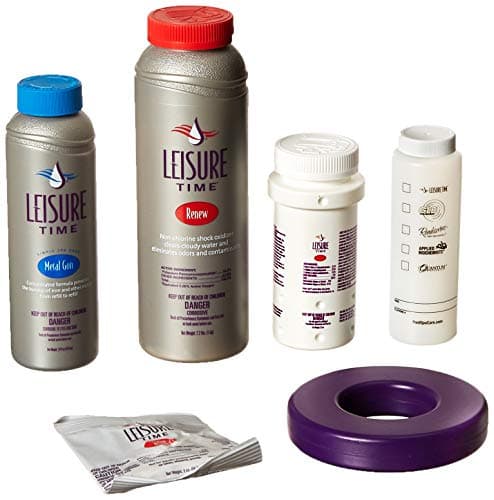
#1 · Best for a first bromine fill
Leisure Time Spa Bromine Start-Up Kit
Leisure Time · scored 8.5/10
The most complete first purchase for a bromine tub, and it includes the bromide bank.
The one genuine reason to buy a kit rather than parts is the bromide bank. A new bromine fill needs sodium bromide established before tablets will hold a residual, and that is exactly the step first-time owners skip when they buy a tub of tablets and nothing else.
Check the pack contents before you buy rather than assuming. Composition varies between retailers, and the difference between a kit with test strips and one without is the difference between using it on day one and placing a second order.
What the maker states
- Chemistry
- Bromine
- Typically includes
- Sodium bromide bank, tablets, shock, balancers
- Covers
- A first fill plus early top-ups, per the label
- Test strips included
- Varies by pack
How it scored
- Completeness
- 9.0
- Instructions
- 8.5
- Cost vs buying separately
- 6.5
- Beginner friendliness
- 9.5
- Availability
- 9.0
Skip this one if: you already own balancers. Kits price the convenience of getting everything at once, and buying the pieces separately is usually cheaper once the staples are on the shelf.
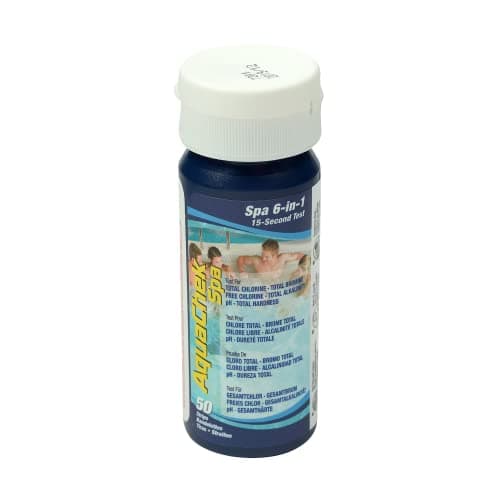
#2 · Best for the weekly check
AquaChek Spa 6-in-1 Test Strips
AquaChek · scored 8.4/10
Six readings in fifteen seconds. Not precise, but precise enough to catch drift early.
Strips get an unfair reputation because people compare them to a reagent kit and call them inaccurate. That is the wrong comparison. The right one is against not testing at all, which is what happens when the routine takes ten minutes. A strip you actually use weekly beats a reference kit in a cupboard.
Two habits make strips far more reliable: keep the container sealed and out of the humid room the tub is in, and read them in daylight rather than under a yellow bulb. Most strip complaints trace back to one of those two.
What the maker states
- Reads
- Hardness, total chlorine, free chlorine, bromine, pH, alkalinity
- Method
- Dip-and-read colorimetric strip
- Time
- Seconds, per the label
- Storage
- Sealed container, away from humidity
How it scored
- Accuracy
- 6.5
- Speed
- 10.0
- Parameters covered
- 9.0
- Cost per test
- 9.0
- Availability
- 9.5
Skip this one if: you need an exact free chlorine number to diagnose a problem. Strips read in color bands; a drop-based kit reads in numbers.
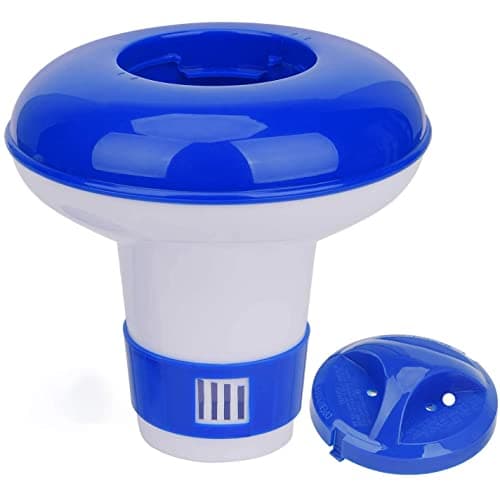
#3 · Best for holding tablets at a controlled rate
Floating chemical dispenser
Generic · scored 8.2/10
A few dollars, and the difference between a steady residual and a sawtooth one.
Tablets dropped loose into a tub dissolve wherever they land, usually against an acrylic surface, and that is how bleached patches happen. A floater keeps them moving and lets you meter the rate with the collar.
Start with the vent nearly closed and open it gradually across a week while you watch your readings. Opening it wide on day one is the classic route to a tub nobody can sit in.
What the maker states
- Type
- Floating tablet holder with an adjustable vent
- Takes
- 1-inch bromine or trichlor tablets, per the maker
- Adjustment
- Rotating collar sets dissolve rate
- Note
- Remove before soaking, per most makers
How it scored
- Dose control
- 8.0
- Build quality
- 6.5
- Ease of use
- 9.0
- Value
- 9.5
- Availability
- 9.5
Skip this one if: your tub has an in-line feeder built in. Running both at once makes the dose impossible to reason about.
Questions people actually ask
Frequently asked questions
What chemicals do I need for a hot tub?
Five: a total alkalinity increaser, a pH adjuster, a sanitizer (bromine tablets or dichlor granules), a shock, and test strips. On bromine, add a sodium bromide bank for the first fill. Everything else waits until a test says you need it.
What order do you add hot tub chemicals in?
Total alkalinity first, then pH, then calcium hardness if needed, then sanitizer, then shock. Alkalinity comes first because it buffers pH: correcting pH while alkalinity is low means the pH will drift straight back.
Do I need a clarifier for a hot tub?
Not as part of a first purchase. A clarifier clumps fine particles so the filter can catch them, which helps clear the last of a haze once the chemistry is right and the filter is clean. Used before that, it does nothing except load the cartridge.
How long after adding chemicals can you use a hot tub?
Follow the wait time on the specific product label, and test before getting in. Non-chlorine shock typically states a short wait of around fifteen minutes; a chlorine shock needs the free chlorine level to come back down into range first.
Can you use pool chemicals in a hot tub?
Some of the same chemistries are used, but the dosing is not transferable and some pool products are not appropriate for a spa at all. The practical problem is scale: a pool dose measured into a 350-gallon tub is a serious overdose. Buy spa-labeled products with spa-scale instructions.
Where the numbers come from
Sources
- CDC, Model Aquatic Health Code (2023, 4th edition) - the source for the pH 7.2-7.8 range and the hot-tub disinfectant levels quoted on this site
- CDC, Controlling Legionella in Hot Tubs - the primary reference for the health and disinfection guidance quoted here
- PHTA, Find a Standard - the index confirming which ANSI standard actually covers water quality in public pools and hot tubs or spas
- ANSI webstore, ANSI/APSP/ICC 5-2011 - scope confirms it covers residential INGROUND SWIMMING POOLS, which is why we do not cite it for spa water
Read next
Related on Float & Filter
- The best hot tub chemicals
The specific products for each item on the list above.
- Hot tub pH and total alkalinity
Why alkalinity comes first, in more detail.
- The best hot tub test strips and test kits
The item on the list without which the other four are guesswork.
- The hot tub maintenance schedule
Where each of these products fits in the weekly routine.
- The best hot tub floating dispensers
The one accessory on the list above, compared properly.
- Hot tub chlorine tablets vs granules
Why the tablets next to the granules are a pool product.
- Inflatable hot tub chemicals
The same list for a small vinyl tub, where the doses are halved.