Comparison
How Often to Change Hot Tub Water
Divide your tub volume by three, then divide that by the number of daily bathers. The answer is roughly how many days the water has left.
By Scooter M. · Published · How we pick

How this page is funded: the buy buttons below are Amazon affiliate links. If you buy through one we earn a commission at no extra cost to you. It does not change what we recommend, and where the better answer is a retailer we earn nothing from, we say so. The full version.
The answer, up front. Take your tub volume in gallons, divide it by three, then divide that by the average number of people using the tub per day. The result is roughly how many days the water has left. A 400-gallon tub used by two people a day gives 400 divided by 3 divided by 2, which is about 66 days.
That is the standard industry rule of thumb, and it is a starting point rather than a law. It exists because the thing that ages hot tub water is what bathers bring into it relative to how much water there is to dilute it.
What the formula is actually estimating
| Tub volume | 1 bather/day | 2 bathers/day | 4 bathers/day |
|---|---|---|---|
| 250 gallons | ~83 days | ~42 days | ~21 days |
| 350 gallons | ~117 days | ~58 days | ~29 days |
| 400 gallons | ~133 days | ~67 days | ~33 days |
| 500 gallons | ~167 days | ~83 days | ~42 days |
The numbers above are the formula applied, not measurements. Use them as a planning cadence, and let the water itself override them, because it will.
Why water has a service life at all
Nothing you put in a hot tub leaves except by draining. Specifically:
- Cyanuric acid accumulates with every dose of stabilized chlorine and progressively blunts the chlorine you add afterwards.
- Total dissolved solids rise with every balancer you add, and make everything harder to move.
- Body oils and lotions accumulate faster than shock removes them, and are what produce foam and scum lines.
- Calcium concentrates as water evaporates and you top up, and there is no way to reduce it.
- Sanitizer by-products build up and are what make old water smell used even when it tests correctly.
None of those are visible, all of them make the water harder to keep right, and the cumulative effect is a tub that fights you every week. That is the actual reason for the interval.
What shortens the interval
- Heavy or irregular bather load. A party is worth several ordinary days.
- Nobody showering first. Lotions and deodorant go straight in.
- Stabilized chlorine used exclusively. Cyanuric acid accumulation is the specific mechanism.
- Hard fill water. Calcium starts high and only rises.
- A neglected filter. Organics that should have been removed stay in the water.
- Frequent defoamer use. Silicone accumulates and loads the cartridge.
What lengthens it
- Bromine rather than dichlor. No cyanuric acid accumulation at all — see bromine vs chlorine.
- Weekly enzyme dosing. Organics get digested rather than accumulating.
- A properly maintained filter. Rinse weekly, soak monthly.
- Showering before getting in. The cheapest measure available.
Four signs the water is finished, whatever the calendar says
- Foam that returns within days however much defoamer you use. See why your hot tub foams.
- Sanitizer that will not hold despite correct dosing and no unusual bather load.
- A dullness that survives a corrected chemistry, a clean filter and a shock.
- A used smell that returns within a day of shocking.
Any of those means the water is done. Continuing to treat it costs more in chemicals than the water change would have, and takes longer than the afternoon draining it would have taken.
The special cases
If the tub is not being used at all, the water still ages, just more slowly, and it still needs a sanitizer residual. Do not assume an unused tub can be left indefinitely; sanitizer decays whether or not anyone is in the water, and the CDC’s hot tub guidance is about maintaining disinfectant rather than about bather numbers.[source]
In winter, the interval does not change but the job is harder. Plan water changes for a mild spell, and never drain and leave a tub empty in a freeze.
On a salt system, the same accumulation applies. A salt cell generates chlorine from dissolved salt; it does not remove dissolved solids or body oils, and the water ages the same way.
When you do change it
Purge the plumbing before you drain, wipe the shell while it is empty, and rebalance from scratch on the refill. The full procedure is on draining and refilling a hot tub, and the chemistry restart is on first chemicals after a refill. Target the same numbers you always do: pH 7.2 to 7.8, sanitizer at the published hot tub level.[source]
What fixes it
The products for this job
Named because they do the specific job this page describes, not because they are the only options. Specifications are the manufacturer’s published figures.
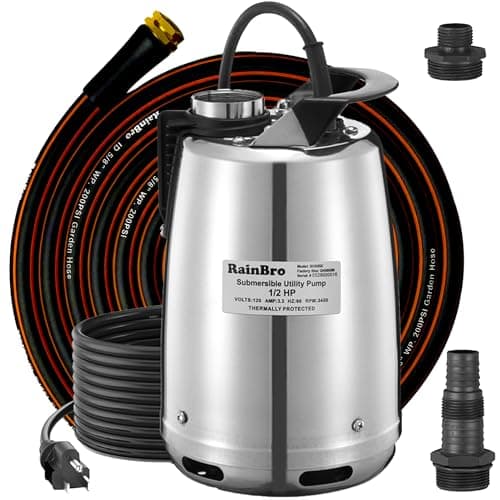
#1 · Best for not waiting three hours
RainBro 1/2 HP submersible drain pump
RainBro · scored 8.5/10
Turns a half-day drain into twenty minutes. The most boring worthwhile purchase here.
The single biggest reason people stretch a water change from four months to seven is that draining through the built-in valve takes most of an afternoon. Removing that friction is worth more to your water quality than most chemicals.
Watch it as the water gets low. Utility pumps do not like running dry, and the last inch is a wet-vac job anyway.
What the maker states
- Flow
- 2,300 GPH, per the listing
- Max lift
- 23 ft, per the listing
- Included
- 10 ft hose, 3/4 in GHT adapter, 25 ft cord, per the listing
- Minimum suction
- Not stated in the listing
How it scored
- Drain speed
- 9.5
- Build quality
- 7.0
- Ease of use
- 8.5
- Value
- 8.5
- Availability
- 9.0
Skip this one if: your tub has a gravity drain that runs somewhere useful and you are not in a hurry.
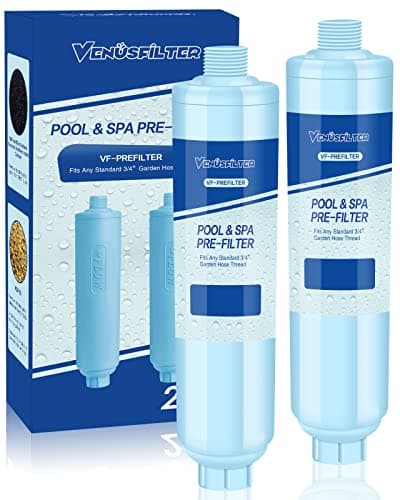
#2 · Best for filling from well or hard water
Garden hose pre-filter
Generic · scored 7.7/10
Filters the water going in, which is much easier than treating it once it is in.
Every problem you keep out of the tub at fill time is one you do not have to chase with chemistry for the next four months. On well water in particular, a pre-filter is the cheapest single improvement to water quality available.
It slows the fill noticeably. On a 400-gallon tub that is a real cost in time, and it is the main reason people stop using one.
What the maker states
- Type
- In-line hose filter
- Targets
- Sediment and metals, per the maker
- Fits
- Standard garden hose thread
- Life
- Rated by gallons, per the maker
How it scored
- Metal removal
- 8.0
- Sediment removal
- 8.5
- Fill speed impact
- 5.5
- Value on hard water
- 8.5
- Availability
- 8.5
Skip this one if: your municipal water is soft and metal-free. Then it is a cartridge cost for no measurable benefit.
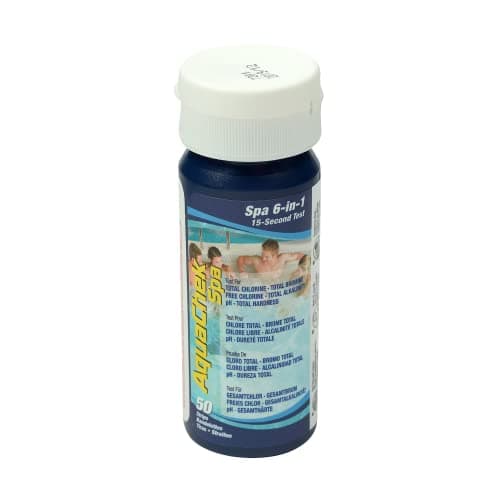
#3 · Best for the weekly check
AquaChek Spa 6-in-1 Test Strips
AquaChek · scored 8.4/10
Six readings in fifteen seconds. Not precise, but precise enough to catch drift early.
Strips get an unfair reputation because people compare them to a reagent kit and call them inaccurate. That is the wrong comparison. The right one is against not testing at all, which is what happens when the routine takes ten minutes. A strip you actually use weekly beats a reference kit in a cupboard.
Two habits make strips far more reliable: keep the container sealed and out of the humid room the tub is in, and read them in daylight rather than under a yellow bulb. Most strip complaints trace back to one of those two.
What the maker states
- Reads
- Hardness, total chlorine, free chlorine, bromine, pH, alkalinity
- Method
- Dip-and-read colorimetric strip
- Time
- Seconds, per the label
- Storage
- Sealed container, away from humidity
How it scored
- Accuracy
- 6.5
- Speed
- 10.0
- Parameters covered
- 9.0
- Cost per test
- 9.0
- Availability
- 9.5
Skip this one if: you need an exact free chlorine number to diagnose a problem. Strips read in color bands; a drop-based kit reads in numbers.
Questions people actually ask
Frequently asked questions
How often should you change hot tub water?
Divide your tub volume in gallons by three, then divide that by the average number of bathers per day. The result is roughly how many days the water has left. A 400-gallon tub used by two people a day works out at about 66 days.
How do you know when to change hot tub water?
Four signs override the calendar: foam that returns within days regardless of defoamer, sanitizer that will not hold despite correct dosing, a dullness that survives corrected chemistry plus a clean filter plus a shock, and a used smell that comes back a day after shocking.
How often should you change hot tub water if it is not used?
Less often, but not never. Water still ages without bathers, sanitizer still decays, and an unused tub still needs a residual maintained. Test it on the same weekly schedule and change it when the signs appear rather than assuming it can be left indefinitely.
Does a salt water hot tub need water changes?
Yes, on the same basis. A salt cell generates chlorine from dissolved salt; it does not remove dissolved solids, body oils or accumulated by-products, so the water ages exactly the same way.
Can you change just part of the hot tub water?
A partial drain and refill dilutes accumulated calcium, cyanuric acid and dissolved solids, which is genuinely useful as a stopgap. It does not address biofilm in the plumbing and it does not let you wipe the shell, so it postpones a full change rather than replacing one.
Where the numbers come from
Sources
- CDC, Model Aquatic Health Code (2023, 4th edition) - the source for the pH 7.2-7.8 range and the hot-tub disinfectant levels quoted on this site
- CDC, Controlling Legionella in Hot Tubs - the primary reference for the health and disinfection guidance quoted here
- PHTA, Find a Standard - the index confirming which ANSI standard actually covers water quality in public pools and hot tubs or spas
Read next
Related on Float & Filter
- Draining and refilling a hot tub
The procedure, once the formula says it is time.
- First chemicals after a refill
The chemistry restart on fresh water.
- Why your hot tub foams
Persistent foam is the clearest sign the water is finished.
- Bromine vs chlorine for a hot tub
Cyanuric acid accumulation is a chlorine-only problem.
- Hot tub winter care
Do the pre-winter change on a mild day, not in January.
- The best hot tub drain pumps
Making the drain quick enough that you actually do it on schedule.