Diagnostic guide
Why Your Hot Tub Water Is Cloudy
The most common cause is a filter that has stopped passing water. But there are five distinct causes and they need five different responses.
By Scooter M. · Published · How we pick

How this page is funded: the buy buttons below are Amazon affiliate links. If you buy through one we earn a commission at no extra cost to you. It does not change what we recommend, and where the better answer is a retailer we earn nothing from, we say so. The full version.
Cloudy water has five common causes, and they look almost identical from above. Rather than listing all five and then giving you four fixes in a fixed order, this page branches on something you can actually observe. Find your line below and go to that section.
Which of these is you?
- It went cloudy right after I shocked it
- It has been cloudy since I refilled it
- Everything tests fine and it is still cloudy
- It is cloudy and it smells
- It is cloudy and the surfaces feel slippery
Cloudy right after shocking
Why this happens. Shock does its job by breaking organic material down, and the by-products of that reaction are temporarily in suspension. What you are looking at is the shock working, not failing. It is also possible you shocked water whose pH was out of range, which produces a genuine clouding rather than a temporary one.
How to confirm it. Note the time. A post-shock haze clears within a few hours to a day with the pump running. If it is still there after 24 hours, this is not your branch.
The fix, in order. Leave the jets running and the cover off for the label time. Check pH is between 7.2 and 7.8;[source] if it is not, correct it and let the water circulate. Do not add anything else, and specifically do not add a clarifier on top of a fresh shock. If a faint haze survives the next day, then clarify.
Cloudy since the refill
Why this happens. Fill water carries its own chemistry with it. High calcium hardness, dissolved metals from a well, or simply alkalinity a long way out of range all produce cloudiness that appears on day one and does not clear on its own.
How to confirm it. Test calcium hardness and total alkalinity, not just pH and sanitizer. If hardness is well above the 150 to 250 ppm range or alkalinity is far outside 80 to 120 ppm, that is your answer.[source]
The fix, in order. Correct total alkalinity first, then pH, and let each change circulate fully before the next. If hardness is high, add a sequestrant to hold calcium in solution, and plan on filling through a hose pre-filter next time. If hardness is low, raise it with calcium chloride to the bottom of the range. The whole sequence is on first chemicals after a refill, and the hardness detail is on calcium hardness.
Balanced, and still cloudy
This is the branch nobody answers, and it is a real and common query. Every number reads correctly and the water is still hazy. The chemistry is not the problem, which means the problem is mechanical.
Why this happens. Almost always a filter that has stopped passing water. Cartridges fail from oil rather than debris, and the failure is gradual enough that there is never a day you notice it got worse. A cartridge that looks clean can be passing a fraction of its rated flow.
How to confirm it. Two checks. Pull the cartridge and look at the pleats: gray and tacky is an oil load. And watch the jets on a full-power cycle: weak flow with a clean-looking filter is the signature.
The fix, in order. Chemically soak the cartridge overnight, not a rinse — water does not remove oil. Rinse until the run-off is completely clear, refit, and run a full filtration cycle. In most cases the water clears within a day. If the cartridge comes out of a proper soak still restricting flow, it is finished; see when to replace a filter.
If the filter is genuinely fine, the remaining possibilities are filtration time too short for the tub’s volume, which is on filter cycle settings, or water that has simply reached the end of its life. Both are more likely than any chemical you have not tried yet.
Cloudy and it smells
Why this happens. A strong chlorine smell means combined chloramines — spent chlorine bound to organics — which means too little effective sanitizer, not too much. A musty or earthy smell points somewhere else entirely, usually the plumbing.
How to confirm it. Test free chlorine and total chlorine separately. If total reads well above free, that gap is your chloramine load and this is your branch.
The fix, in order. Confirm pH is in range, then shock — a chlorine shock if the sanitizer reading is low, non-chlorine if it is not. Run the jets with the cover off for the label time. Retest. Free chlorine should come back and the smell should go with it. The detail is on shocking a hot tub.
If the smell is musty rather than chemical, and it survives a shock, the source is biofilm in the pipework rather than anything in the water.
Cloudy and the surfaces feel slippery
Why this happens. A slick feel on the shell or the waterline is biological growth. It lives on surfaces and inside the plumbing, not in the water, which is why a water test can look perfectly acceptable while this is going on.
How to confirm it. Run a finger along the waterline and just below it. Slippery rather than merely wet is the signature. A tub that keeps consuming sanitizer for no visible reason is the other clue, because the growth is eating it.
The fix, in order. This one does not respond to water treatment, because the problem is not in the water. Purge the plumbing with a dedicated cleaner, drain, wipe the shell and waterline while the tub is empty, and refill. The full procedure is on hot tub biofilm. This is also the case where the CDC’s guidance on maintaining a disinfectant residual is most directly relevant.[source]
If none of those worked
The honest escalation is a drain, a plumbing flush and a refill. Water has a service life: cyanuric acid from stabilized chlorine, dissolved solids from every balancer you have added and accumulated body oils all build up, none of them leave except by draining, and every one makes the water harder to keep clear.
A tub that fights you every single week usually does not have a chemistry problem. It has old water. Work through how often to change hot tub water and then draining and refilling.
Preventing it
- Shower before getting in. Most of the load is lotions and deodorant.
- Rinse swimwear in plain water; detergent residue is a major contributor.
- Rinse the filter weekly and soak it monthly.
- Shock after heavy use, not on a calendar.
- Dose an enzyme weekly to handle organics between shocks.
- Change the water on schedule rather than when it forces you to.
Is cloudy hot tub water safe?
Cloudiness itself is a clarity problem rather than a health verdict, and the meaningful question is whether the water carries a sanitizer residual. The CDC gives at least 3 ppm free chlorine for hot tubs and pH 7.2 to 7.8,[source] and maintaining that residual is the core of its guidance on controlling Legionella in hot tubs.[source] If you cannot hold a residual, do not use the tub until you can. If anyone becomes unwell, that is a question for a doctor and not for a website.
What fixes it
The products for this job
Named because they do the specific job this page describes, not because they are the only options. Specifications are the manufacturer’s published figures.
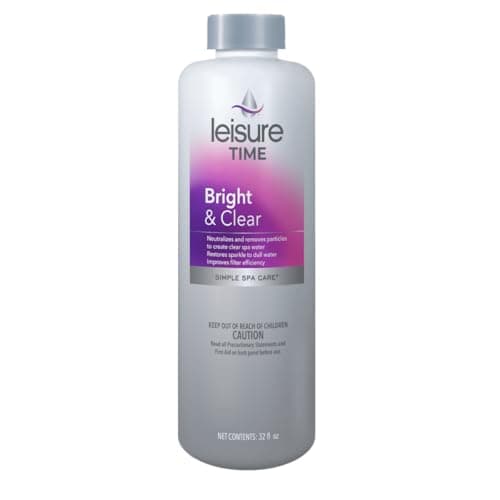
#1 · Best for fine particles the filter is missing
Leisure Time Bright and Clear
Leisure Time · scored 8.1/10
A clarifier clumps fine solids so the filter can catch them. It does not fix chemistry.
Clarifiers work by making small particles stick to each other until they are big enough for a cartridge to trap. That means the cartridge has to be clean and the pump has to run, or the clarified particles just circulate.
It is a finisher, not a fix. Balance the water and sort the sanitizer first, then use a clarifier to clear the last of the haze. Used in the other order it is money spent on a symptom.
What the maker states
- Type
- Polymer clarifier
- Job
- Agglomerates fine particles for the filter
- Filter must be
- Clean, or the clarifier has nowhere to put anything
- Dose
- By tub volume, per the label
How it scored
- Clarity gain
- 8.5
- Speed
- 8.0
- Filter load
- 6.0
- Value
- 8.5
- Availability
- 9.0
Skip this one if: your water is cloudy because your sanitizer is low. Clarifier on unsanitized water buys you a day and costs you a filter clean.
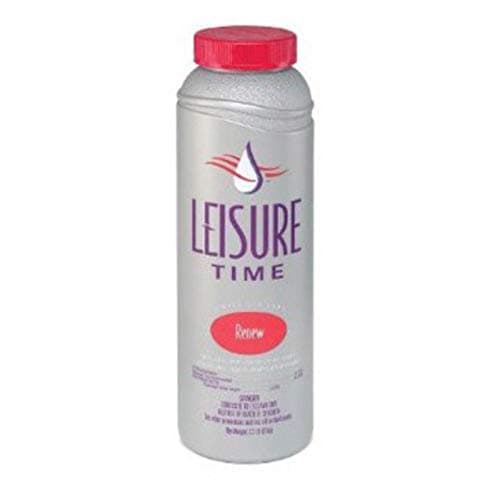
#2 · Best for the weekly oxidize
Leisure Time Renew Non-Chlorine Shock
Leisure Time · scored 8.6/10
The shock you can use and get back in the water quickly. Oxidizes; does not sanitize.
Non-chlorine shock does one job well: it oxidizes the organic load a soak leaves behind, which is what turns water dull and gives it that flat, used smell. On a bromine tub it does a second job for free, converting spent bromide back into active bromine.
Understand what it is not. MPS is an oxidizer, not a sanitizer. If the problem is biological rather than organic, this will not fix it and the tub will stay exactly as cloudy as it was.
What the maker states
- Chemistry
- Potassium monopersulfate (MPS)
- Job
- Oxidizes body oils, lotions and sweat
- Reactivates bromine
- Yes, on a bromine tub
- Wait before soaking
- Per the label, typically about 15 minutes
How it scored
- Oxidizing power
- 8.0
- Ease of dosing
- 9.5
- Odor and skin feel
- 9.0
- Cost per month
- 8.0
- Availability
- 9.0
Skip this one if: you are dealing with an actual contamination event. MPS burns off organics, it does not kill what a chlorine shock kills, and reaching for it instead is a common reason a cloudy tub stays cloudy.
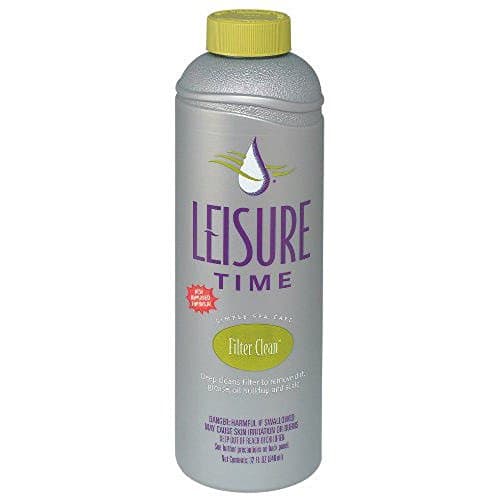
#3 · Best for the monthly deep clean
Leisure Time Filter Clean
Leisure Time · scored 8.4/10
A proper cartridge cleaner, which is a different product from a rinse.
The reason a rinsed filter still restricts flow is that the load is oil, not grit, and water does not remove oil. A dedicated cartridge cleaner is a surfactant designed to release exactly that, and the difference in flow after a proper soak is obvious at the jets.
Rinse harder afterwards than you think you need to. Cleaner left in the pleats goes straight into your water and is a very common cause of foaming that owners then blame on the tub.
What the maker states
- Format
- Concentrate for soaking
- Targets
- Body oils, lotions, light scale
- Soak time
- Per the label, commonly overnight
- Rinse
- Thoroughly, before refitting
How it scored
- Oil removal
- 9.0
- Scale removal
- 7.5
- Ease of use
- 8.0
- Cost per clean
- 8.0
- Availability
- 9.0
Skip this one if: your filter is only ever lightly loaded. A hose rinse handles surface debris; this is for the oils a rinse cannot shift.
Questions people actually ask
Frequently asked questions
Why is my hot tub water cloudy when the chemicals are balanced?
Almost always the filter. Cartridges clog with body oils rather than debris, and the decline is gradual enough that there is never a day you notice. Chemically soak the cartridge overnight rather than rinsing it, rinse thoroughly, refit and run a full filtration cycle.
Is cloudy hot tub water safe to use?
Cloudiness is a clarity problem, and the meaningful question is whether the water carries a sanitizer residual. The CDC gives at least 3 ppm free chlorine and pH 7.2 to 7.8 for hot tubs. If you cannot hold a residual, do not use the tub until you can.
How long does it take for cloudy hot tub water to clear?
A post-shock haze clears within a few hours to a day with the pump running. Cloudiness from a loaded filter clears within a day of a proper chemical soak. Anything still cloudy after a corrected chemistry, a clean filter and a shock is usually water at the end of its life.
Why did my hot tub go cloudy after shocking?
Because shock breaks organic material down and the by-products are briefly in suspension. That is the shock working. Leave the jets running with the cover off, check pH is in range, and give it up to a day before adding anything else.
Will clarifier fix cloudy hot tub water?
Only as a finisher. A clarifier clumps fine particles so the filter can catch them, which needs a clean cartridge and the pump running. Added to water with low sanitizer or a loaded filter, it does nothing except make the loading worse.
Where the numbers come from
Sources
- CDC, Model Aquatic Health Code (2023, 4th edition) - the source for the pH 7.2-7.8 range and the hot-tub disinfectant levels quoted on this site
- CDC, Controlling Legionella in Hot Tubs - the primary reference for the health and disinfection guidance quoted here
- PHTA, Find a Standard - the index confirming which ANSI standard actually covers water quality in public pools and hot tubs or spas
Read next
Related on Float & Filter
- Hot tub pH and total alkalinity
The chemistry branch, in full.
- How to clean a hot tub filter
The single most common fix for balanced-but-cloudy water.
- The best hot tub clarifiers and defoamers
The remedy products, once you know which branch you are in.
- How often to change hot tub water
When the honest answer is that the water is finished.
- Hot tub scale and hard water stains
If the marks are on the surfaces rather than in the water.
- Hot tub rash and itchy skin
Where water condition stops being a clarity question.