Roundup
The Best Hot Tub Test Strips and Test Kits
A strip you use every week beats a reference kit in a cupboard. Here is where each one earns its place, and where strips genuinely are not enough.
By Scooter M. · Updated · How we pick
How this page is funded: the buy buttons below are Amazon affiliate links. If you buy through one we earn a commission at no extra cost to you. It does not change what we recommend, and where the better answer is a retailer we earn nothing from, we say so. The full version.
The short answer
Top pick
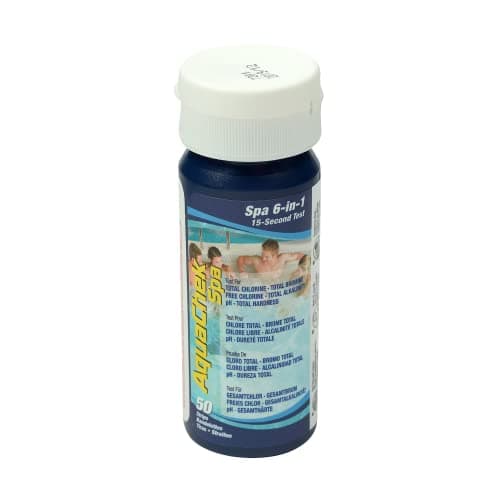
AquaChek Spa 6-in-1 Test Strips
Six readings in fifteen seconds. Not precise, but precise enough to catch drift early.
Quick picks
Tap a row to jump to the full write-up. Prices come from the live price layer, never from memory.
| # | Product | Best for | Score | Price |
|---|---|---|---|---|
| 1 | AquaChek Spa 6-in-1 Test StripsSix readings in fifteen seconds. Not precise, but precise enough to catch drift early. | The weekly check | 8.4out of 10 | $13.17 · View on Amazon |
| 2 | 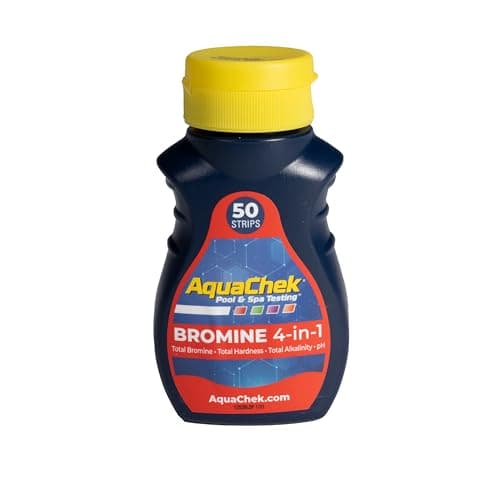 AquaChek Red Bromine Test StripsPrinted on a bromine scale rather than converted from chlorine, which removes a whole class of error. AquaChek Red Bromine Test StripsPrinted on a bromine scale rather than converted from chlorine, which removes a whole class of error. | Bromine tubs specifically | 8.1out of 10 | $12.10 · View on Amazon#ad how this is funded · price as of October 18, 2026 |
| 3 | 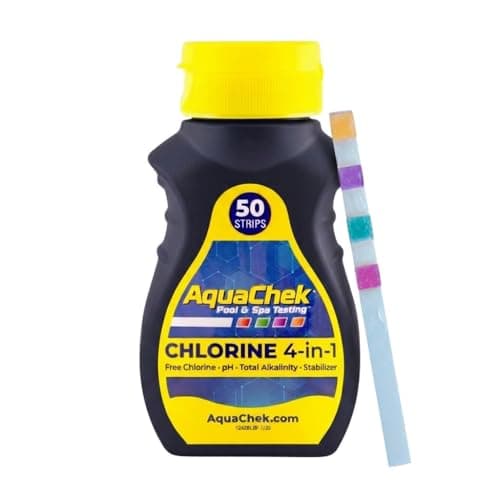 AquaChek Yellow 4-in-1 Chlorine Test StripsFree chlorine on its own scale, which is the number you actually dose against. AquaChek Yellow 4-in-1 Chlorine Test StripsFree chlorine on its own scale, which is the number you actually dose against. | Chlorine tubs specifically | 8.2out of 10 | $11.69 · View on Amazon#ad how this is funded · price as of October 18, 2026 |
| 4 | 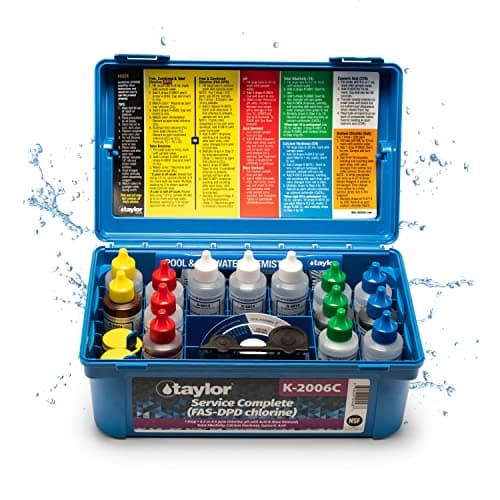 Taylor K-2006C FAS-DPD Complete Test KitThe reference kit. Overkill for a weekly check, decisive when something is wrong. Taylor K-2006C FAS-DPD Complete Test KitThe reference kit. Overkill for a weekly check, decisive when something is wrong. | Getting a real number | 8.4out of 10 | $146.99 · View on Amazon#ad how this is funded · price as of October 18, 2026 |
| 5 | 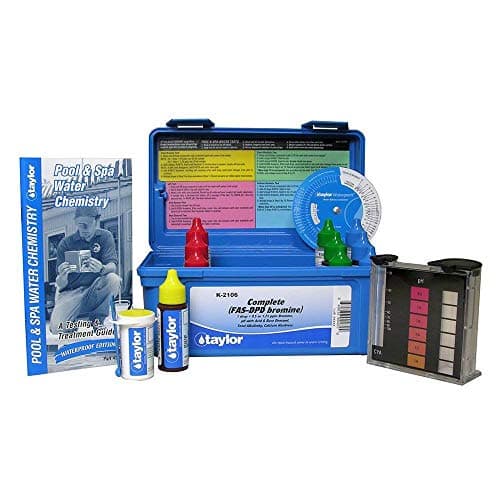 Taylor K-2106 FAS-DPD Bromine Test KitThe bromine-scaled sibling of the K-2006. Same rigor, right units, no conversion. Taylor K-2106 FAS-DPD Bromine Test KitThe bromine-scaled sibling of the K-2006. Same rigor, right units, no conversion. | Precise bromine readings | 8.0out of 10 | $86.80 · View on Amazon#ad how this is funded · price as of October 18, 2026 |
| 6 | 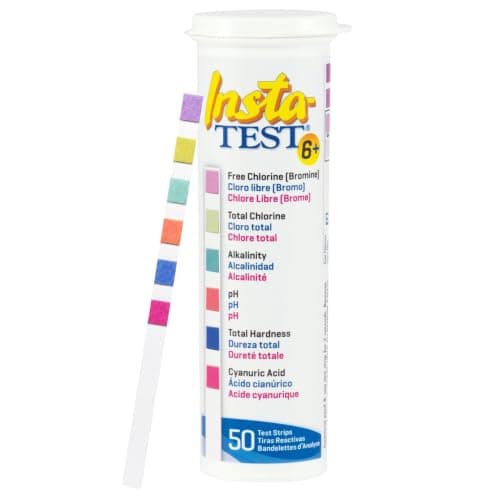 LaMotte Insta-Test 6-Way Pool & Spa Test StripsA credible cross-check when one brand of strips starts reading oddly. LaMotte Insta-Test 6-Way Pool & Spa Test StripsA credible cross-check when one brand of strips starts reading oddly. | A second opinion | 7.8out of 10 | $17.47 · View on Amazon#ad how this is funded · price as of October 18, 2026 |
Scores are our own, from the published scoring method on how we pick. They are an editorial judgment of published specifications, not a test result, and they are deliberately kept out of the page’s structured data.
Buy strips for the weekly check and, if you want one, a titration kit for the week something is wrong. That is the whole recommendation, and the rest of this page is about why the usual framing of this decision is upside down.
Strips get called inaccurate because people compare them to a reagent kit. That is the wrong comparison. The right comparison is against not testing at all, which is exactly what happens when the routine takes ten minutes and involves counting drops. A strip that is accurate to within a band, used every single week, keeps water in better condition than a laboratory-grade kit used four times a year.
What you actually need to measure
Five things, and only three of them weekly. Sanitizer level, pH and total alkalinity are the weekly readings, because all three move. Calcium hardness and cyanuric acid change slowly and only need checking at a fill and occasionally in between.
| Reading | Target | How often | Strip good enough? |
|---|---|---|---|
| Free chlorine | At least 3 ppm in a hot tub[source] | Weekly, and after heavy use | Yes for routine, no for diagnosis |
| Bromine | 4-8 ppm | Weekly | Yes, on a bromine-scaled strip |
| pH | 7.2-7.8[source] | Weekly | Yes |
| Total alkalinity | 80-120 ppm | Weekly | Yes |
| Calcium hardness | 150-250 ppm in an acrylic spa | At fill, then occasionally | Roughly |
| Cyanuric acid | Rises with every dichlor dose; only leaves by draining | Mid-cycle on a chlorine tub | No. This needs a reagent kit. |
Match the strip to the chemistry
The single most common testing mistake is reading a bromine tub on a chlorine strip. Both are measured by the same reaction, and converting between them takes a factor of roughly 2.25. Every time you skip that conversion, you under-dose. A strip printed on the right scale removes the arithmetic and therefore removes the error, which is why the bromine-specific and chlorine-specific strips both appear on this list despite the six-in-one covering both.
The two habits that fix most strip complaints
Keep the container sealed and out of the room the tub is in. Strips are hygroscopic and humidity degrades the pads, and the failure mode is not an obviously broken strip: it is a consistent wrong answer that you trust. Second, read them in daylight rather than under a yellow bulb. Colorimetric comparison against a printed chart is exactly as light-dependent as it sounds.
If those two are already true and a reading still looks wrong, that is what a second brand of strips or a reagent kit is for. A cross-check turns a confusing fortnight into a five-minute answer.
When you genuinely need a titration kit
Three situations. When the water is misbehaving and the strips insist everything is fine. When you need to know whether a smell is under-sanitized water or combined chloramines, which requires reading free and total chlorine separately as numbers rather than bands. And when you suspect cyanuric acid has accumulated far enough to blunt your chlorine, which no strip in this list will tell you.
That last one is the strongest argument for owning a reagent kit on a chlorine tub. Every dose of stabilized chlorine adds cyanuric acid, which never leaves except by draining, and a tub that seems to consume sanitizer for no reason is often just carrying too much of it.
What testing is ultimately for
Maintaining a sanitizer residual is the core of the CDC’s guidance on controlling Legionella in hot tubs.[source] That is the reason the fifteen seconds matter, and it is worth remembering when the strips feel like a chore. Once you have a reading, the dosage chart turns it into a quantity, and the maintenance schedule tells you when to do it again.
Every pick, in full
The picks in detail
Specifications below are the manufacturer’s own published figures, attributed as such. We have not tested these units and the scores are an editorial judgment of published data against the published method, not a test result.
#1 · Best for the weekly check
AquaChek Spa 6-in-1 Test Strips
AquaChek · scored 8.4/10
Six readings in fifteen seconds. Not precise, but precise enough to catch drift early.
Strips get an unfair reputation because people compare them to a reagent kit and call them inaccurate. That is the wrong comparison. The right one is against not testing at all, which is what happens when the routine takes ten minutes. A strip you actually use weekly beats a reference kit in a cupboard.
Two habits make strips far more reliable: keep the container sealed and out of the humid room the tub is in, and read them in daylight rather than under a yellow bulb. Most strip complaints trace back to one of those two.
What the maker states
- Reads
- Hardness, total chlorine, free chlorine, bromine, pH, alkalinity
- Method
- Dip-and-read colorimetric strip
- Time
- Seconds, per the label
- Storage
- Sealed container, away from humidity
How it scored
- Accuracy
- 6.5
- Speed
- 10.0
- Parameters covered
- 9.0
- Cost per test
- 9.0
- Availability
- 9.5
Skip this one if: you need an exact free chlorine number to diagnose a problem. Strips read in color bands; a drop-based kit reads in numbers.
#2 · Best for bromine tubs specifically
AquaChek Red Bromine Test Strips
AquaChek · scored 8.1/10
Printed on a bromine scale rather than converted from chlorine, which removes a whole class of error.
Bromine and chlorine are measured by the same reaction, and a chlorine strip reading a bromine tub needs a conversion of roughly 2.25 applied in your head. Every time you skip that, you under-dose. A strip printed on a bromine scale removes the arithmetic and therefore the mistake.
It covers fewer parameters than the 6-in-1, so a lot of bromine owners end up with both: this one for the routine sanitizer check, the wider strip when they want the whole picture.
What the maker states
- Reads
- Total bromine, total alkalinity, pH
- Scale
- Bromine, not chlorine converted
- Method
- Dip-and-read strip
- Storage
- Sealed, dry
How it scored
- Accuracy
- 7.0
- Speed
- 10.0
- Parameters covered
- 6.5
- Cost per test
- 9.0
- Availability
- 9.0
Skip this one if: you run chlorine. A bromine scale reads a chlorine tub high, and you will under-dose accordingly.
#3 · Best for chlorine tubs specifically
AquaChek Yellow 4-in-1 Chlorine Test Strips
AquaChek · scored 8.2/10
Free chlorine on its own scale, which is the number you actually dose against.
Free chlorine is the number that matters, because total chlorine includes the spent combined chloramines that make water smell like a public pool. A strip that separates the two tells you whether you need more sanitizer or a shock, and those are opposite actions.
If total reads well above free, that gap is your chloramine load and the answer is to shock, not to add more dichlor.
What the maker states
- Reads
- Free chlorine, total chlorine, pH, total alkalinity
- Scale
- Separates free from total
- Method
- Dip-and-read strip
- Storage
- Sealed, dry
How it scored
- Accuracy
- 7.0
- Speed
- 10.0
- Parameters covered
- 7.5
- Cost per test
- 9.0
- Availability
- 9.5
Skip this one if: you run bromine, for the same reason in reverse.
#4 · Best for getting a real number
Taylor K-2006C FAS-DPD Complete Test Kit
Taylor Technologies · scored 8.4/10
The reference kit. Overkill for a weekly check, decisive when something is wrong.
When a tub is misbehaving and the strips insist everything is fine, this settles the argument. FAS-DPD titration gives free and combined chlorine as separate numbers rather than a color band, and it reads cyanuric acid, which is often the invisible reason a chlorine tub feels under-sanitized.
It is a chlorine kit. Bromine owners who want the same rigor want the bromine variant instead. Either way, buy replacement reagents rather than a whole new kit when they expire.
What the maker states
- Method
- FAS-DPD titration for free and combined chlorine
- Also reads
- pH, alkalinity, calcium hardness, cyanuric acid
- Resolution
- 0.2 or 0.5 ppm by sample size, per the manual
- Reagents
- Replaceable, dated
How it scored
- Accuracy
- 9.8
- Speed
- 4.0
- Parameters covered
- 9.5
- Cost per test
- 6.5
- Availability
- 8.5
Skip this one if: you want a fast routine test. This takes minutes and uses reagents that expire; it is a diagnostic tool, not a daily one.
#5 · Best for precise bromine readings
Taylor K-2106 FAS-DPD Bromine Test Kit
Taylor Technologies · scored 8.0/10
The bromine-scaled sibling of the K-2006. Same rigor, right units, no conversion.
Most hot tubs run bromine and most reference kits are sold for chlorine pools. This is the one that reads bromine directly, so there is no conversion step and no chance of applying it backwards.
It is harder to find than the K-2006 and usually a little dearer. If the choice is between this and no reference kit at all, it is worth the search.
What the maker states
- Method
- FAS-DPD titration on a bromine scale
- Also reads
- pH, alkalinity, calcium hardness
- Reagents
- Replaceable, dated
- Sample size
- Selectable, per the manual
How it scored
- Accuracy
- 9.7
- Speed
- 4.0
- Parameters covered
- 8.5
- Cost per test
- 6.5
- Availability
- 7.5
Skip this one if: you only ever need a rough weekly reading. Strips are genuinely adequate for that.
#6 · Best for a second opinion
LaMotte Insta-Test 6-Way Pool & Spa Test Strips
LaMotte · scored 7.8/10
A credible cross-check when one brand of strips starts reading oddly.
Strips do go bad, usually from humidity, and the failure mode is a consistent wrong answer rather than an obviously broken one. A second brand on the shelf turns a confusing week into a five-minute check.
That is genuinely the whole case for it. If your current strips agree with a reagent test, you do not need this.
What the maker states
- Reads
- Varies by version, typically sanitizer, pH, alkalinity
- Method
- Dip-and-read strip
- Maker
- LaMotte, a water-analysis instrument manufacturer
- Storage
- Sealed, dry
How it scored
- Accuracy
- 7.0
- Speed
- 10.0
- Parameters covered
- 7.0
- Cost per test
- 8.0
- Availability
- 7.5
Skip this one if: your existing strips are working. There is no benefit to owning two strip brands beyond checking a suspicious result.
Questions people actually ask
Frequently asked questions
Are hot tub test strips accurate enough?
For weekly routine testing, yes. They read in bands rather than exact numbers, which is enough to tell you whether something needs adjusting. They are not accurate enough for diagnosing a problem, and they cannot read cyanuric acid at all.
Why do my test strips give different results each time?
Usually humidity. Strips degrade if the container is left open or stored in the same humid room as the tub, and the failure is a consistent wrong reading rather than an obviously broken one. Lighting is the other cause: read them in daylight, not under a yellow bulb.
Can I use chlorine test strips on a bromine hot tub?
You can, but you have to multiply the reading by roughly 2.25 to get the bromine figure, and forgetting that means under-dosing. A strip printed on a bromine scale removes the conversion and the mistake.
Do I need a Taylor kit for a hot tub?
Not for routine testing. It earns its place when the strips say everything is fine and the water disagrees, when you need free and combined chlorine as separate numbers, or when you need a cyanuric acid reading that no strip will give you.
How often should I test hot tub water?
Weekly as a minimum, and again after any heavy use. Sanitizer, pH and alkalinity all move week to week. Calcium hardness and cyanuric acid change slowly and only need checking at a fill and occasionally in between.
Where the numbers come from
Sources
- CDC, Model Aquatic Health Code (2023, 4th edition) - the source for the pH 7.2-7.8 range and the hot-tub disinfectant levels quoted on this site
- CDC, Controlling Legionella in Hot Tubs - the primary reference for the health and disinfection guidance quoted here
- PHTA, Find a Standard - the index confirming which ANSI standard actually covers water quality in public pools and hot tubs or spas
Read next
Related on Float & Filter
- Hot tub chemical dosage and levels chart
Turns a reading into a quantity.
- Hot tub pH and total alkalinity
What to do when two of the weekly readings are out.
- The best hot tub chemicals
The products that move each of the numbers you just measured.
- The hot tub maintenance schedule
Where the weekly test sits in the whole routine.
- Hot tub chlorine and bromine levels
What the numbers you just measured should actually be.
- Are digital hot tub water testers worth it?
The expensive upgrade, and why most people should skip it.