Comparison
Bromine vs Chlorine for a Hot Tub
Bromine if you use the tub a few times a week and want it to look after itself. Chlorine if you use it most days, or hardly at all.
By Scooter M. · Published · How we pick
How this page is funded: the buy buttons below are Amazon affiliate links. If you buy through one we earn a commission at no extra cost to you. It does not change what we recommend, and where the better answer is a retailer we earn nothing from, we say so. The full version.
The verdict, up front. Use bromine if your tub gets used a few times a week and you want it to hold sanitizer between visits with minimal attention. Use chlorine if you soak most days, or if the tub sits unused for long stretches and you would rather bring it up quickly than maintain a standing residual. Neither is wrong, and both will keep water safe if you keep them in range.
Everything below is the reasoning behind that, because it is a decision you make once per water cycle and switching means draining.
Side by side
| Attribute | Bromine | Chlorine (dichlor) | Winner |
|---|---|---|---|
| Stability at 104F | Holds a residual for days | Burns off within hours to a day | Bromine |
| Effective pH range | Stays effective across a wider band | Loses effectiveness as pH climbs | Bromine |
| Speed of action | Slower | Fast | Chlorine |
| Odor | Distinct, lingers on skin and towels | Sharper but dissipates faster | Chlorine |
| Reactivated by shock | Yes, non-chlorine shock regenerates bromide | No, shock is consumed | Bromine |
| Adds cyanuric acid | No | Yes, dichlor is stabilized and CYA accumulates | Bromine |
| Setup on a fresh fill | Needs a bromide bank established first | Dose and go | Chlorine |
| Ongoing cost | Typically higher per month | Typically lower per month | Chlorine |
| Attention required | Low | Higher | Bromine |
Stability is the argument that decides it for most people
Hot tubs are hot, and heat is what separates these two chemistries. Chlorine dissipates quickly at 100F and above, which is why the CDC’s figure for hot tubs is at least 3 ppm free chlorine rather than the 1 ppm it gives for pools.[source] You need a higher residual because the residual is being consumed faster, and the practical consequence is that a chlorine tub left alone for a week is often a tub with no sanitizer left in it.
Bromine holds up. It keeps working at spa temperature, it stays effective across a wider pH band, and in a floating dispenser it feeds itself for days. If your tub is used Tuesday and Saturday and nobody thinks about it in between, that is the whole case for bromine.
Chlorine wins on speed and on cost
Dichlor granules dissolve at spa temperature without pre-mixing and act within minutes, which is exactly what you want after four people have been in the tub. A chlorine tub recovers faster from a heavy soak, and it recovers on demand rather than on the tablet’s schedule.
It is also usually the cheaper chemistry month to month, and it does not have the setup step: no bromide bank to establish, so a fresh fill goes from balanced to sanitized in one dose. For a tub used most days, where you are going to be adding sanitizer regularly anyway, chlorine’s disadvantage largely evaporates.
The two things people get wrong
Testing on the wrong scale. Bromine and chlorine are measured by the same reaction, and a chlorine strip reading a bromine tub needs multiplying by roughly 2.25. Skip that and you will chronically under-dose. Buy the strip that matches your chemistry — the test strip comparison covers which is which.
Shocking as though they behave the same way. On a bromine tub, a non-chlorine shock does double duty: it oxidizes the organic load and it converts spent bromide back into active bromine. On a chlorine tub it only does the first job. That is a real practical difference and it is covered in full on shocking a hot tub.
Cyanuric acid: the slow argument against chlorine
Dichlor is stabilized chlorine, which means every dose adds cyanuric acid. CYA protects chlorine from UV, which matters in an outdoor pool and matters very little under a hot tub cover, and it never leaves the water except by draining. Over a full water cycle it accumulates to the point where it measurably blunts your sanitizer, and the symptom is a tub that seems to eat chlorine for no reason.
Bromine has no equivalent accumulation. This is a genuine long-run advantage and it is also one of the real arguments for changing water on schedule rather than topping up indefinitely, which we work through on how often to change hot tub water.
Choose bromine if...
- You use the tub two or three times a week rather than daily.
- You want it to hold sanitizer without weekly attention.
- You go away regularly and want the tub to survive it.
- Your pH tends to run high and you would rather not chase it.
Choose chlorine if...
- You soak most days and are already in the routine.
- You dislike the way bromine smells on skin and towels.
- You want the lower monthly cost.
- You want the tub to go from unsanitized to ready in an hour rather than a day.
How to switch
At a water change, not before. You cannot cleanly convert one chemistry to the other in existing water: bromide left in the tub will convert any chlorine you add straight into bromine, so a tub you believe you have switched to chlorine is still running bromine and testing confusingly. Drain, flush the plumbing while you are at it, refill, and start the new chemistry from scratch. The sequence is on draining and refilling a hot tub.
Safety applies equally to both
Whichever you choose, the thing that matters is holding a residual. The CDC’s guidance on controlling Legionella in hot tubs is built around maintaining disinfectant, not around which disinfectant you picked.[source] And where an industry consensus standard is the right citation for spa water, it is the water-quality standard for public pools and hot tubs, not the inground swimming pool standard that gets quoted on spa pages by mistake.[source]
What fixes it
The products for this job
Named because they do the specific job this page describes, not because they are the only options. Specifications are the manufacturer’s published figures.
#1 · Best for set-and-forget sanitizing
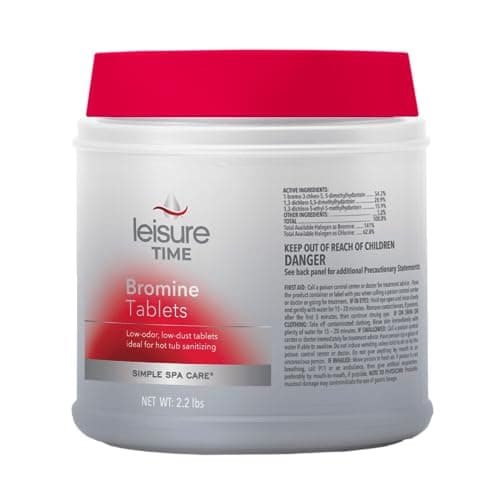
Leisure Time Brominating Tablets
Leisure Time · scored 8.7/10
The default sanitizer for most tubs, and the one that survives 104F best.
Bromine is the chemistry most hot tubs are set up around, and the reason is thermal: bromine keeps working at spa temperatures where chlorine burns off fast. In a floating dispenser the tablets dissolve slowly and hold a residual for days rather than hours, so a tub used twice a week does not need daily attention.
Two things to know before you buy. Bromine tablets alone will not sanitize a brand-new fill, because you need a bromide bank established first, which is what a sodium bromide starter or a bromine startup kit is for. And bromine is not destroyed by shocking: a non-chlorine shock reactivates spent bromide back into free bromine, which is why bromine owners can shock weekly without a chemistry penalty.
What the maker states
- Chemistry
- 1-inch bromine tablets (BCDMH)
- Delivery
- Floating dispenser or in-line feeder
- Target residual
- 3-8 ppm bromine, per the label
- Needs a bromide bank
- Yes, on a fresh fill
How it scored
- Stability at 104F
- 9.5
- Ease of dosing
- 9.0
- Odor and skin feel
- 7.0
- Cost per month
- 7.5
- Availability
- 9.5
Skip this one if: you want the sanitizer gone within an hour of getting out, or bromine bothers your skin. Bromine holds a residual for days, which is the point, but it also means you cannot flip to a fresh-feeling tub on demand the way a dichlor user can.
#2 · Best for chlorine users and fast recovery
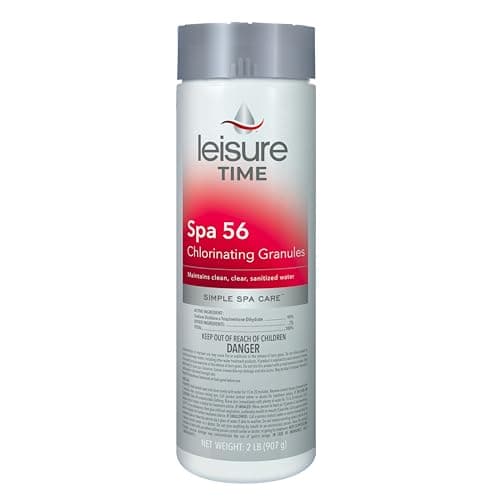
Leisure Time Spa 56 Chlorinating Granules
Leisure Time · scored 8.1/10
Dichlor granules: dissolve fast, act fast, gone fast. The right tool after a heavy soak.
Dichlor is the granular chlorine hot tubs are dosed with, because it dissolves at spa temperature without pre-mixing and it is close enough to pH-neutral not to wreck your balance every time you add it. After a soak with four people in the tub, a measured dose of dichlor is the fastest way to get free chlorine back where the CDC says it should be.
The catch is cyanuric acid. Dichlor is stabilized, so every dose adds CYA that never leaves except by draining. Across a full water cycle that CYA accumulates and progressively blunts your chlorine, which is one of the real arguments for changing the water on schedule rather than topping up forever.
What the maker states
- Chemistry
- Sodium dichlor granules
- Dissolving
- Fast, no pre-mixing required per the label
- Target residual
- CDC gives at least 3 ppm free chlorine in hot tubs
- Adds cyanuric acid
- Yes, dichlor is stabilized
How it scored
- Stability at 104F
- 6.0
- Ease of dosing
- 8.5
- Odor and skin feel
- 8.0
- Cost per month
- 8.5
- Availability
- 9.5
Skip this one if: you only use the tub every couple of weeks. Dichlor burns off quickly at spa temperature, so an unattended chlorine tub goes unsanitized far sooner than a bromine one.
Questions people actually ask
Frequently asked questions
Is bromine or chlorine better for a hot tub?
Bromine is better for a tub used a few times a week, because it holds a residual for days at spa temperature and needs less attention. Chlorine is better for a tub used most days, because it acts faster, costs less per month and does not accumulate cyanuric acid.
Can you switch from bromine to chlorine without draining?
No. Bromide left in the water converts added chlorine straight back into bromine, so the tub carries on running bromine while testing confusingly. Switch at a water change, ideally with a plumbing flush before you drain.
Does bromine smell worse than chlorine?
It smells different and it lingers longer on skin and towels. Chlorine smells sharper but dissipates faster. Neither should smell strongly in balanced water: a strong chlorine smell usually means combined chloramines and a need to shock, not too much sanitizer.
Do you still need to shock a bromine hot tub?
Yes, and it does more on bromine than on chlorine. A non-chlorine shock oxidizes the organic load and also converts spent bromide back into active bromine, which is why bromine owners can shock weekly without any chemistry penalty.
Which is cheaper, bromine or chlorine?
Chlorine is usually cheaper per month. Bromine costs more in tablets but needs less intervention, so the real comparison is money against time rather than money against money.
Where the numbers come from
Sources
- CDC, Model Aquatic Health Code (2023, 4th edition) - the source for the pH 7.2-7.8 range and the hot-tub disinfectant levels quoted on this site
- CDC, Controlling Legionella in Hot Tubs - the primary reference for the health and disinfection guidance quoted here
- PHTA, Find a Standard - the index confirming which ANSI standard actually covers water quality in public pools and hot tubs or spas
- ANSI webstore, ANSI/APSP/ICC 5-2011 - scope confirms it covers residential INGROUND SWIMMING POOLS, which is why we do not cite it for spa water
Read next
Related on Float & Filter
- The best hot tub chemicals
The products for whichever chemistry you just chose.
- Shocking a hot tub
Where the two chemistries behave most differently.
- Salt water vs mineral vs traditional sanitizing
The third and fourth options, and why they are not what people expect.
- Draining and refilling a hot tub
The only clean moment to switch chemistry.
- The best hot tub floating dispensers
Whichever tablet you chose still needs metering.
- Best hot tub chemicals for sensitive skin
Before switching chemistry over skin, rule out pH and chloramines.
- The best hot tub bromine tablets
Which tablet to buy once you have chosen bromine.
- Bromine granules vs tablets
Once bromine is chosen, the next question is which format.