Buyer's guide
Hot Tub Salt Water Systems
Nearly every listing calls these chemical-free. A salt system is a chlorine generator that makes chlorine in your water. Buy one for what it really does, and price it on the part that wears out.
By Scooter M. · Published · How we pick

How this page is funded: the buy buttons below are Amazon affiliate links. If you buy through one we earn a commission at no extra cost to you. It does not change what we recommend, and where the better answer is a retailer we earn nothing from, we say so. The full version.
The short answer
Top pick
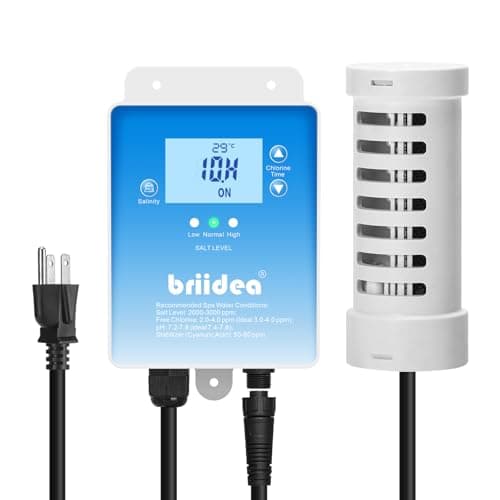
Briidea salt chlorine generator
Publishes its cell life, which is the single number that decides what salt really costs you.
Quick picks
Tap a row to jump to the full write-up. Prices come from the live price layer, never from memory.
| # | Product | Best for | Score | Price |
|---|---|---|---|---|
| 1 | Briidea salt chlorine generatorPublishes its cell life, which is the single number that decides what salt really costs you. | Most tubs converting to salt | 7.8out of 10 | $179.99 · View on Amazon#ad how this is funded · price as of October 18, 2026 |
| 2 | 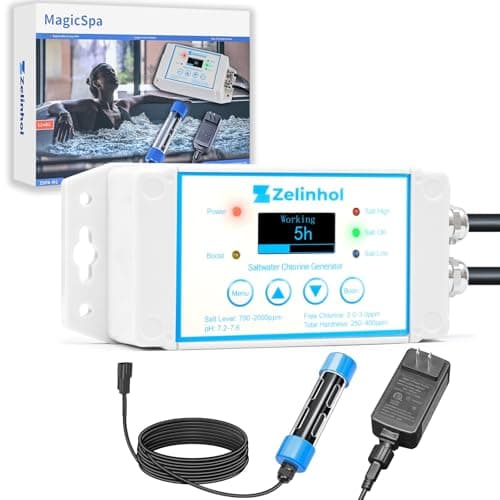 Zelinhol salt chlorine generator with OLED displaySelf-cleaning cell and a tool-free swap, which go after the two real chores salt creates. Zelinhol salt chlorine generator with OLED displaySelf-cleaning cell and a tool-free swap, which go after the two real chores salt creates. | Less cell maintenance | 7.6out of 10 | $237.95 · View on Amazon#ad how this is funded · price as of October 18, 2026 |
| 3 | 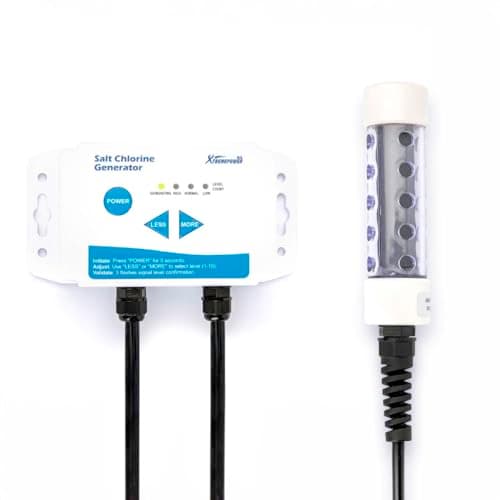 XtremepowerUS saltwater chlorine generation systemA lower-cost unit from an established brand that names portable and inflatable tubs outright. XtremepowerUS saltwater chlorine generation systemA lower-cost unit from an established brand that names portable and inflatable tubs outright. | Portable and inflatable tubs | 6.8out of 10 | $139.95 · View on Amazon#ad how this is funded · price as of October 18, 2026 |
| 4 | 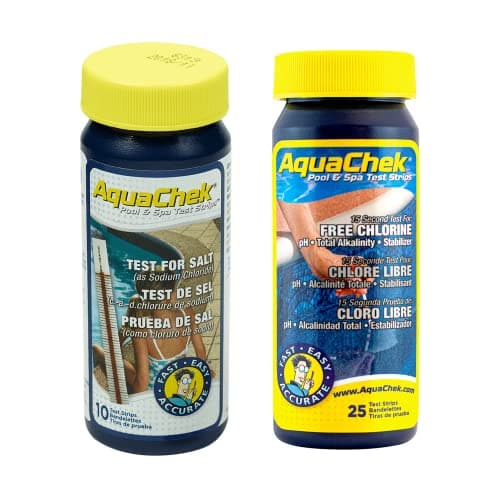 AquaChek salt system test kitAn independent salt reading, plus the chlorine and cyanuric acid readings salt users need anyway. AquaChek salt system test kitAn independent salt reading, plus the chlorine and cyanuric acid readings salt users need anyway. | Checking the salt yourself | 8.8out of 10 | $22.39 · View on Amazon#ad how this is funded · price as of October 18, 2026 |
| 5 | 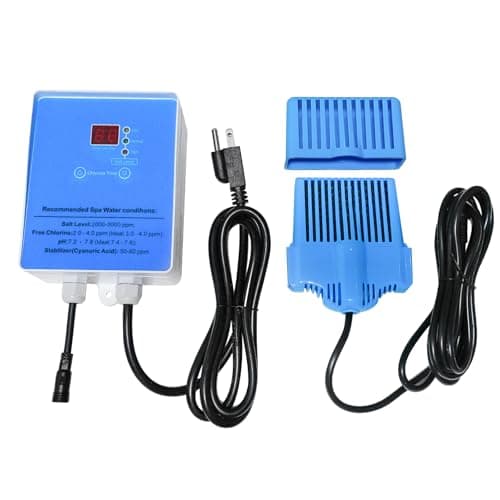 Xyarna drop-in salt chlorine generatorBy a wide margin the cheapest way into salt on this page, and its listing calls it a chlorine generator rather than chemical-free. Xyarna drop-in salt chlorine generatorBy a wide margin the cheapest way into salt on this page, and its listing calls it a chlorine generator rather than chemical-free. | Trying salt as cheaply as possible | 6.0out of 10 | $69.99 · View on Amazon#ad how this is funded · price as of October 18, 2026 |
Scores are our own, from the published scoring method on how we pick. They are an editorial judgment of published specifications, not a test result, and they are deliberately kept out of the page’s structured data.
The verdict, up front. A hot tub salt system is a chlorine generator. You dissolve ordinary salt in the water, and a cell uses electricity to turn some of it into chlorine. The water in your tub is chlorinated, with the same chlorine as the granules in a bucket.
That matters because almost every salt generator for sale calls itself “chemical-free.” It is not. Chlorine is a chemical, and so is the salt. What a salt system really changes is how the chlorine gets into the water, not whether it is there. If that is what you want, a salt system is a good buy. If you wanted to stop using chlorine, it will not do that.
This page is for people who have already decided on salt. If you are still choosing between salt, minerals and standard chlorine or bromine, start with salt vs mineral vs traditional, which covers that decision.
Before you buy anything: is your tub rated for salt?
Do this check first, before comparing any of the units below. Salt water is corrosive to some metals and some tub parts, and not every spa is built to take it. Adding salt to a tub that is not rated for it can damage the heater, and on some tubs it may affect the warranty.
Look in your owner’s manual or ask the manufacturer directly whether your model can run a salt system. We cannot answer this for you, because it depends on the specific tub. If the answer is no, none of the products on this page are right for you, however good they look.
What the cell actually does
Inside the cell are titanium plates. When the unit runs, a small electric current passes between them, and the salt in the water near the plates is split. Some of it becomes chlorine, which spreads through the tub and sanitizes the water just as added chlorine would.
Once that chlorine is used up, it turns back into salt. So the salt is mostly recycled rather than consumed, which is why you add salt far less often than you would add chlorine. That recycling is the genuine convenience, and it is real.
What people usually notice most is the feel. Many owners describe salt water as softer on the skin than a tub dosed by hand, and that is a large part of why they switch.
How we judged these
| Criterion | Why it matters |
|---|---|
| Publishes cell life | The cell wears out and costs money to replace. A unit that states its rated life lets you work out the real running cost. One that does not leaves you guessing. |
| Maintenance burden | Scale builds up on the cell plates. Self-cleaning and an easy cell swap cut down the chores salt creates. |
| Controls and feedback | A salt readout and adjustable output help you hold steady water. A bare timer gives you less to work with. |
| Sized for a hot tub | A rating of “up to 3,000 gallons” is a pool-sized ceiling. What counts is fit for a small, heavily used tub. |
| Value | Price against what you actually get, including the cost of replacing the cell later. |
One thing we deliberately did not score: the “chemical-free” label. It appears on almost every listing and is wrong on all of them, so it tells you nothing about which unit to choose.
The number that decides what salt costs you
Salt systems are often sold on saving money on chemicals. That saving is real, but it leaves out the cell. The titanium plates wear down with use and eventually need replacing, and a replacement cell is a meaningful expense.
So the most useful figure on any listing is the rated cell life, given in hours. One unit below states up to 3,000 hours. That sounds like a lot, but work it through: a cell that runs a few hours a day uses up 3,000 hours in roughly a year or two, not a decade. Treat that as arithmetic on the maker’s own claim, not a tested result.
When a listing does not state cell life at all, you cannot plan for the replacement. That is why “publishes cell life” carries real weight in our scores, and why a unit that hides the number scores lower on it.
Managing the salt level
Each system has its own target salt level, and they are not all the same. Use the figure in your unit’s manual rather than a number from a forum or from a different product. Running too little salt means the cell makes too little chlorine; running too much can be harder on the tub.
Salt does not evaporate. When water evaporates from the tub, the salt stays behind. Salt only leaves with water that physically leaves: splash-out, a partial drain, or a full water change. So you mainly top up salt after draining and refilling, not every week. The full water change routine is on draining and refilling.
Most units have some kind of salt indicator, but do not rely on it alone. A separate salt test gives you a reading that does not depend on the sensor inside the unit you are checking. When the indicator and the water disagree, the independent test is the one to trust. That is why a salt test kit is on this list.
Expect pH to creep up
Making chlorine this way tends to push pH upward over time. It is a normal side effect of how the cell works, not a sign that something is broken. Plan to test pH regularly and bring it down when it drifts.
This matters because chlorine gets weaker as pH rises. A salt tub sitting at the top of the pH range is getting less sanitizing out of the chlorine the cell is making. Keep alkalinity steady first, then correct pH, as covered in pH and total alkalinity.
A word on stabilizer in a covered tub
Some salt systems suggest adding cyanuric acid, the stabilizer that protects chlorine from sunlight. That advice comes from outdoor pools. A covered hot tub gets little sunlight, so the protection does little, but the stabilizer still builds up, and it only leaves when you drain.
Too much of it makes chlorine less effective at the level you read.[source] Whatever your unit suggests, test for cyanuric acid rather than assume, which the test kit below can do. The fuller explanation of why it accumulates is on chlorine tablets vs granules.
What does not change
Switching to salt changes how chlorine arrives. It does not change the standard your water has to meet. The targets are the same ones this site uses everywhere: at least 3 ppm free chlorine, with pH between 7.2 and 7.8.[source][source]
You still test the water. You still balance pH and alkalinity. And you still shock from time to time, because a salt cell makes chlorine steadily and can fall behind after a heavy soak. See shocking a hot tub for when and how.
What a salt system will not fix
- Biofilm in the plumbing. Growth inside the pipes is protected from the chlorine in the water. That needs a purge and a drain — see hot tub biofilm.
- A dirty filter. The cell sanitizes; it does not remove debris or oils. Keep cleaning the cartridge.
- Old water. Dissolved solids still build up, so water still needs changing on a schedule — how often to change hot tub water.
- Scale on the cell. Hard water leaves scale on the plates, which cuts output. Self-cleaning units help, but checking the cell is still part of the job.
Drop-in or built in?
Every unit on this page is a drop-in system: the cell sits in the tub and a controller mounts above it, with no plumbing work. That is the realistic option for most owners converting a tub they already have.
Some tubs are sold with a salt system built in by the manufacturer. If yours came that way, use the parts and salt level the manufacturer specifies rather than a universal drop-in unit.
On prices, and on what these scores are
Drop-in salt systems sit in the middle of hot tub spending: more than a season of chemicals up front, with a cell to replace later. Every button reads the live price where our price layer has one; anything we cannot verify, we do not print. The reasoning is on how we pick.
The scores are an editorial judgment of each listing’s published features, stated cell life and controls, against our published method. We have not tested these units. Every specification is the seller’s own claim, and savings percentages in particular are figures we cannot check. There is no rating markup anywhere in this page’s structured data.
The honest summary
Confirm your tub is rated for salt before anything else. Then choose a unit that tells you its cell life, because the cell is what really costs money over time. Keep a separate salt test on hand, expect pH to drift up, and keep testing chlorine the same way you always did. A salt system makes hot tub care easier and the water often softer. It does not make it chemical-free, and it does not remove the routine.
Every pick, in full
The picks in detail
Specifications below are the manufacturer’s own published figures, attributed as such. We have not tested these units and the scores are an editorial judgment of published data against the published method, not a test result.
#1 · Best for most tubs converting to salt
Briidea salt chlorine generator
Briidea · scored 7.8/10
Publishes its cell life, which is the single number that decides what salt really costs you.
The cell is the part that wears out, and replacing it is the recurring cost nobody quotes you up front. This listing states a rated life of up to 3,000 hours. That is the number to price against: a tub running the cell a few hours a day gets through that in a year or two, not a decade. Units that do not publish the figure leave you guessing at the one cost that matters.
It is a drop-in unit, so the cell sits in the water and the controller mounts above it with no plumbing work. A near-identical listing is sold under the Westaho name at the same price, describing the same US-made titanium cell and the same 3,000-hour rating. We found no published difference that would justify choosing one over the other. A WiFi version of this unit is also sold for a little more.
What the maker states
- Cell
- Titanium, US-made, per the listing
- Rated cell life
- Up to 3,000 hours, per the listing
- Rated for
- Hot tubs and swim spas up to 2,000 gal, per the listing
- Install
- Drop-in, no plumbing, per the listing
How it scored
- Maintenance burden
- 6.5
- Controls and feedback
- 7.5
- Publishes cell life
- 9.0
- Sized for a hot tub
- 8.5
- Value
- 7.5
Skip this one if: your tub maker has not approved salt. Check that before buying any unit on this page, because salt can cost you a heater.
#2 · Best for less cell maintenance
Zelinhol salt chlorine generator with OLED display
Zelinhol · scored 7.6/10
Self-cleaning cell and a tool-free swap, which go after the two real chores salt creates.
Scale building up on the cell plates is the main maintenance job with any salt system. Reversing polarity is the standard way to shed it, and this unit does it automatically, per its listing. The tool-free cell swap matters too, because the cell is a consumable you will replace more than once.
Two honest caveats. The listing quotes savings of 'up to 50%' and 'up to 80%' on maintenance costs, and those are the maker's own figures with nothing we can check them against. And it does not state a rated cell life in hours, which is the number we would most want before paying the highest price on this page.
What the maker states
- Cell cleaning
- Auto-reverse polarity, per the listing
- Cell replacement
- Quick-change, no tools, per the listing
- Output control
- 10 adjustable levels, per the listing
- Rated for
- Spas up to 2,500 gal, per the listing
How it scored
- Maintenance burden
- 9.5
- Controls and feedback
- 9.5
- Publishes cell life
- 5.0
- Sized for a hot tub
- 8.0
- Value
- 6.0
Skip this one if: you want to know the cell's rated life before buying. This listing does not state one in hours, and the savings percentages it quotes are its own claims.
#3 · Best for portable and inflatable tubs
XtremepowerUS saltwater chlorine generation system
XtremepowerUS · scored 6.8/10
A lower-cost unit from an established brand that names portable and inflatable tubs outright.
The useful detail here is fit. The listing names inflatable and portable hot tubs directly, which most salt units do not. If you own one of those and want salt, this is the one that says it was built with your tub in mind.
Read the gallon rating correctly. 'Up to 3,000 gallons' is a ceiling that suits a small pool; a hot tub is a fraction of that. The capacity number tells you nothing about how well it handles a small, heavily used tub. No cell life is published, so budget for replacement without knowing when it will come.
What the maker states
- Suited to
- Spas, cold plunges, inflatable and portable tubs, per the listing
- Run cycle
- Automatic, every 3 hours, per the listing
- Salt feedback
- LED salt-level indicator, per the listing
- Rated for
- Up to 3,000 gal, per the listing
How it scored
- Maintenance burden
- 6.5
- Controls and feedback
- 7.5
- Publishes cell life
- 4.0
- Sized for a hot tub
- 7.5
- Value
- 8.5
Skip this one if: you want to plan for cell replacement. No rated cell life is published, and 'up to 3,000 gallons' is a pool-sized ceiling, not a guide to hot tub fit.
#4 · Best for checking the salt yourself
AquaChek salt system test kit
AquaChek · scored 8.8/10
An independent salt reading, plus the chlorine and cyanuric acid readings salt users need anyway.
A salt generator's built-in salt indicator is a convenience, not a measurement you should bet a heater on. A separate salt titrator gives you a reading that does not depend on the sensor inside the unit you are checking, which is exactly what you want when the indicator and the water disagree.
The 4-way strips earn their place too. They read cyanuric acid, which most spa strips do not, and CYA matters here: salt systems are often paired with stabilizer, and in a covered tub it builds up with nowhere to go. Note that the salt titrators are few per kit, so this is a periodic check, not a daily one.
What the maker states
- Salt strips
- White titrators, 400 to 7,000 ppm, per the listing
- 4-way strips
- Free chlorine, pH, alkalinity, cyanuric acid, per the listing
- Contents
- 10 salt titrators, 25 4-way strips, per the listing
- Sold for
- Pools and spas, per the listing
How it scored
- Reads what salt users need
- 9.0
- Independent of the unit
- 9.5
- Ease of use
- 8.5
- Cost
- 8.0
- Availability
- 9.0
Skip this one if: you already own strips that read cyanuric acid and a separate salt test. Then this duplicates what you have.
#5 · Best for trying salt as cheaply as possible
Xyarna drop-in salt chlorine generator
Xyarna · scored 6.0/10
By a wide margin the cheapest way into salt on this page, and its listing calls it a chlorine generator rather than chemical-free.
The cheapest generator here by a long way, at roughly half what the next unit up costs, and it is sized honestly for a hot tub rather than borrowed from a pool. Its listing also describes it as a salt chlorine generator, which is what it is. That is worth noting on a page about honest buying, because a competing drop-in listing in the same search puts chemical-free right in its title for a device whose entire job is making chlorine.
The trade-off is that you are told almost nothing. The listing states no salinity readout, no cell life and no control detail, so you will be relying entirely on separate test strips to know your salt level and you have no published basis for guessing when the cell wears out. That is workable at this price, but it means the strips below are not optional with this unit.
What the maker states
- Type
- Drop-in conversion kit, per the listing
- Rated for
- Up to 2,000 gallons, per the listing
- Salt feedback
- None stated in the listing
- Rated cell life
- Not stated in the listing
How it scored
- Maintenance burden
- 5.5
- Controls and feedback
- 4.5
- Publishes cell life
- 3.0
- Sized for a hot tub
- 8.0
- Value
- 9.0
Skip this one if: you want to see your salt level. The listing names no salinity readout and no cell life, so test strips do the job the unit will not.
Questions people actually ask
Frequently asked questions
Is a hot tub salt water system chemical-free?
No. A salt system is a chlorine generator. The cell uses electricity to turn dissolved salt into chlorine, so the water is chlorinated. Listings that say chemical-free are wrong. What changes is how the chlorine gets into the water, not whether it is there.
Can I put a salt system in any hot tub?
Not necessarily. Salt water is corrosive to some metals and parts, and not every tub is rated for it. Adding salt to the wrong tub can damage the heater and may affect the warranty. Check your owner’s manual or ask the manufacturer before buying a unit.
Do you still need to test the water with a salt system?
Yes. You still hold at least 3 ppm free chlorine and pH between 7.2 and 7.8, you still balance alkalinity, and you still shock after heavy use. You also test the salt level, ideally with a separate kit rather than relying on the unit’s own indicator.
How long does a hot tub salt cell last?
It depends on the unit and how many hours it runs. One listing states up to 3,000 hours. Run a few hours a day, that is roughly a year or two of use, based on the maker’s own figure. Many listings do not state a cell life at all, so check before you buy.
Why does pH keep rising in a salt water hot tub?
Making chlorine with a salt cell tends to push pH up over time. It is a normal side effect, not a fault. Keep alkalinity steady first, then bring pH down when it drifts, because chlorine works less well as pH climbs.
Where the numbers come from
Sources
- CDC, Model Aquatic Health Code (2023, 4th edition) - the source for the pH 7.2-7.8 range and the hot-tub disinfectant levels quoted on this site
- CDC, Preventing Hot Tub Rash - the source for the 4-8 ppm bromine figure, the prevention steps, and the guidance on when to see a healthcare provider
- PHTA, Find a Standard - the index confirming which ANSI standard actually covers water quality in public pools and hot tubs or spas
Read next
Related on Float & Filter
- Salt water vs mineral vs traditional sanitizing
The decision to make before buying any salt system.
- Hot tub pH and total alkalinity
Why salt systems push pH up, and what to correct first.
- Hot tub chlorine and bromine levels
The chlorine target a salt cell still has to hit.
- The best hot tub test strips and test kits
Testing does not stop when you switch to salt.