Reference
Hot Tub Chemical Dosage and Levels Chart
The numbers to aim for, where each one comes from, and how to turn a label instruction into a dose for your actual tub.
By Scooter M. · Updated · How we pick

How this page is funded: the buy buttons below are Amazon affiliate links. If you buy through one we earn a commission at no extra cost to you. It does not change what we recommend, and where the better answer is a retailer we earn nothing from, we say so. The full version.
The target ranges
| Reading | Target | Where the number comes from | Check |
|---|---|---|---|
| pH | 7.2 - 7.8 | CDC, for pools and hot tubs[source] | Weekly |
| Free chlorine | At least 3 ppm | CDC, hot tub figure (higher than the 1 ppm pool figure)[source] | Weekly and after use |
| Bromine | 4 - 8 ppm | CDC, hot tub rash prevention guidance[source] | Weekly |
| Total alkalinity | 80 - 120 ppm | Industry consensus; the ANSI reference for spa water is the public pools and hot tubs standard[source] | Weekly |
| Calcium hardness | 150 - 250 ppm (acrylic spa) | Industry consensus | At fill, then occasionally |
| Cyanuric acid | Keep low; rises with every dichlor dose | Accumulates and blunts chlorine; only removable by draining | Mid-cycle, reagent kit only |
| Water temperature | Manufacturer maximum, commonly 104F | Tub manual | Continuously |
Two of those rows deserve a note. The CDC gives at least 3 ppm free chlorine in hot tubs, higher than the pool figure, because heat consumes chlorine faster and the bather load per gallon in a spa is far greater.[source] And the ANSI standard people quote for spa water is frequently the wrong one: ANSI/APSP/ICC-5 covers residential inground swimming pools.[source]
Why there is no universal dose-per-gallon table here
Because publishing one would be making up numbers. Dosing depends on the concentration of the specific product in your hand, and concentrations differ between brands and between products within a brand. A table saying "add one tablespoon of alkalinity increaser per 100 gallons" looks authoritative and is wrong for roughly half the products on the shelf.
What we can give you is the method for using the label correctly, which works for every product and does not go stale.
Step 1: know your actual volume
Look it up in the tub manual first; the manufacturer’s figure is the right one. If you do not have it, estimate:
- Square or rectangular: length x width x average depth in feet, x 7.5 = gallons. Use average depth, because the footwell is deeper than the seats.
- Round: radius x radius x 3.14 x average depth in feet, x 7.5 = gallons.
Then reduce your estimate by roughly a fifth to account for seats, molding and the space bodies displace. A tub whose footprint suggests 450 gallons is often closer to 350 in practice. Over-estimating volume means over-dosing every single time.
Step 2: dose to the low end, then retest
Every correction on this page is easier to make twice than to undo once. Calculate the dose the label gives for your volume, add somewhere between half and three quarters of it, run the jets for a full circulation cycle, and retest before adding more.
Calcium hardness is the extreme case: there is no calcium reducer, so an over-correction can only be fixed by draining. Total alkalinity is the second worst, because lowering it takes acid plus aeration plus patience.
Step 3: fix them in the right order
Alkalinity, then pH, then hardness, then sanitizer, then shock. Alkalinity first because it buffers pH; get that wrong and every subsequent pH correction unwinds itself over the following week.
The weekly version
| Reading says | Do this | Then |
|---|---|---|
| Sanitizer low | Dose sanitizer to the label | Retest before use |
| pH high, alkalinity in range | Add dry acid, half dose | Run a cycle, retest |
| pH low, alkalinity low | Raise alkalinity first | Retest pH; it often corrects itself |
| pH will not stay put | Stop adjusting pH. Read alkalinity. | Raise TA into 80-120 ppm |
| Total chlorine well above free | Shock. That gap is combined chloramines. | Retest after the label wait |
| Everything in range, water still dull | Clean the filter, then shock | See cloudy water |
Print this or screenshot it. It is the version of this page that actually gets used, and it lives permanently at the top of the maintenance schedule as well, which is not gated behind an email form either.
What fixes it
The products for this job
Named because they do the specific job this page describes, not because they are the only options. Specifications are the manufacturer’s published figures.
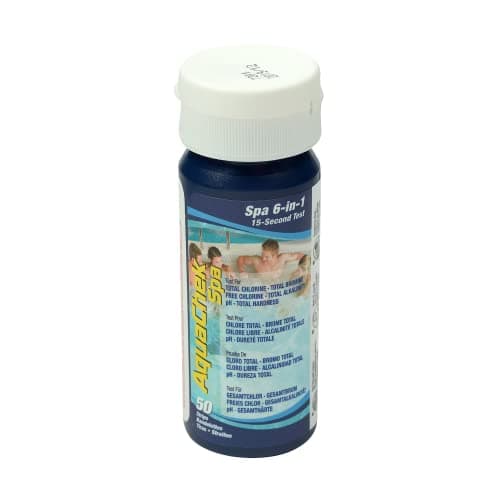
#1 · Best for the weekly check
AquaChek Spa 6-in-1 Test Strips
AquaChek · scored 8.4/10
Six readings in fifteen seconds. Not precise, but precise enough to catch drift early.
Strips get an unfair reputation because people compare them to a reagent kit and call them inaccurate. That is the wrong comparison. The right one is against not testing at all, which is what happens when the routine takes ten minutes. A strip you actually use weekly beats a reference kit in a cupboard.
Two habits make strips far more reliable: keep the container sealed and out of the humid room the tub is in, and read them in daylight rather than under a yellow bulb. Most strip complaints trace back to one of those two.
What the maker states
- Reads
- Hardness, total chlorine, free chlorine, bromine, pH, alkalinity
- Method
- Dip-and-read colorimetric strip
- Time
- Seconds, per the label
- Storage
- Sealed container, away from humidity
How it scored
- Accuracy
- 6.5
- Speed
- 10.0
- Parameters covered
- 9.0
- Cost per test
- 9.0
- Availability
- 9.5
Skip this one if: you need an exact free chlorine number to diagnose a problem. Strips read in color bands; a drop-based kit reads in numbers.
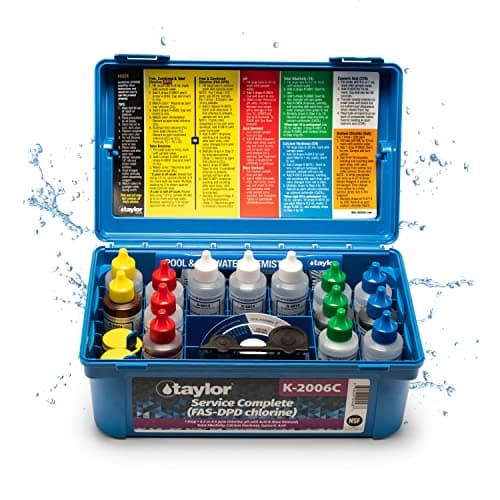
#2 · Best for getting a real number
Taylor K-2006C FAS-DPD Complete Test Kit
Taylor Technologies · scored 8.4/10
The reference kit. Overkill for a weekly check, decisive when something is wrong.
When a tub is misbehaving and the strips insist everything is fine, this settles the argument. FAS-DPD titration gives free and combined chlorine as separate numbers rather than a color band, and it reads cyanuric acid, which is often the invisible reason a chlorine tub feels under-sanitized.
It is a chlorine kit. Bromine owners who want the same rigor want the bromine variant instead. Either way, buy replacement reagents rather than a whole new kit when they expire.
What the maker states
- Method
- FAS-DPD titration for free and combined chlorine
- Also reads
- pH, alkalinity, calcium hardness, cyanuric acid
- Resolution
- 0.2 or 0.5 ppm by sample size, per the manual
- Reagents
- Replaceable, dated
How it scored
- Accuracy
- 9.8
- Speed
- 4.0
- Parameters covered
- 9.5
- Cost per test
- 6.5
- Availability
- 8.5
Skip this one if: you want a fast routine test. This takes minutes and uses reagents that expire; it is a diagnostic tool, not a daily one.
Questions people actually ask
Frequently asked questions
What should hot tub chemical levels be?
pH 7.2 to 7.8 and at least 3 ppm free chlorine, both per CDC guidance for hot tubs. Total alkalinity 80 to 120 ppm and calcium hardness 150 to 250 ppm in an acrylic spa are industry consensus ranges. Bromine users target 4 to 8 ppm, which the CDC publishes in its hot tub rash prevention guidance.
How much chemical do I add to a hot tub?
Whatever the specific product label says for your volume, dosed at half to three quarters of that figure first, then retested after a full circulation cycle. Concentrations differ between products, so there is no universal dose-per-gallon figure that is true for all of them.
How do I work out my hot tub volume?
Use the manual figure if you have it. Otherwise, for a rectangular tub, multiply length by width by average depth in feet and multiply by 7.5, then reduce the result by about a fifth to allow for seats and molding. Over-estimating volume means over-dosing every time.
Why does my pH keep going up?
Usually because total alkalinity is out of range, so nothing is buffering the pH. Aeration from the jets also drives pH up over time. Fix alkalinity into 80 to 120 ppm first and the pH will usually settle without further intervention.
Where the numbers come from
Sources
- CDC, Model Aquatic Health Code (2023, 4th edition) - the source for the pH 7.2-7.8 range and the hot-tub disinfectant levels quoted on this site
- CDC, Preventing Hot Tub Rash - the source for the 4-8 ppm bromine figure, the prevention steps, and the guidance on when to see a healthcare provider
- PHTA, Find a Standard - the index confirming which ANSI standard actually covers water quality in public pools and hot tubs or spas
- ANSI webstore, ANSI/APSP/ICC 5-2011 - scope confirms it covers residential INGROUND SWIMMING POOLS, which is why we do not cite it for spa water
- CDC, Controlling Legionella in Hot Tubs - the primary reference for the health and disinfection guidance quoted here
Read next
Related on Float & Filter
- Hot tub pH and total alkalinity
The two readings that move most, and what to do about each.
- The best hot tub test strips and test kits
How to get the readings this chart interprets.
- Hot tub calcium hardness
The one number you cannot bring back down.
- The hot tub maintenance schedule
When to take each reading, as a printable table.
- Hot tub chlorine and bromine levels
The sanitizer rows of this chart, in full.
- Are digital hot tub water testers worth it?
Whether a photometer is worth it for reading these numbers.
- The best hot tub alkalinity increasers
Choosing the container, including the pool size that costs less per pound.
- The best hot tub pH increasers
Which container of soda ash to buy once the chart says you need some.