Finder
Hot Tub Cover Size Guide: How to Measure
A custom cover made to a wrong number is not returnable in any useful sense. This is the highest-stakes ten minutes in hot tub ownership.
By Scooter M. · Published · How we pick

How this page is funded: the buy buttons below are Amazon affiliate links. If you buy through one we earn a commission at no extra cost to you. It does not change what we recommend, and where the better answer is a retailer we earn nothing from, we say so. The full version.
Five numbers decide whether a replacement cover seals: length, width, corner radius, skirt depth and fold direction. Take all five, take them twice, and write them down before you go near a checkout. A custom cover is made to your figures, so a wrong figure is a wrong cover with no useful route back.
1. Length and width
Measure the outside of the tub cabinet, at the widest point, not the water surface and not the acrylic rim. The cover has to overhang the shell to seal against the top edge, and every maker sizes from the cabinet for that reason.
Take both measurements at the outer lip, from edge to edge, with the tape flat rather than following any curve. If the two long sides differ by more than a fraction, measure again: tubs are usually square and tape measures usually are not held straight.
2. Corner radius
This is the one people guess, and a guessed radius produces a cover that will not seal along two edges. There is a simple way to get it right without any specialist tool.
- Lay a large sheet of paper or card over one corner of the tub.
- Trace the curve of the cabinet corner onto it.
- Cut along the traced line and check the cut edge sits flush against the corner all the way round.
- Measure from the point where the curve begins to the imaginary square corner. That distance is the radius.
Common radii cluster around a handful of values, and most makers ask you to pick from a list. If yours falls between two, the cut-card template tells you which side to round to. Do not average them.
3. Skirt depth
The skirt is the flap that hangs down the outside of the cabinet, and it is what stops wind getting under the cover and what completes the seal. Measure how far down the side you want it to hang, typically a few inches.
Too short and the cover sits on top rather than over, and it will lift. Too long and it fouls the cabinet trim or the lifter brackets. If you have a lifter, check its clearance before choosing.
4. Fold direction
Covers fold along a hinge across the middle, and the fold runs either along the length or across the width. That decision determines which side the cover opens toward, which has to match where your lifter is mounted and where you have space.
Stand at the tub and decide which side you want to fold it toward, then specify the hinge running perpendicular to that direction. Getting this wrong is not fatal — the cover still fits — but it means opening it toward a wall for the next several years.
5. Taper and thickness
Not strictly a measurement, but a specification you choose. The taper is the difference in thickness between the middle of the cover and its edges, and it exists so water runs off rather than pooling. A common specification is a taper of about an inch across the panel.
Thicker covers insulate better and weigh more. If a lifter is already fitted, check its rating before ordering the thickest option available, because a heavier cover on a marginal lifter is how brackets bend.
A checklist to take outside
| Measurement | Where exactly | Common mistake |
|---|---|---|
| Length | Outside of the cabinet, widest point | Measuring the acrylic rim or the water |
| Width | Outside of the cabinet, widest point | Following a curve rather than going straight across |
| Corner radius | Where the curve starts to the square corner | Guessing instead of templating |
| Skirt depth | Down the cabinet side from the top edge | Ignoring lifter bracket clearance |
| Fold direction | Which way you want it to open | Not checking against the lifter position |
Where to buy, honestly
Genuinely custom-fit covers are sold direct by specialist makers, not on general marketplaces. We are not in any of their affiliate programs, so we earn nothing from pointing you there, and we are pointing you there anyway because a universal cover will not do this job. Get two quotes and compare on foam density, taper and vapor barrier rather than on headline price.
If your cover is not actually finished — if the vinyl is intact and only the foam is heavy — a foam core replacement may be the cheaper answer, and replace or repair works that decision through before you spend on a full cover.
Why the fit matters beyond neatness
Most heat leaves a hot tub as evaporation off the water surface. A cover that does not seal against the rim leaves a gap for that vapor to escape, and the cost shows up on the electricity bill rather than anywhere visible. A cover that seals is also a barrier over water held at spa temperature,[source] which is a safety consideration as well as an energy one.
What fixes it
The products for this job
Named because they do the specific job this page describes, not because they are the only options. Specifications are the manufacturer’s published figures.
#1 · Best for actually replacing a dead cover
Custom-fit replacement cover (The Cover Guy)
The Cover Guy · scored 8.5/10
Genuinely not available on Amazon. If you need a real replacement, this is where you go.
This is the honest answer to the most expensive question in the category, and we earn nothing for giving it. Genuinely custom-fit replacement covers are made to order from your measurements, and general marketplaces do not sell them.
Before ordering, read the size guide and take every measurement twice, including the corner radius and the skirt depth. A custom cover made to a wrong number is not returnable in any useful sense.
What the maker states
- Type
- Custom-fit tapered foam cover
- Ordering
- By measured dimensions, radius and skirt
- Lead time
- Made to order
- Our commission
- None. We are not in their affiliate program.
How it scored
- Weather protection
- 9.0
- Heat retention
- 9.5
- Fit accuracy
- 9.5
- Durability
- 8.5
- Value
- 6.0
Skip this one if: your cover is one season old and only looks tired. Conditioning and a cap are far cheaper than a custom cover.
#2 · Best for a second custom quote
Custom-fit replacement cover (My Spa Cover)
My Spa Cover · scored 8.4/10
Worth pricing against the other custom makers. Same category, same commission for us: none.
Custom cover pricing moves around considerably for what is essentially the same construction, so getting a second quote is worth the ten minutes. Specification differences worth asking about are foam density, taper and the vapor barrier.
We list two makers rather than one precisely because we earn nothing either way, so there is no reason for us to steer you.
What the maker states
- Type
- Custom-fit tapered foam cover
- Ordering
- By measured dimensions
- Lead time
- Made to order
- Our commission
- None. We are not in their affiliate program.
How it scored
- Weather protection
- 9.0
- Heat retention
- 9.5
- Fit accuracy
- 9.0
- Durability
- 8.5
- Value
- 6.5
Skip this one if: you have already got a quote you are happy with. Custom covers vary less than the prices do.
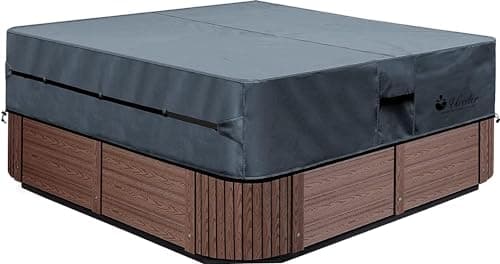
#3 · Best for extending a hard cover's life
Hot tub cover cap
Generic · scored 7.2/10
The cheapest thing on this page and, per dollar, the most effective.
Vinyl hard covers fail two ways: UV cracks the top skin, then water gets into the foam and the cover gets heavy. A cap addresses the first cause, which is what makes it cheap prevention against an expensive replacement.
It buys time; it does not reverse damage. A cover already saturated with water needs a new foam core or a new cover, and no cap will help.
What the maker states
- Type
- Slip-over cap for a hard cover
- Purpose
- Blocks UV and sheds standing water
- Fixing
- Elasticated skirt or straps
- Sizing
- By hard cover dimensions
How it scored
- Weather protection
- 8.0
- Heat retention
- 1.5
- Fit accuracy
- 7.0
- Durability
- 6.5
- Value
- 9.5
Skip this one if: you take the cover off daily. A cap that has to come off and go back on every evening will end up in the corner of the yard by March.
Questions people actually ask
Frequently asked questions
How do you measure a hot tub for a new cover?
Measure the outside of the cabinet at its widest point for length and width, template the corner radius with a piece of card, decide the skirt depth down the cabinet side, and choose the fold direction to match where your lifter is and where you have space. Take every figure twice.
Do you measure a hot tub cover from the shell or the cabinet?
The cabinet. The cover has to overhang the shell to seal against the top edge, so every maker sizes from the outside of the cabinet, not from the acrylic rim and definitely not from the water surface.
How do I find my hot tub cover corner radius?
Lay card over a corner, trace the cabinet curve, cut along the line and check it sits flush. Then measure from where the curve begins to the imaginary square corner. That distance is the radius, and templating it beats guessing every time.
What thickness should a hot tub cover be?
Thicker insulates better and weighs more. The important specification alongside thickness is the taper, typically about an inch across the panel, which is what makes water run off instead of pooling. If a lifter is fitted, check its rating before ordering the thickest option.
Can I buy a made-to-measure hot tub cover online?
Yes, direct from specialist makers who build to your measurements. General marketplaces sell universal and semi-fitted weather covers rather than custom tapered foam covers, so a real replacement means buying direct.
Where the numbers come from
Sources
Read next
Related on Float & Filter
- The best hot tub covers
What to buy once you have the five numbers.
- Replace or repair a waterlogged cover
Check whether you need a whole cover before ordering one.
- The best hot tub cover lifters
Fold direction and skirt depth both depend on the lifter.
- What hot tub maintenance actually costs
Why a sealing cover is the biggest lever on the bill.