Reference
The Hot Tub Maintenance Schedule
The whole routine as a table you can print and tape inside the cabinet door. There is no email form in front of it, and there never will be.
By Scooter M. · Updated · How we pick

How this page is funded: the buy buttons below are Amazon affiliate links. If you buy through one we earn a commission at no extra cost to you. It does not change what we recommend, and where the better answer is a retailer we earn nothing from, we say so. The full version.
Fifteen minutes a week keeps a hot tub in a state where nothing ever goes badly wrong. Three weeks of nothing followed by a panicked afternoon of chemicals produces water that is technically in range and still unpleasant. The routine is the product; the individual bottles are just tools.
Print this page or screenshot the two tables. It is deliberately not behind an email capture, because a checklist you have to give an address for is a lead magnet rather than a resource.
The schedule
| When | Job | Why | Time |
|---|---|---|---|
| Every use | Check the temperature and give the water a look | Catches problems while they are small | Seconds |
| Every use | Replace the cover properly and latch it | Heat retention and the safety barrier | Seconds |
| Weekly | Test sanitizer, pH and total alkalinity | All three move week to week | 1 min |
| Weekly | Correct anything out of range | Small corrections beat large ones | 5 min |
| Weekly | Shock, and after any heavy use | Oxidizes the organic load | 5 min |
| Weekly | Rinse the filter cartridge | Clears debris from between the pleats | 3 min |
| Weekly | Check the floater or feeder is not empty | An empty floater is how sanitizer reaches zero | Seconds |
| Monthly | Chemical soak of the filter | Removes the oils a rinse cannot | 10 min plus a soak |
| Monthly | Wipe the waterline | Scum ring is the visible edge of the organic load | 5 min |
| Monthly | Check calcium hardness | Drifts up as you top up after evaporation | 1 min |
| Quarterly | Purge the plumbing, then drain | Biofilm lives where no treatment reaches | An hour, plus draining |
| Quarterly | Clean the empty shell and jet faces, and vacuum out any settled grit | The only time you have access | 20 min |
| Quarterly | Refill and rebalance from scratch | Fresh water, correct sequence | An evening |
| Quarterly | Clean and condition the cover | UV is what kills covers | 15 min |
| Annually | Replace the filter cartridge | Media fatigue is not fixable by cleaning | 2 min |
| Annually | Inspect the cover for cracks and weight | Catches the failure chain at step one | 5 min |
The numbers to check against
| Reading | Target | Source |
|---|---|---|
| pH | 7.2 - 7.8 | CDC[source] |
| Free chlorine | At least 3 ppm | CDC, hot tub figure[source] |
| Bromine | 4 - 8 ppm | CDC, hot tub rash prevention[source] |
| Total alkalinity | 80 - 120 ppm | Industry consensus[source] |
| Calcium hardness | 150 - 250 ppm | Industry consensus, acrylic spa |
Those two tables together are the entire reference. Everything else on this site is an expansion of one row of one of them.
The weekly fifteen minutes, in order
- Lift the cover, look at the water, note anything different.
- Dip a test strip. Read it in daylight, not under a yellow bulb.
- Correct alkalinity first if it is out, then pH, then sanitizer.
- Check the floater or feeder has tablets in it.
- Shock if the tub has been used since the last one.
- Pull the cartridge and rinse it while the shock circulates.
- Refit, replace the cover, latch it.
Doing them in that order matters for one reason: alkalinity buffers pH, so correcting pH first means correcting it again next week. The reasoning is on pH and total alkalinity.
Adjusting the schedule to your tub
Heavy use. Shock after each busy session rather than weekly, and expect the water change interval to shorten. The formula for that is on how often to change hot tub water.
Light or seasonal use. Keep testing weekly. Sanitizer decays whether or not anyone is in the water, and the CDC’s guidance on maintaining disinfectant does not have a bather-number exemption.[source]
Bromine rather than chlorine. The cadence is the same; the weekly shock does more, because non-chlorine shock also reactivates spent bromide. See shocking a hot tub.
Hard or well water. Add a hardness check at every top up rather than monthly, and consider filling through a pre-filter.
What to keep on the shelf
Sanitizer, non-chlorine shock, alkalinity increaser, a pH adjuster, test strips, filter cleaner. That is the whole standing inventory for this schedule, and the reasoning for each is on what chemicals you actually need. Everything else is bought when a test says to buy it.
What fixes it
The products for this job
Named because they do the specific job this page describes, not because they are the only options. Specifications are the manufacturer’s published figures.
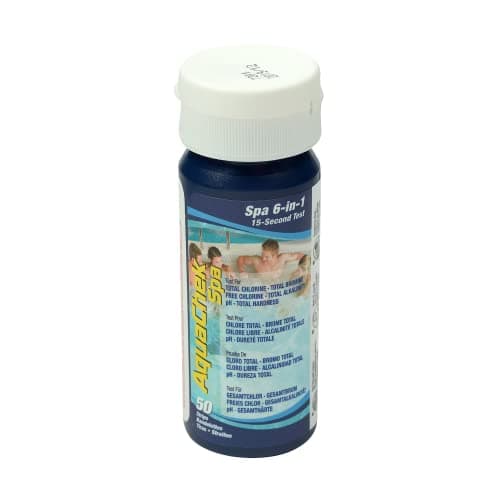
#1 · Best for the weekly check
AquaChek Spa 6-in-1 Test Strips
AquaChek · scored 8.4/10
Six readings in fifteen seconds. Not precise, but precise enough to catch drift early.
Strips get an unfair reputation because people compare them to a reagent kit and call them inaccurate. That is the wrong comparison. The right one is against not testing at all, which is what happens when the routine takes ten minutes. A strip you actually use weekly beats a reference kit in a cupboard.
Two habits make strips far more reliable: keep the container sealed and out of the humid room the tub is in, and read them in daylight rather than under a yellow bulb. Most strip complaints trace back to one of those two.
What the maker states
- Reads
- Hardness, total chlorine, free chlorine, bromine, pH, alkalinity
- Method
- Dip-and-read colorimetric strip
- Time
- Seconds, per the label
- Storage
- Sealed container, away from humidity
How it scored
- Accuracy
- 6.5
- Speed
- 10.0
- Parameters covered
- 9.0
- Cost per test
- 9.0
- Availability
- 9.5
Skip this one if: you need an exact free chlorine number to diagnose a problem. Strips read in color bands; a drop-based kit reads in numbers.
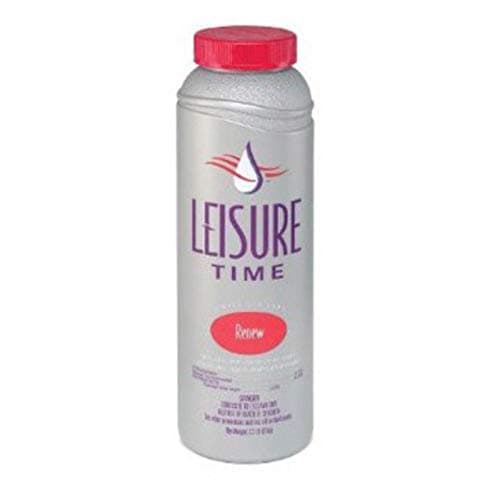
#2 · Best for the weekly oxidize
Leisure Time Renew Non-Chlorine Shock
Leisure Time · scored 8.6/10
The shock you can use and get back in the water quickly. Oxidizes; does not sanitize.
Non-chlorine shock does one job well: it oxidizes the organic load a soak leaves behind, which is what turns water dull and gives it that flat, used smell. On a bromine tub it does a second job for free, converting spent bromide back into active bromine.
Understand what it is not. MPS is an oxidizer, not a sanitizer. If the problem is biological rather than organic, this will not fix it and the tub will stay exactly as cloudy as it was.
What the maker states
- Chemistry
- Potassium monopersulfate (MPS)
- Job
- Oxidizes body oils, lotions and sweat
- Reactivates bromine
- Yes, on a bromine tub
- Wait before soaking
- Per the label, typically about 15 minutes
How it scored
- Oxidizing power
- 8.0
- Ease of dosing
- 9.5
- Odor and skin feel
- 9.0
- Cost per month
- 8.0
- Availability
- 9.0
Skip this one if: you are dealing with an actual contamination event. MPS burns off organics, it does not kill what a chlorine shock kills, and reaching for it instead is a common reason a cloudy tub stays cloudy.
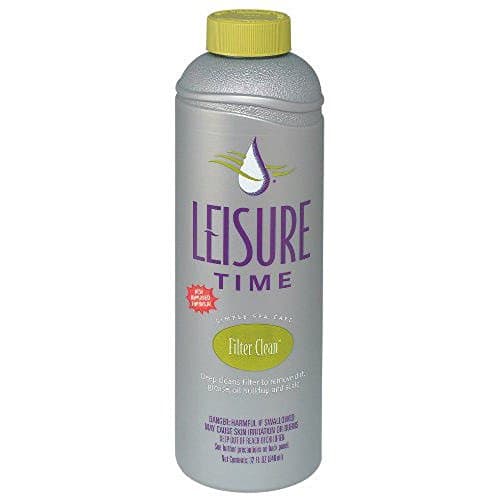
#3 · Best for the monthly deep clean
Leisure Time Filter Clean
Leisure Time · scored 8.4/10
A proper cartridge cleaner, which is a different product from a rinse.
The reason a rinsed filter still restricts flow is that the load is oil, not grit, and water does not remove oil. A dedicated cartridge cleaner is a surfactant designed to release exactly that, and the difference in flow after a proper soak is obvious at the jets.
Rinse harder afterwards than you think you need to. Cleaner left in the pleats goes straight into your water and is a very common cause of foaming that owners then blame on the tub.
What the maker states
- Format
- Concentrate for soaking
- Targets
- Body oils, lotions, light scale
- Soak time
- Per the label, commonly overnight
- Rinse
- Thoroughly, before refitting
How it scored
- Oil removal
- 9.0
- Scale removal
- 7.5
- Ease of use
- 8.0
- Cost per clean
- 8.0
- Availability
- 9.0
Skip this one if: your filter is only ever lightly loaded. A hose rinse handles surface debris; this is for the oils a rinse cannot shift.
Questions people actually ask
Frequently asked questions
What is the weekly hot tub maintenance routine?
Test sanitizer, pH and total alkalinity; correct anything out of range, starting with alkalinity; check the floater has tablets in it; shock if the tub has been used; and rinse the filter cartridge. About fifteen minutes in total.
How often should you shock a hot tub?
Weekly as a default, and after any heavy use. The schedule should follow bather load rather than the calendar, because four people on a Saturday leave far more organic load than one person twice in the week.
What should you do monthly to a hot tub?
Chemically soak the filter cartridge rather than just rinsing it, wipe the waterline, and check calcium hardness, which drifts up as you top up after evaporation.
Is there a printable hot tub maintenance checklist?
This page is it. Print it or screenshot the two tables, which cover the schedule and the target ranges. There is no email form in front of it and no download to request.
What hot tub maintenance is needed daily?
Almost none. Check the temperature and give the water a look each time you use it, and replace and latch the cover properly afterwards. The real work is weekly.
Where the numbers come from
Sources
- CDC, Model Aquatic Health Code (2023, 4th edition) - the source for the pH 7.2-7.8 range and the hot-tub disinfectant levels quoted on this site
- CDC, Preventing Hot Tub Rash - the source for the 4-8 ppm bromine figure, the prevention steps, and the guidance on when to see a healthcare provider
- CDC, Controlling Legionella in Hot Tubs - the primary reference for the health and disinfection guidance quoted here
- PHTA, Find a Standard - the index confirming which ANSI standard actually covers water quality in public pools and hot tubs or spas
Read next
Related on Float & Filter
- Hot tub chemical dosage and levels chart
The quantities behind the weekly corrections.
- How often to change hot tub water
Setting the quarterly interval for your tub.
- How to clean a hot tub filter
The weekly rinse and the monthly soak, in detail.
- What hot tub chemicals do you actually need?
The standing inventory this schedule assumes.
- Hot tub winter care
How the routine changes when it gets cold.
- The best hot tub cleaning tools and kits
The physical tools behind the weekly skim and waterline wipe.