Guide
Hot Tub Chlorine and Bromine Levels
The CDC gives at least 3 ppm free chlorine in a hot tub, three times the pool figure. Heat is the reason, and it explains almost everything else on this page.
By Scooter M. · Published · How we pick
How this page is funded: the buy buttons below are Amazon affiliate links. If you buy through one we earn a commission at no extra cost to you. It does not change what we recommend, and where the better answer is a retailer we earn nothing from, we say so. The full version.
The CDC specifies at least 3 ppm free chlorine in a hot tub, against 1 ppm for a swimming pool, alongside a pH range of 7.2 to 7.8.[source] That three-fold difference is the most useful fact on this page, and almost everything else here follows from it.
For bromine the CDC gives 4 to 8 ppm, published in its hot tub rash prevention guidance rather than in the Model Aquatic Health Code.[source] Product labels commonly print a slightly wider 3 to 8 ppm band; where the two differ we use the CDC figure and say so.
Why a hot tub needs so much more than a pool
Three things stack up, and they all pull the same direction.
- Heat. Sanitizer is consumed faster at 102F than at 80F, and chlorine in particular dissipates quickly at spa temperatures.
- Bather load per gallon. Four people in a 400-gallon tub is a density a swimming pool never approaches. Everything those four people bring in is diluted into a fraction of the water.
- Agitation. Jets drive off sanitizer and strip carbon dioxide, which pushes pH up, which in turn makes chlorine less effective.
The practical consequence: a hot tub left alone for a week is very often a hot tub with no sanitizer left in it, and holding a residual is the core of the CDC’s guidance on controlling Legionella in hot tubs.[source]
Free, combined and total — the distinction that matters
| Reading | What it is | What to do about it |
|---|---|---|
| Free chlorine | Sanitizer still available to do work | This is the number you dose against |
| Combined chlorine | Spent chlorine bound to organics (chloramines) | Shock. Do not add more sanitizer. |
| Total chlorine | Free plus combined | Only useful alongside the free reading |
| Total bromine | Bromine is measured as one figure; spent bromide reactivates on shocking | Dose to 4-8 ppm, shock weekly |
If total reads well above free, that gap is your chloramine load. It is also what people are smelling when they say the tub smells “too chlorinated”, and the fix is the opposite of what the smell suggests: shock it. That is worked through on shocking a hot tub.
Which reading are you looking at?
Reading is low or zero
The most common state, and the one that matters. Check the floater or feeder has tablets in it before anything else — an empty dispenser is the single most frequent cause and costs nothing to rule out.
Then dose to the label for your volume, run the jets, and retest after a full circulation cycle rather than immediately. If the reading is still low the next day with the tub unused, you have demand rather than a dosing problem: something is consuming it. That is usually a heavy organic load, or biofilm in the plumbing.
Reading is high
Do not get in. The MAHC sets a maximum free chlorine concentration for water that is open to bathers, and a tub well above the target band needs time rather than intervention.[source]
Close the floater collar down, take the cover off, and run the jets. Sanitizer falls on its own, and aeration with the cover off speeds it up considerably. Retest before anyone gets in. If it got high because the collar was wide open, that is a dispenser setting problem — see the floating dispenser roundup.
Reading will not hold between tests
Three candidate causes, in the order worth checking:
- pH is high. Chlorine loses effectiveness as pH climbs, so the same measured number does less work. Fix pH and alkalinity first.
- Cyanuric acid has accumulated. Every dose of stabilized chlorine adds CYA, which never leaves except by draining and progressively blunts the chlorine you add. No strip reads it; a reagent kit does.
- Biofilm is eating it. A tub that consumes sanitizer with no bathers to explain it is usually feeding something in the pipework. See hot tub biofilm.
Reading looks fine but the water does not
Check you are reading the right scale. Bromine and chlorine are measured by the same reaction, and a chlorine strip used on a bromine tub needs multiplying by roughly 2.25 — skip that and you chronically under-dose while believing you are in range. Buy the strip that matches your chemistry; the test strip roundup covers which is which.
How often to test
Weekly as a floor, and again after any heavy session. A tub used by four people on a Saturday has consumed far more sanitizer than one used by a single person twice midweek, and testing on the calendar rather than on the load is how people get caught out.
After a water change, test daily for the first few days while the fill settles. The whole sequence is on first chemicals after a refill, and where the weekly test sits in the routine is on the maintenance schedule.
A note on which standard to trust
We lead with the CDC on this site for two reasons: its guidance covers hot tubs specifically, and it is free, so you can check us without buying anything. Where an industry consensus standard is the right reference for spa water parameters, it is the water-quality standard for public pools and hot tubs.[source]
What is not the right reference, and gets quoted on spa pages anyway, is ANSI/APSP/ICC-5 — its scope is residential inground swimming pools.[source] If you see a spa article citing it for water chemistry, that is a signal about the article.
What fixes it
The products for this job
Named because they do the specific job this page describes, not because they are the only options. Specifications are the manufacturer’s published figures.
#1 · Best for the weekly check
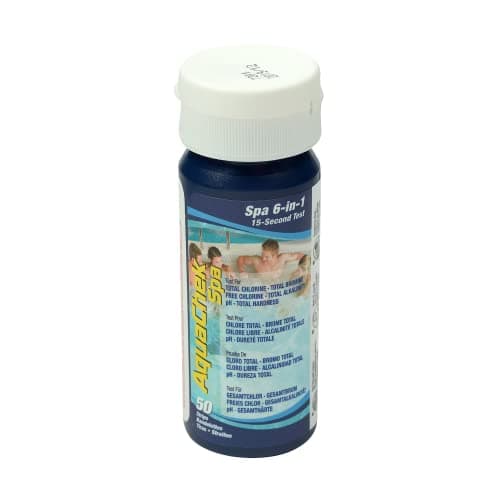
AquaChek Spa 6-in-1 Test Strips
AquaChek · scored 8.4/10
Six readings in fifteen seconds. Not precise, but precise enough to catch drift early.
Strips get an unfair reputation because people compare them to a reagent kit and call them inaccurate. That is the wrong comparison. The right one is against not testing at all, which is what happens when the routine takes ten minutes. A strip you actually use weekly beats a reference kit in a cupboard.
Two habits make strips far more reliable: keep the container sealed and out of the humid room the tub is in, and read them in daylight rather than under a yellow bulb. Most strip complaints trace back to one of those two.
What the maker states
- Reads
- Hardness, total chlorine, free chlorine, bromine, pH, alkalinity
- Method
- Dip-and-read colorimetric strip
- Time
- Seconds, per the label
- Storage
- Sealed container, away from humidity
How it scored
- Accuracy
- 6.5
- Speed
- 10.0
- Parameters covered
- 9.0
- Cost per test
- 9.0
- Availability
- 9.5
Skip this one if: you need an exact free chlorine number to diagnose a problem. Strips read in color bands; a drop-based kit reads in numbers.
#2 · Best for set-and-forget sanitizing
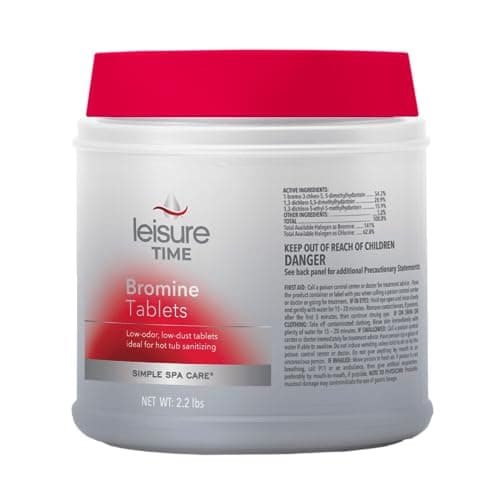
Leisure Time Brominating Tablets
Leisure Time · scored 8.7/10
The default sanitizer for most tubs, and the one that survives 104F best.
Bromine is the chemistry most hot tubs are set up around, and the reason is thermal: bromine keeps working at spa temperatures where chlorine burns off fast. In a floating dispenser the tablets dissolve slowly and hold a residual for days rather than hours, so a tub used twice a week does not need daily attention.
Two things to know before you buy. Bromine tablets alone will not sanitize a brand-new fill, because you need a bromide bank established first, which is what a sodium bromide starter or a bromine startup kit is for. And bromine is not destroyed by shocking: a non-chlorine shock reactivates spent bromide back into free bromine, which is why bromine owners can shock weekly without a chemistry penalty.
What the maker states
- Chemistry
- 1-inch bromine tablets (BCDMH)
- Delivery
- Floating dispenser or in-line feeder
- Target residual
- 3-8 ppm bromine, per the label
- Needs a bromide bank
- Yes, on a fresh fill
How it scored
- Stability at 104F
- 9.5
- Ease of dosing
- 9.0
- Odor and skin feel
- 7.0
- Cost per month
- 7.5
- Availability
- 9.5
Skip this one if: you want the sanitizer gone within an hour of getting out, or bromine bothers your skin. Bromine holds a residual for days, which is the point, but it also means you cannot flip to a fresh-feeling tub on demand the way a dichlor user can.
#3 · Best for chlorine users and fast recovery
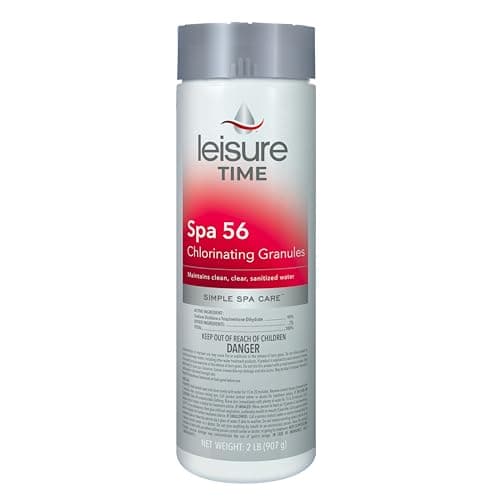
Leisure Time Spa 56 Chlorinating Granules
Leisure Time · scored 8.1/10
Dichlor granules: dissolve fast, act fast, gone fast. The right tool after a heavy soak.
Dichlor is the granular chlorine hot tubs are dosed with, because it dissolves at spa temperature without pre-mixing and it is close enough to pH-neutral not to wreck your balance every time you add it. After a soak with four people in the tub, a measured dose of dichlor is the fastest way to get free chlorine back where the CDC says it should be.
The catch is cyanuric acid. Dichlor is stabilized, so every dose adds CYA that never leaves except by draining. Across a full water cycle that CYA accumulates and progressively blunts your chlorine, which is one of the real arguments for changing the water on schedule rather than topping up forever.
What the maker states
- Chemistry
- Sodium dichlor granules
- Dissolving
- Fast, no pre-mixing required per the label
- Target residual
- CDC gives at least 3 ppm free chlorine in hot tubs
- Adds cyanuric acid
- Yes, dichlor is stabilized
How it scored
- Stability at 104F
- 6.0
- Ease of dosing
- 8.5
- Odor and skin feel
- 8.0
- Cost per month
- 8.5
- Availability
- 9.5
Skip this one if: you only use the tub every couple of weeks. Dichlor burns off quickly at spa temperature, so an unattended chlorine tub goes unsanitized far sooner than a bromine one.
Questions people actually ask
Frequently asked questions
What should chlorine levels be in a hot tub?
The CDC specifies at least 3 ppm free chlorine in a hot tub, which is higher than the 1 ppm figure for swimming pools, because heat consumes chlorine faster and bather load per gallon is far greater. The same guidance gives a pH range of 7.2 to 7.8.
What should bromine levels be in a hot tub?
The CDC gives 4 to 8 ppm, published in its hot tub rash prevention guidance rather than in the Model Aquatic Health Code. Product labels commonly print a slightly wider 3 to 8 ppm band; where the two differ we use the CDC figure.
Why does my hot tub lose chlorine so fast?
Heat, bather load per gallon and jet agitation all consume it far faster than in a pool. If it disappears with nobody using the tub, suspect high pH blunting it, accumulated cyanuric acid from stabilized chlorine, or biofilm in the plumbing consuming it.
Is it safe to use a hot tub with high chlorine?
Not while it is above the range. Close the dispenser collar, take the cover off and run the jets: sanitizer falls on its own and aeration speeds it up. Retest before anyone gets in rather than relying on a clock.
Can you use chlorine test strips on a bromine hot tub?
Only with a conversion. Both are measured by the same reaction and a chlorine reading needs multiplying by roughly 2.25 to give the bromine figure. Forgetting that means chronic under-dosing, which is why a strip printed on the right scale is worth buying.
Where the numbers come from
Sources
- CDC, Model Aquatic Health Code (2023, 4th edition) - the source for the pH 7.2-7.8 range and the hot-tub disinfectant levels quoted on this site
- CDC, Preventing Hot Tub Rash - the source for the 4-8 ppm bromine figure, the prevention steps, and the guidance on when to see a healthcare provider
- CDC, Controlling Legionella in Hot Tubs - the primary reference for the health and disinfection guidance quoted here
- PHTA, Find a Standard - the index confirming which ANSI standard actually covers water quality in public pools and hot tubs or spas
- ANSI webstore, ANSI/APSP/ICC 5-2011 - scope confirms it covers residential INGROUND SWIMMING POOLS, which is why we do not cite it for spa water
Read next
Related on Float & Filter
- Hot tub chemical dosage and levels chart
Every target range on the site in one table.
- The best hot tub test strips and test kits
Getting the reading this page interprets.
- Shocking a hot tub
What to do when total reads well above free.
- The best hot tub floating dispensers
The collar setting is how you hold the level steady.
- Hot tub ozonators
The equipment that lowers demand for this residual without ever replacing it.
- The best hot tub bromine tablets
The tablets that hold the bromine figure on this page.