Diagnostic guide
Hot Tub Scale and Hard Water Stains
Chalky white is calcium. Brown or rust is metal. Green is copper. Three different marks, three different products, and one of them cannot be fixed in full water.
By Scooter M. · Published · How we pick
How this page is funded: the buy buttons below are Amazon affiliate links. If you buy through one we earn a commission at no extra cost to you. It does not change what we recommend, and where the better answer is a retailer we earn nothing from, we say so. The full version.
Deposits on a hot tub shell come in three colors and they mean three different things. Get the identification right and the fix is straightforward; get it wrong and you will spend an afternoon scrubbing a metal stain with a product designed for calcium.
Which of these is you?
- Chalky white crust, gritty to the touch — calcium scale
- Brown, orange or rust-colored marks — iron
- Blue-green staining — copper
- Poor heating, or a tub that trips out — scale where you cannot see it
Chalky white crust
Why this happens. Calcium coming out of solution and depositing on surfaces. Two conditions are almost always true together: calcium hardness is high, and pH is sitting near the top of the range. Scale forms far more readily as pH rises, which is why a tub that runs high-pH scales even at moderate hardness.
How to confirm it. It is gritty rather than slippery, it is white or gray rather than colored, and it does not wipe off with a cloth. Test calcium hardness against the 150 to 250 ppm range for an acrylic spa.[source]
The fix, in order. Bring pH down toward the lower half of the CDC’s 7.2 to 7.8 band[source] and keep it there, because that alone slows further deposition. Add a weekly stain-and-scale product to hold dissolved calcium in suspension. Then remove what has already deposited — and that part happens on a drained tub, because nothing you add to full water lifts hardened scale off a surface.
The part people get wrong. Hardness only moves one way. There is no calcium reducer, so if your reading is high the route down is dilution: a partial drain with softer water, or a full change. That is worked through on hot tub calcium hardness.
Brown, orange or rust-colored marks
Why this happens. Iron in the fill water. It arrives dissolved and invisible, then oxidizes once it meets sanitizer and deposits as a stain. This is a fill-water problem rather than a maintenance failure, and it is common on wells and on supplies running through old iron pipework.
How to confirm it. The giveaway is timing: the marks appear in the days after a fresh fill rather than building slowly over months. If shocking a newly filled tub turned the water briefly brown or cloudy, that is dissolved iron oxidizing.
The fix. A metal sequestrant added at start-up grabs dissolved metals before they can deposit, which is why it is a fresh-fill product rather than a weekly one. For the stains already on the shell, that is a drained-tub job with a stain remover appropriate to the surface.
Prevention is much cheaper than removal here. Filling through a hose pre-filter keeps the iron out of the tub in the first place, which is far easier than sequestering it once it is in. The trade is fill speed, and on a 400-gallon tub that is a real cost in time.
Blue-green staining
Why this happens. Copper, usually from the plumbing rather than from the water supply. Acidic water is corrosive to copper, so a tub that has been run at low pH, or one with very soft water and low calcium, can dissolve copper out of its own pipework and heater and then deposit it on the shell.
How to confirm it. The color is distinctive, and the history usually is too: a period of low pH, a heavy acid dose, or a fill with softened water.
The fix. This one is worth treating as a warning rather than a cosmetic problem. Water aggressive enough to pull copper out of the plumbing is also working on seals and the heater. Correct pH and calcium hardness, add a sequestrant at the next fill, and stop the underlying condition. Removing the stain is the easy half.
Scale where you cannot see it
Why this matters more than the shell. Scale forms fastest where the temperature is highest, which is the heater element, not the waterline. A scaled element transfers heat poorly, runs hotter to compensate, and eventually fails or trips out.
How to suspect it. Longer heat-up times, a tub struggling to hold temperature, or intermittent tripping. None of those is proof, and diagnosing a heater is not something a website can do for you — but if the shell is visibly scaling, the element is scaling too.
What to do. Address the water chemistry, and get the equipment looked at by someone who can actually open it. This is the point where the honest answer is a technician rather than a product.
Stopping it coming back
- Test hardness at every fill and correct it once, to the bottom of the range, because it drifts upward on its own as water evaporates and you top up.
- Keep pH in the lower half of the band. This is the single most effective preventive measure and it costs nothing.
- Use a sequestrant if your fill water needs one — and only then. On soft municipal water it addresses nothing.
- Fill through a pre-filter on well or hard water.
- Change the water on schedule. Calcium concentrates with every top-up and only leaves by draining.
What scale is not
It is not biofilm. Scale is gritty and mineral; biofilm is slippery and biological, lives inside the plumbing, and needs a purge rather than an acid. See hot tub biofilm.
It is not a scum line. A greasy ring at the waterline is body oils and comes off with a cloth. See the hot tub scum line.
It is not a sanitizer problem, and none of this changes the requirement to hold a residual, which is what the CDC’s hot tub guidance is built around.[source]
What fixes it
The products for this job
Named because they do the specific job this page describes, not because they are the only options. Specifications are the manufacturer’s published figures.
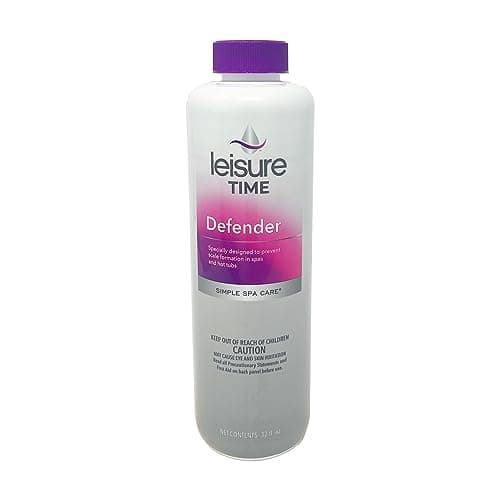
#1 · Best for hard or metal-bearing fill water
Leisure Time Defender
Leisure Time · scored 7.6/10
A sequestrant, not a cleaner. Genuinely useful on well water, pointless on soft municipal water.
Sequestrants hold dissolved metals and hardness minerals in solution so they cannot deposit on the shell and the heater. On a tub filled from a well, or from a supply with visible hardness, that is worth doing at every fill.
On soft municipal water it does nothing you need. This is the clearest example on the site of a product that is either essential or a waste depending entirely on a number you can measure for a few cents.
What the maker states
- Job
- Sequesters metals and scale-forming minerals
- Best added
- At fill, before the water heats
- Re-dose
- Per the label, typically monthly
- Not a
- Sanitizer, clarifier or stain remover
How it scored
- Predictability
- 7.5
- Ease of dosing
- 9.0
- Value on hard water
- 8.5
- Value on soft water
- 3.0
- Availability
- 8.5
Skip this one if: your calcium hardness is already in range and your fill water carries no metals. You would be paying for a problem you do not have.
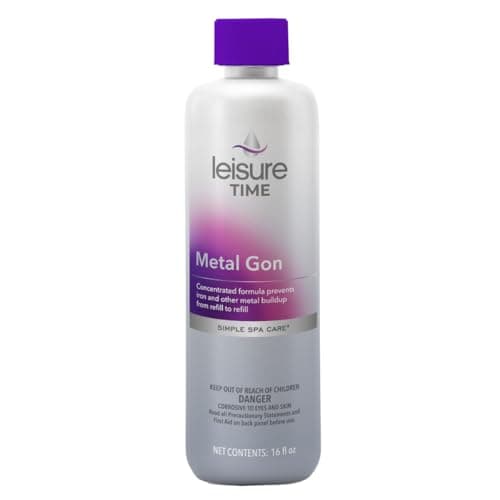
#2 · Best for the fresh fill on well water
Leisure Time Metal Gon
Leisure Time · scored 7.4/10
A start-up metal sequestrant. Does one job at one moment, and nothing the rest of the time.
This and a weekly stain-and-scale product get bought interchangeably and are two different tools. Metal Gon is a start-up dose that grabs dissolved metals as the tub fills; the weekly product keeps calcium and metals suspended over the months that follow.
If your fill water runs through iron pipework or comes off a well, brown or rust-colored marks on the shell are metals rather than dirt, and this is what prevents them. On soft municipal water it addresses nothing you have.
What the maker states
- Job
- Sequesters iron, copper and other metals, per the maker
- Added
- At every fresh fill, per the maker
- Prevents
- Metal staining of the shell
- Not a
- Week-to-week scale controller
How it scored
- Metal stain prevention
- 8.5
- Scale control
- 4.0
- Ease of dosing
- 9.0
- Value on well water
- 8.5
- Value on soft water
- 2.5
Skip this one if: your fill water carries no metals. On clean municipal water this is a bottle you will not finish and did not need.
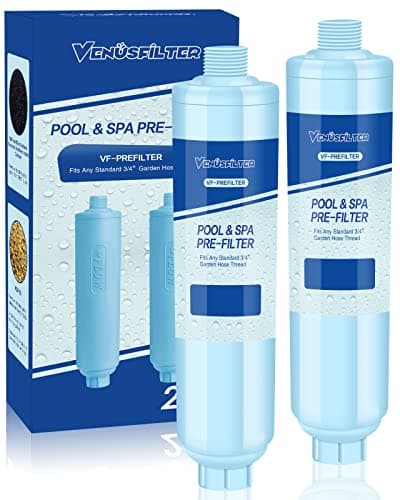
#3 · Best for filling from well or hard water
Garden hose pre-filter
Generic · scored 7.7/10
Filters the water going in, which is much easier than treating it once it is in.
Every problem you keep out of the tub at fill time is one you do not have to chase with chemistry for the next four months. On well water in particular, a pre-filter is the cheapest single improvement to water quality available.
It slows the fill noticeably. On a 400-gallon tub that is a real cost in time, and it is the main reason people stop using one.
What the maker states
- Type
- In-line hose filter
- Targets
- Sediment and metals, per the maker
- Fits
- Standard garden hose thread
- Life
- Rated by gallons, per the maker
How it scored
- Metal removal
- 8.0
- Sediment removal
- 8.5
- Fill speed impact
- 5.5
- Value on hard water
- 8.5
- Availability
- 8.5
Skip this one if: your municipal water is soft and metal-free. Then it is a cartridge cost for no measurable benefit.
Questions people actually ask
Frequently asked questions
How do you remove scale from a hot tub?
Hardened scale comes off a drained tub, not a full one: nothing you add to the water lifts deposits that have already formed. Before removing it, bring pH toward the lower half of 7.2 to 7.8 and correct calcium hardness, or it will simply return.
What causes brown stains in a hot tub?
Iron in the fill water. It arrives dissolved and invisible, then oxidizes when it meets sanitizer and deposits as a stain. The giveaway is timing: it shows up in the days after a fresh fill rather than building slowly. A metal sequestrant at start-up prevents it; a hose pre-filter prevents it more cheaply.
What are the blue-green stains in my hot tub?
Copper, usually dissolved out of the tub's own plumbing by water that is too acidic or too soft. Treat it as a warning rather than a cosmetic issue: water aggressive enough to attack copper is also working on seals and the heater.
Does scale damage a hot tub heater?
Scale forms fastest where temperature is highest, which is the heater element rather than the waterline. A scaled element transfers heat poorly and runs hotter to compensate. If the shell is visibly scaling, assume the element is too, and get the equipment looked at by someone who can open it.
Does a sequestrant remove existing stains?
Not really. Sequestrants hold dissolved metals and hardness minerals in solution so they cannot deposit, which is prevention. Marks already on the shell need removing directly from a drained tub.
Where the numbers come from
Sources
- CDC, Model Aquatic Health Code (2023, 4th edition) - the source for the pH 7.2-7.8 range and the hot-tub disinfectant levels quoted on this site
- PHTA, Find a Standard - the index confirming which ANSI standard actually covers water quality in public pools and hot tubs or spas
- CDC, Controlling Legionella in Hot Tubs - the primary reference for the health and disinfection guidance quoted here
Read next
Related on Float & Filter
- Hot tub calcium hardness
The number behind white scale, and the one you cannot bring back down.
- Hot tub pH and total alkalinity
Keeping pH low in the band is the cheapest scale prevention there is.
- The hot tub scum line
The other waterline mark, and a completely different problem.
- Draining and refilling a hot tub
Scale removal is a drained-tub job.
- Filling a hot tub from a well
When the deposit came in with the water rather than forming in it.
- The best hot tub descalers and scale control
Removers versus preventers, and which one your deposit actually needs.