Guide
What to Do With Your Hot Tub When You Go Away
Leave it running. Drop the temperature a few degrees, shock it, load a slow-release floater on a conservative setting and lock the cover. Switching it off with water in it is the one genuinely expensive option.
By Scooter M. · Published · How we pick

How this page is funded: the buy buttons below are Amazon affiliate links. If you buy through one we earn a commission at no extra cost to you. It does not change what we recommend, and where the better answer is a retailer we earn nothing from, we say so. The full version.
The verdict, up front. For any absence from a long weekend to about three weeks: leave the tub running and circulating, drop the set point a few degrees rather than switching anything off, balance and shock the water the day before you leave, load a slow-release sanitizer in a floater set conservatively, and lock the cover down. For a month or more, the choice is between asking someone to test it weekly or draining and winterizing it properly — but a tub left full and switched off is the one option that can cost you a pump.
Two things are often confused in this question, so it is worth splitting them. Energy and risk point in opposite directions. Switching the heater off genuinely does save energy over two weeks. It also removes freeze protection, stops circulation, and leaves several hundred gallons of warm-then-tepid water sitting with no sanitizer residual, which is the condition the CDC’s hot tub guidance exists to prevent.[source] The cheap option is cheap because it is the risky one, and the saving is a few dollars.
What to do, by how long you are away
| Away for | Power | Temperature | Sanitizer plan | Before you go |
|---|---|---|---|---|
| 1–3 days | Leave on | Normal | Nothing special | Test, cover, done |
| 4–10 days | Leave on | Down a few degrees | Shock, then a floater on a low setting | Clean the filter, balance, lock the cover |
| 2–3 weeks | Leave on | Down to the low end you are comfortable with | Shock, bromine floater, or ask someone to test once | Full balance, clean filter, thermal blanket, locked cover |
| 1–3 months | Leave on, or winterize | Low end | Someone tests and doses weekly, or drain it | Decide which, and do it properly |
| A whole season | Winterize and switch off | n/a | n/a | Drain, blow the lines, cover |
| Any length, in freezing weather | Never off with water in it | Running | As above | See winter care |
The row that does the most work is the last one. A heated, circulating tub protects its own plumbing; a cold one full of water does not, and the failure is not a nuisance but a burst manifold. Hot tub winter care covers that case, including what to do if the power goes out while you are gone.
The day-before checklist
Twenty minutes, in this order. The order matters because shocking a tub whose chemistry is out of range wastes the shock.
- Test and balance. pH and alkalinity first, because sanitizer does less work at high pH. The CDC range is 7.2 to 7.8.[source] Get there before you do anything else — pH and total alkalinity.
- Clean the filter. A loaded cartridge is a restriction, and two weeks of restricted flow with nobody watching is how a heater trips out. Rinse at minimum, chemically soak if it is due: how to clean a hot tub filter.
- Shock it. You are resetting the organic load to zero so the sanitizer you leave behind is not spent in the first 48 hours. Which shock, and how long the cover stays off afterwards, is on shocking a hot tub.
- Load a floater, conservatively. Fill the dispenser and set the collar lower than your normal setting, not higher. See the sizing discussion below — this is the step people get backwards.
- Drop the set point. A few degrees down cuts standing heat loss without taking the tub out of its own freeze protection. Leave circulation and filter cycles exactly as they are.
- Top up the water level. Evaporation over three weeks can drop a tub to the point where the pump pulls air, and a dry-run is a pump-seal problem.
- Fit a thermal blanket, then lock the cover. The blanket cuts evaporation at the surface; the locks keep the cover on the tub rather than across the lawn.
The sanitizer that survives an empty fortnight
An unattended tub fails in one of two directions, and both are dispenser-setting problems rather than chemistry problems.
- Runs out. You come home to cloudy or green water, and the tub has spent part of the absence with no residual at all. The fix is on cloudy water or algae, and it costs a water change often enough to be worth avoiding.
- Overshoots. Three weeks of a wide-open floater in a closed, hot, unused tub concentrates sanitizer in a sealed space. That is how cover undersides go chalky and pillows bleach, and the tub is unusable on arrival until it comes back down.
Best for an absence of a week or more: bromine tablets in a floater. Bromine is the right tool here for a specific reason — spent bromide is reactivated by shocking rather than lost, it holds up better at the top of the pH range, and tablets release slowly and predictably. A chlorine tub can be left on a floater too, but chlorine is consumed rather than banked, so it fades faster. The trade-offs in full are on bromine vs chlorine for a hot tub, and tablet choice is on the best hot tub bromine tablets.
Best for metering it out slowly: a dispenser with a numbered collar rather than an open basket, so you can set it low and repeat the same setting next time. Our floating dispenser roundup ranks them on exactly that control.
Worth having if you travel often: a mineral cartridge or an ozonator. Neither is a sanitizer and neither holds a residual, but both reduce demand, which means the sanitizer you leave behind lasts longer. Read mineral sanitizers and ozonators for what they can and cannot do — and note that a mineral cartridge has a service life of its own, so starting a three-week trip on a four-month-old cartridge is pointless.
Should you just turn it off?
Only in two cases. If you are going away for a season and will drain and winterize properly, switching off is correct — the tub is empty, so there is nothing to protect. And if you live somewhere that never freezes and you are away for months, draining it is reasonable, provided you leave it empty and dry rather than full and cold.
What does not work is the middle option people reach for: full, cold and switched off for two or three weeks. You get stagnant water with no residual, a filter sitting wet in dead water, and in any climate with a cold snap the risk of freezing in the pipework. On arrival you will drain it anyway, so the saving is an illusion.
If the motivation is the running cost rather than the absence, the levers that actually move the number are the cover’s condition and the filter cycle, not switching the heater off for a fortnight. That is quantified on what hot tub maintenance actually costs, where a waterlogged cover dominates the electricity line, and replace or repair a cover tells you whether yours is the problem.
Economy, sleep and vacation modes
Most controllers have some version of an economy or sleep setting, and what it does varies by manufacturer: typically it only heats to the set point during programmed filter cycles rather than on demand. That is useful for an absence, and it is not the same thing as switching off, because circulation and freeze protection are still active.
We are deliberately not telling you which button to press, because the naming and behavior differ between controllers and the only reliable source is your own manual. What you want to confirm is that the mode you choose keeps the filter cycles running — hot tub filter cycle settings explains why circulation is doing more work here than the heater is.
Security and weather while nobody is home
An unattended hot tub is a cover problem more than a water problem. Two things to do:
- Best for an unsupervised tub: cover locks. A latched, locked cover is a barrier against a child reaching the water, and it is the single thing on this page worth doing whether or not you are going anywhere. No cover accessory changes the supervision requirement, but a locked one removes casual access while the house is empty.
- Best for an exposed site: wind straps. A cover that leaves the tub in a gale is a cover you replace, and it takes the tub’s heat retention with it. Options are on cover locks, clips and wind straps.
Also worth two minutes: move the cover lifter to its parked position and clear anything from the cover that rain will turn into standing water. Snow load specifically is on covers for cold climates and snow load.
The first ten minutes when you get back
- Test before anyone gets in. Not after. A tub that has been shut up for two weeks can be high or zero, and neither reading is a tub to soak in — chlorine and bromine levels covers what to do with each.
- Take the cover off and let it breathe while you test. If the reading is high, that alone brings it down.
- Shock it. Whatever happened in your absence, the organic load is not zero and the sanitizer has been working unattended.
- Rinse the filter and check the water level.
- If the water is cloudy, diagnose before dosing. Cloudy after an absence is usually spent sanitizer, not a clarity problem, and clarifier is the wrong first move — why your hot tub water is cloudy.
If it comes back foaming, smelling or slick to the touch, the absence may have let biofilm establish in the plumbing. That is worth dealing with properly rather than masking: hot tub biofilm and flushing the lines.
If the trip is longer than the water
One scheduling point that saves money. Water has a working life measured in bather-days, not calendar days — the rule of thumb on how often to change hot tub water divides the tub’s volume by three and then by the average daily bathers. If your fill is already two-thirds used up and you are leaving for three weeks, change the water before you go rather than after. You come home to a fresh fill instead of to a tub that needs draining before anyone can use it, and the whole startup sequence happens while you are there to watch it — first chemicals after a refill.
Where this fits in the ordinary routine is on the hot tub maintenance schedule.
What fixes it
The products for this job
Named because they do the specific job this page describes, not because they are the only options. Specifications are the manufacturer’s published figures.
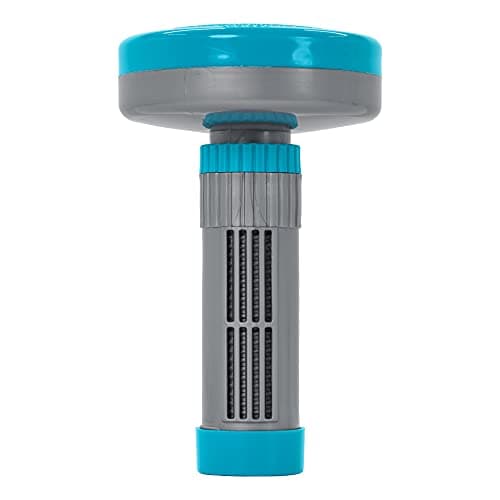
#1 · Best for fine dose control
U.S. Pool Supply floating dispenser, 13-setting
U.S. Pool Supply · scored 8.8/10
Thirteen flow settings and a weighted cap that keeps it out of the skimmer.
The weighted base is the detail worth paying for. A light floater gets pulled toward the skimmer by the circulation, parks itself over the intake and doses one corner of the tub while the rest of the water gets very little.
Thirteen settings sounds like packaging copy until you run a tub that sees two people midweek and six on a Saturday. Being able to step the rate down one notch rather than choosing between fully open and fully closed is the difference between a steady residual and a sawtooth.
What the maker states
- Takes
- 1-inch chlorine or bromine tablets
- Flow control
- 13 settings, per the maker
- Top
- Flat, so it sits under a cover
- Bottom
- Weighted screw-on cap, per the maker
How it scored
- Dose control
- 9.5
- Stays out of the skimmer
- 9.0
- Build quality
- 8.0
- Ease of refilling
- 8.5
- Availability
- 9.0
Skip this one if: you want to set it once and never think about it again. Thirteen settings is only an advantage if you are willing to walk them up and down against your test readings.
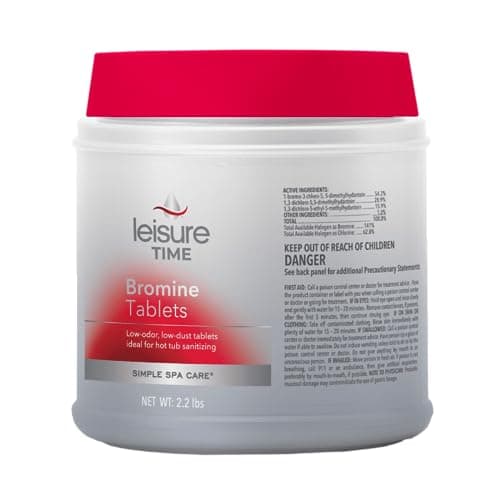
#2 · Best for set-and-forget sanitizing
Leisure Time Brominating Tablets
Leisure Time · scored 8.7/10
The default sanitizer for most tubs, and the one that survives 104F best.
Bromine is the chemistry most hot tubs are set up around, and the reason is thermal: bromine keeps working at spa temperatures where chlorine burns off fast. In a floating dispenser the tablets dissolve slowly and hold a residual for days rather than hours, so a tub used twice a week does not need daily attention.
Two things to know before you buy. Bromine tablets alone will not sanitize a brand-new fill, because you need a bromide bank established first, which is what a sodium bromide starter or a bromine startup kit is for. And bromine is not destroyed by shocking: a non-chlorine shock reactivates spent bromide back into free bromine, which is why bromine owners can shock weekly without a chemistry penalty.
What the maker states
- Chemistry
- 1-inch bromine tablets (BCDMH)
- Delivery
- Floating dispenser or in-line feeder
- Target residual
- 3-8 ppm bromine, per the label
- Needs a bromide bank
- Yes, on a fresh fill
How it scored
- Stability at 104F
- 9.5
- Ease of dosing
- 9.0
- Odor and skin feel
- 7.0
- Cost per month
- 7.5
- Availability
- 9.5
Skip this one if: you want the sanitizer gone within an hour of getting out, or bromine bothers your skin. Bromine holds a residual for days, which is the point, but it also means you cannot flip to a fresh-feeling tub on demand the way a dichlor user can.
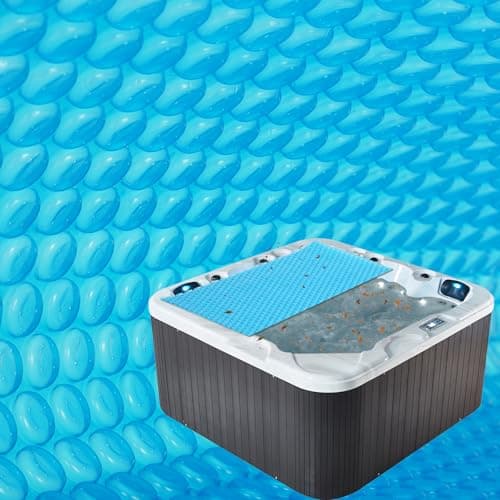
#3 · Best for cutting evaporation
Spa thermal blanket
Generic · scored 7.7/10
Bubbles down. It floats on the water under the hard cover and cuts evaporative loss.
Most of a hot tub's heat leaves as evaporation from the water surface, not through the cover. A floating blanket sits directly on the water and stops that, which is a different mechanism from the hard cover's insulation and is why the two work together rather than competing.
Trim it to the water line, not the tub rim, and pull it out before you get in. Left in place under a soak it wraps around people and jets.
What the maker states
- Type
- Floating bubble blanket
- Orientation
- Bubble side down, against the water
- Sizing
- Cut to fit the water surface
- Replaces
- Nothing. Used under the hard cover.
How it scored
- Heat retention
- 7.5
- Evaporation control
- 9.0
- Chemical saving
- 7.0
- Durability
- 6.0
- Value
- 9.0
Skip this one if: you think it replaces a hard cover. It does not: it has no structural strength and provides no safety barrier.
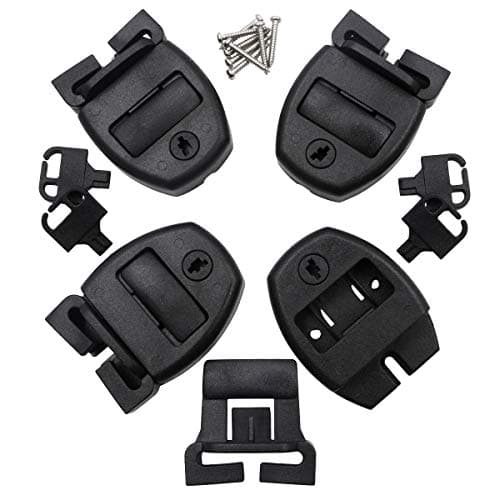
#4 · Best for keyed closure on a family tub
Hot tub cover locks with keys, 4-set
Huouo · scored 7.9/10
Pinch-release keyed latches. The closest thing here to a child-deterrent closure.
Keyed latches are the sensible default on any tub in a garden a child can reach. Four of them hold the cover down at all four corners and mean the cover cannot simply be flipped back by hand.
We want to be careful about what this is. Latches are a deterrent and a wind fixing. They are not a safety cover standard, they do not make a tub safe to leave unattended around small children, and no product on this page changes the fact that supervision is the actual control.
What the maker states
- Type
- Keyed cover locks, pinch center release
- Quantity
- 4 sets, per the listing
- Includes
- Keys, per the listing
- Fitting
- Replaces existing cover straps
How it scored
- Holds in wind
- 7.5
- Fitting effort
- 7.5
- Cost
- 9.0
- Durability outdoors
- 7.0
- Works on any tub
- 7.5
Skip this one if: you are treating this as a safety device. It is a deterrent that slows a curious child down; it is not a certified safety cover.
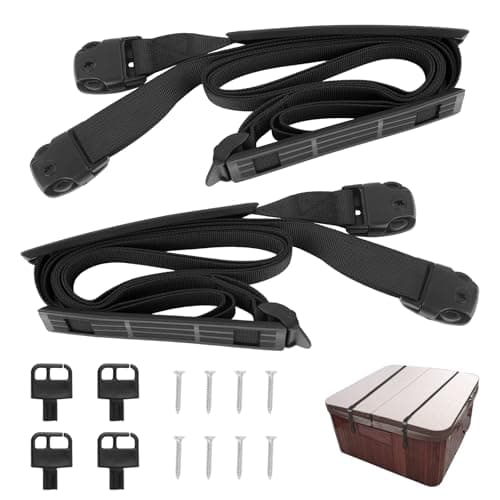
#5 · Best for the cheapest way to stop a cover blowing off
EINDER heavy duty hot tub cover wind straps, 9.5 ft
EINDER · scored 8.3/10
Two long straps that go right over the cover and anchor low. Simple, and it works.
The physics of a lost cover is simple: wind gets under a lifted edge and the cover behaves like a wing. A strap that crosses the cover and pulls down at both ends removes the lift, and it is the cheapest insurance you can buy against a replacement cover.
Two honest points. The straps are the easy half; the anchor is the hard half, and you need something genuinely fixed to attach to. And webbing left in sun and frost degrades, so treat these as a consumable you inspect each autumn rather than a permanent fitting.
What the maker states
- Type
- Over-the-cover strap pair
- Length
- 9.5 ft, per the listing
- Quantity
- 2 straps, per the listing
- Anchors
- Not included; you supply the fixing point
How it scored
- Holds in wind
- 8.5
- Fitting effort
- 8.0
- Cost
- 9.5
- Durability outdoors
- 7.0
- Works on any tub
- 9.0
Skip this one if: you have nowhere solid to anchor to. A strap tied to decking that lifts is a strap that takes the decking with it.
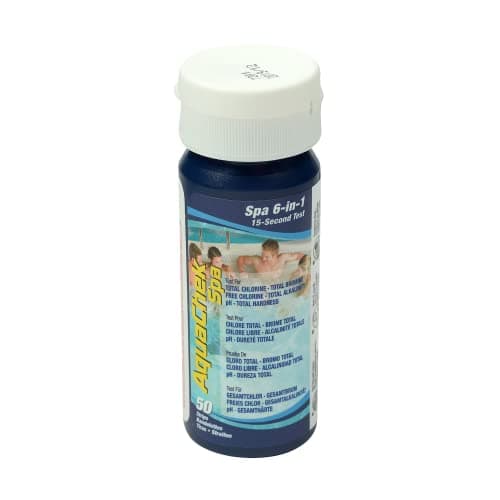
#6 · Best for the weekly check
AquaChek Spa 6-in-1 Test Strips
AquaChek · scored 8.4/10
Six readings in fifteen seconds. Not precise, but precise enough to catch drift early.
Strips get an unfair reputation because people compare them to a reagent kit and call them inaccurate. That is the wrong comparison. The right one is against not testing at all, which is what happens when the routine takes ten minutes. A strip you actually use weekly beats a reference kit in a cupboard.
Two habits make strips far more reliable: keep the container sealed and out of the humid room the tub is in, and read them in daylight rather than under a yellow bulb. Most strip complaints trace back to one of those two.
What the maker states
- Reads
- Hardness, total chlorine, free chlorine, bromine, pH, alkalinity
- Method
- Dip-and-read colorimetric strip
- Time
- Seconds, per the label
- Storage
- Sealed container, away from humidity
How it scored
- Accuracy
- 6.5
- Speed
- 10.0
- Parameters covered
- 9.0
- Cost per test
- 9.0
- Availability
- 9.5
Skip this one if: you need an exact free chlorine number to diagnose a problem. Strips read in color bands; a drop-based kit reads in numbers.
Questions people actually ask
Frequently asked questions
Should you leave a hot tub on while on vacation?
Yes, for anything up to about three weeks. Leave the power on and the filter cycles running, drop the set point a few degrees, and shock the water and load a floater before you go. Switching a full tub off saves a few dollars of electricity but removes freeze protection and circulation and leaves the water with no residual.
What temperature should I leave my hot tub at while away?
A few degrees below your normal soaking temperature, or the low end of what your controller offers in its economy or sleep mode. The aim is to cut standing heat loss while keeping the tub circulating and protected against a freeze. Do not switch the heater off while there is water in the tub.
Can I leave a hot tub for 2 weeks?
Comfortably, if you prepare it. Balance and shock the day before, clean the filter, load a slow-release sanitizer in a floater on a conservative setting, top up the water level and lock the cover. Bromine tablets suit this better than chlorine because spent bromide is reactivated by shocking rather than lost.
Should I turn my hot tub off at night?
No. Reheating from cold costs more than holding temperature through the night, the tub loses its freeze protection while it is off, and the filter cycles that keep the water clear stop with it. If nightly running cost is the concern, the lever is the cover’s condition, not the power switch.
What chemicals should I add before going on vacation?
Balance pH and alkalinity first, then shock to reset the organic load, then load a floater with slow-release tablets set lower than your normal position. Do not simply double the sanitizer: an unused, closed tub concentrates it, which bleaches pillows and cover undersides.
Should I drain my hot tub if I am away for a month?
Either arrange for someone to test and dose it weekly, or drain and winterize it properly. What to avoid is the middle option: full, cold and switched off, which gives you stagnant water with no residual and, in any climate that can freeze, a real risk to the plumbing.
Will my hot tub go green if I leave it for two weeks?
Only if the sanitizer runs out. Green or cloudy water after an absence almost always means the residual was spent in the first few days, usually because the tub was not shocked before departure or the floater was empty. Shock first, then load the dispenser, and the water holds far longer.
Where the numbers come from
Sources
Read next
Related on Float & Filter
- Hot tub winter care
The freezing-weather version, including a power cut while you are gone.
- The best hot tub floating dispensers
The collar setting is what makes an unattended tub work.
- The hot tub maintenance schedule
Where this sits in the ordinary routine.
- How often to change hot tub water
Whether to change the water before you leave rather than after.
- Hot tub cover locks, clips and wind straps
Keeping the cover on the tub while nobody is home.