Guide
Hot Tub Filter Cycle Settings
Turn the whole volume over at least twice a day, split across two cycles. Beyond that you are buying diminishing returns with electricity.
By Scooter M. · Published · How we pick
How this page is funded: the buy buttons below are Amazon affiliate links. If you buy through one we earn a commission at no extra cost to you. It does not change what we recommend, and where the better answer is a retailer we earn nothing from, we say so. The full version.
The useful target is turning the full volume of the tub over at least twice in twenty-four hours, split across two cycles rather than one. On most domestic tubs that works out at somewhere around two cycles of two hours, and on a tub with a slower circulation pump it will be longer.
Your manual is the authority for your specific tub. What follows is how to reason about the setting rather than a number to copy.
Work it out for your tub
Two figures give you the answer: your volume in gallons, and the circulation pump’s flow rate in gallons per minute, both from the manual.
- Minutes per turnover = volume in gallons divided by flow in gallons per minute.
- Daily filtration needed = minutes per turnover x 2, as a minimum.
A 400-gallon tub with a circulation pump moving 20 gallons per minute turns over in 20 minutes, so two turnovers is 40 minutes of pump time a day. In practice most tubs are set far above that, because filtration cycles also drive the heater and because circulation is not perfectly efficient — water short-circuits from the return straight back to the suction rather than mixing thoroughly.
Which is the real point: turnover arithmetic gives you a floor, not a target. Two cycles of a couple of hours is a sane default that comfortably clears the floor on almost any domestic tub.
Why two cycles beat one
Contamination arrives at intervals, not continuously. If your only cycle runs at 3am, everything that goes into the water at 8pm sits in it untouched for seven hours. Splitting the same total pump time across morning and evening halves the worst-case gap, at no extra cost.
Set one cycle to run shortly after the time you typically use the tub. That is when the organic load is highest and when filtration and sanitizer contact do the most good.
Where the trade-offs actually are
| If you run | You get | You pay |
|---|---|---|
| Below two turnovers a day | Lower pump electricity | Cloudier water, more shocking, faster sanitizer use |
| Two cycles, around two hours each | Clear water on most tubs | A modest, predictable pump cost |
| Continuous circulation | Best clarity, steadiest temperature | Highest pump cost; some tubs are designed for this |
| More cycles than that | Very little extra | Electricity, and a filter that loads faster |
One thing worth flagging: some tubs are built around a low-power circulation pump that is designed to run continuously, and on those the 24-hour setting is not extravagance, it is how the tub was engineered. Check the manual before deciding you are wasting money.
The setting is not a substitute for a clean filter
Increasing filtration time to compensate for a loaded cartridge is running the pump against a restriction for longer, which costs electricity and achieves very little. If clarity has fallen off, clean the filter before you touch the cycle settings — how to clean a hot tub filter covers the routine, and when to replace a filter covers the case where cleaning will not help.
Filtration, heating and the cover
On most tubs the filtration cycle also runs the heater, which means the cycle setting interacts with your energy bill in a second way. If you are looking at filtration settings to save money, the far bigger lever is heat retention: a cover that has stopped sealing costs more than any pump schedule. That arithmetic is on what hot tub maintenance actually costs, and the cover side is on thermal blanket vs hard cover.
And whatever the schedule, filtration is in service of the same thing everything else here is: keeping an effective sanitizer residual in the water, per the CDC’s hot tub guidance.[source]
What fixes it
The products for this job
Named because they do the specific job this page describes, not because they are the only options. Specifications are the manufacturer’s published figures.
#1 · Best for buying the safe option
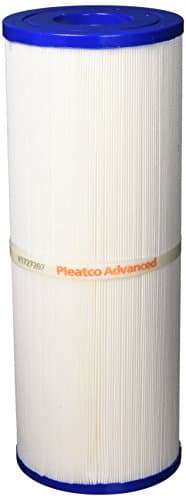
Pleatco PRB50-IN replacement cartridge
Pleatco · scored 8.6/10
The reference line. If a cartridge exists for your tub, Pleatco almost certainly makes it.
Filter cartridges are one of the few categories where the brand matters less than the part number, because fit is dictated by your tub. Pleatco earns its place by having the broadest catalog and a numbering scheme that cross-references cleanly to the other two majors.
Where the money goes is the end caps and the pleat count. Cheap cartridges usually fail at the cap rather than the media, by deforming after a few hot cleaning cycles, and a deformed cap lets water bypass the pleats entirely.
What the maker states
- Range
- Catalog covers most OEM spa cartridges
- Media
- Pleated polyester, antimicrobial in the M lines
- Part numbering
- P-prefixed, cross-referenced to Unicel and Filbur
- Fit
- Determined by your tub, not by brand
How it scored
- Build quality
- 9.0
- Catalog coverage
- 9.5
- Cleanability
- 8.5
- Value
- 6.5
- Availability
- 9.5
Skip this one if: your tub does not take this size. This is the PRB50-IN / C-4950 class, the most common spa cartridge but far from the only one -- confirm your part number on the filter finder before ordering.
#2 · Best for the monthly deep clean
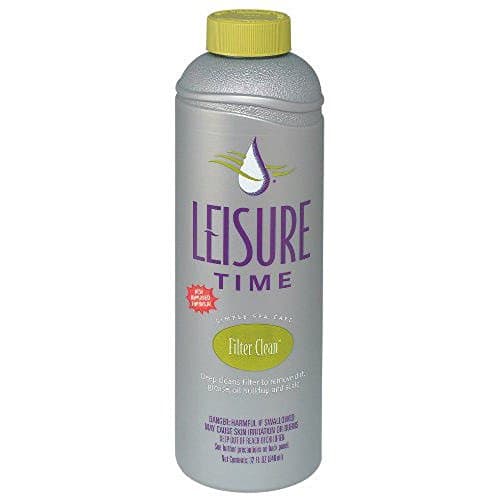
Leisure Time Filter Clean
Leisure Time · scored 8.4/10
A proper cartridge cleaner, which is a different product from a rinse.
The reason a rinsed filter still restricts flow is that the load is oil, not grit, and water does not remove oil. A dedicated cartridge cleaner is a surfactant designed to release exactly that, and the difference in flow after a proper soak is obvious at the jets.
Rinse harder afterwards than you think you need to. Cleaner left in the pleats goes straight into your water and is a very common cause of foaming that owners then blame on the tub.
What the maker states
- Format
- Concentrate for soaking
- Targets
- Body oils, lotions, light scale
- Soak time
- Per the label, commonly overnight
- Rinse
- Thoroughly, before refitting
How it scored
- Oil removal
- 9.0
- Scale removal
- 7.5
- Ease of use
- 8.0
- Cost per clean
- 8.0
- Availability
- 9.0
Skip this one if: your filter is only ever lightly loaded. A hose rinse handles surface debris; this is for the oils a rinse cannot shift.
Questions people actually ask
Frequently asked questions
How long should a hot tub filter cycle run?
Long enough to turn the full volume over at least twice in twenty-four hours, split across two cycles. On most domestic tubs that lands around two cycles of two hours, but your manual's volume and flow-rate figures give the exact floor for your tub.
Should a hot tub run 24 hours a day?
Some are designed to. Tubs built around a low-power circulation pump are engineered for continuous running and the manual will say so. On a tub with a conventional pump, two cycles a day is the sensible default and continuous running costs more for a small clarity gain.
Is it better to run one long filter cycle or two short ones?
Two shorter ones. Contamination arrives at intervals, so a single overnight cycle leaves everything added during the evening sitting untreated for hours. Splitting the same pump time in two halves the worst-case gap at no extra cost.
Does running the filter longer save chemicals?
Up to a point, because better circulation means the sanitizer meets more of the water. Beyond about two turnovers a day the returns fall off sharply, and running longer to compensate for a clogged cartridge achieves almost nothing.
Where the numbers come from
Sources
Read next
Related on Float & Filter
- How to clean a hot tub filter
Fix the cartridge before changing the schedule.
- What hot tub maintenance actually costs
Where pump time sits against heat loss in the annual figure.
- The best hot tub filter cartridges
More media area means less pressure on the schedule.
- Why your hot tub water is cloudy
Filtration time is one of the four things to check.
- Bullfrog spa filter replacements
Which filter your Bullfrog takes depends on the series and the year.