Guide
Hot Tub Winter Care
The most expensive winter mistake is switching a tub off with water still in it. A running tub protects its own plumbing; a cold one does not.
By Scooter M. · Published · How we pick
How this page is funded: the buy buttons below are Amazon affiliate links. If you buy through one we earn a commission at no extra cost to you. It does not change what we recommend, and where the better answer is a retailer we earn nothing from, we say so. The full version.
Do not switch a hot tub off for the winter with water still in it. A heated, circulating tub is protecting its own plumbing. A tub switched off at the wall in a freeze, with water sitting in pipes and pumps, is a burst-pipe risk and one of the more expensive things that can happen to a hot tub.
There are exactly two defensible winter positions: run it properly, or drain and winterize it properly. The gap between them — full of water, switched off — is where the damage happens.
Running through the winter
This is what most owners should do, and winter is when a hot tub is genuinely at its best. The routine does not change; the margins get tighter.
Heat retention becomes the whole game
The temperature difference between the water and the air is at its largest, so every weakness in the cover costs more than it did in July. A cover that was merely tired in summer is expensive in January.
- Check the cover seals all the way round. A gap you could ignore in mild weather is a continuous heat leak now.
- Add a floating thermal blanket under the hard cover. It attacks evaporation directly, which is the dominant loss mechanism and the one that scales worst with cold air. Bubbles down — see thermal blanket vs hard cover.
- Do not drop the temperature between soaks. Reheating from cold uses back what you saved and leaves the tub unusable in the meantime. On a well-covered tub, holding temperature is generally cheaper.
The arithmetic for your own tub is on what hot tub maintenance actually costs, and it is worth doing once in winter because that is when the numbers are largest and the cover’s condition shows up most clearly.
Snow, and the cover as a structure
In winter the cover stops being purely thermal and starts carrying load. Clear snow after each fall with a broom or a foam snow rake, never a shovel, and never stand or kneel on a cover — it is rated for a distributed load, not a point load. The full detail is on covers for cold climates and snow load.
Chemistry does not get a winter off
Sanitizer decays whether or not anyone is using the tub, and cold weather does nothing to remove the requirement. Keep testing weekly. The targets are unchanged: pH 7.2 to 7.8 and at least 3 ppm free chlorine, or 4 to 8 ppm bromine.[source][source]
Bromine is the more forgiving chemistry for a tub that gets checked less often in bad weather, because it holds a residual for days rather than hours. If you are switching anyway, a pre-winter water change is the moment — see bromine vs chlorine.
Jobs worth doing before the first freeze
- Condition the cover. Flexible vinyl handles freeze-thaw far better than vinyl that has spent a summer going chalky. Doing it in autumn rather than spring is the whole point.
- Change the water now rather than in January. A water change means an empty tub outdoors, and you want that on a mild day. Work out whether yours is due on how often to change hot tub water.
- Purge the plumbing while you are draining. Biofilm is harder to deal with when the weather makes you reluctant to open anything — flushing the plumbing lines.
- Fit a fresh filter cartridge, or at least a properly soaked one. Winter is a bad time to discover the cartridge is finished.
- Check the cover latches and clips. Wind under a cover is what removes covers, and winter wind is the test.
- Clear the area around the tub. You will be walking on it in the dark on ice. Somewhere to put the cover, and a non-slip route, are worth sorting in advance.
Using it in the cold
Two practical things change. Evaporation is far more visible, so you will be topping up more often than you expect — and every top-up dilutes chemistry and concentrates calcium, so test after topping up rather than assuming.
And people stay in longer in winter, which raises the bather load per session. Shock on the load rather than the calendar, exactly as shocking a hot tub describes.
If there is a power cut
This is the winter scenario worth having thought about in advance, because a tub without power in a hard freeze is on a clock.
- Keep the cover on and latched. A full, covered, insulated tub holds heat for a surprisingly long time.
- Do not open it to check. Every look costs heat you cannot replace.
- If the outage will be long and hard freezing is forecast, the safe answer is to drain the tub and the equipment properly rather than hope. That is a winterization job, not a quick drain.
Where the line sits depends on your tub, your insulation and the temperature, and no website can tell you that for your specific installation. Your manual and your dealer can.
The other option: winterize it properly
If you genuinely will not use the tub for months, closing it down is legitimate — but it is a real job rather than switching it off. It means draining the shell, clearing water out of the pipework, pumps, heater and every low point, and protecting it against what is left. Get it wrong and you have done the burst-pipe thing deliberately.
Follow your manufacturer’s winterization procedure specifically, because low points and drain locations differ between tubs, and this is one of the places where a generic internet guide is worse than the manual sitting in your drawer. If you are not confident, this is worth paying a technician for once and watching while they do it.
Do the purge before you drain, so you are not sealing a season of biofilm into dry pipework.
Coming back in spring
A tub that ran all winter needs nothing special — carry on. A tub that was winterized needs a full startup: refill through the filter housing to avoid an airlock, then balance in order. Both are on draining and refilling and first chemicals after a refill.
Whichever route you took, the requirement on the other side is the same one that governs the rest of the year: a sanitizer residual you can hold consistently.[source]
What fixes it
The products for this job
Named because they do the specific job this page describes, not because they are the only options. Specifications are the manufacturer’s published figures.
#1 · Best for cutting evaporation
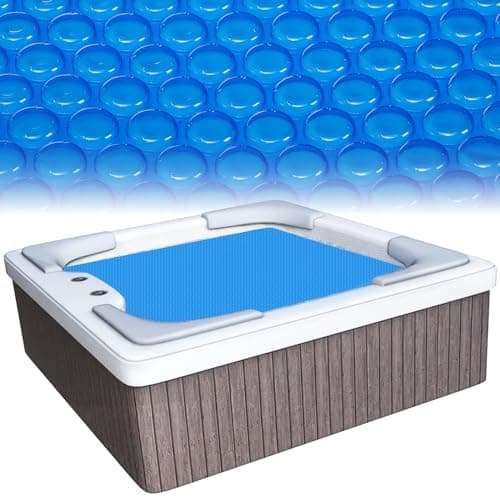
Spa thermal blanket
Generic · scored 7.7/10
Bubbles down. It floats on the water under the hard cover and cuts evaporative loss.
Most of a hot tub's heat leaves as evaporation from the water surface, not through the cover. A floating blanket sits directly on the water and stops that, which is a different mechanism from the hard cover's insulation and is why the two work together rather than competing.
Trim it to the water line, not the tub rim, and pull it out before you get in. Left in place under a soak it wraps around people and jets.
What the maker states
- Type
- Floating bubble blanket
- Orientation
- Bubble side down, against the water
- Sizing
- Cut to fit the water surface
- Replaces
- Nothing. Used under the hard cover.
How it scored
- Heat retention
- 7.5
- Evaporation control
- 9.0
- Chemical saving
- 7.0
- Durability
- 6.0
- Value
- 9.0
Skip this one if: you think it replaces a hard cover. It does not: it has no structural strength and provides no safety barrier.
#2 · Best for extending a hard cover's life
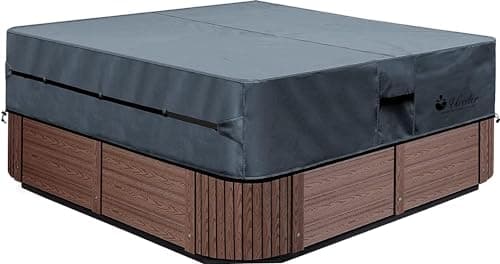
Hot tub cover cap
Generic · scored 7.2/10
The cheapest thing on this page and, per dollar, the most effective.
Vinyl hard covers fail two ways: UV cracks the top skin, then water gets into the foam and the cover gets heavy. A cap addresses the first cause, which is what makes it cheap prevention against an expensive replacement.
It buys time; it does not reverse damage. A cover already saturated with water needs a new foam core or a new cover, and no cap will help.
What the maker states
- Type
- Slip-over cap for a hard cover
- Purpose
- Blocks UV and sheds standing water
- Fixing
- Elasticated skirt or straps
- Sizing
- By hard cover dimensions
How it scored
- Weather protection
- 8.0
- Heat retention
- 1.5
- Fit accuracy
- 7.0
- Durability
- 6.5
- Value
- 9.5
Skip this one if: you take the cover off daily. A cap that has to come off and go back on every evening will end up in the corner of the yard by March.
#3 · Best for the weekly check
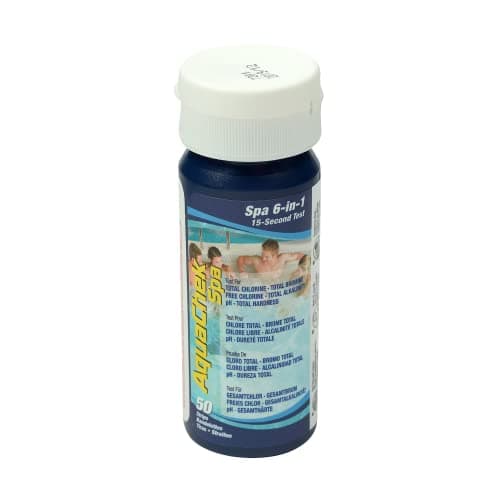
AquaChek Spa 6-in-1 Test Strips
AquaChek · scored 8.4/10
Six readings in fifteen seconds. Not precise, but precise enough to catch drift early.
Strips get an unfair reputation because people compare them to a reagent kit and call them inaccurate. That is the wrong comparison. The right one is against not testing at all, which is what happens when the routine takes ten minutes. A strip you actually use weekly beats a reference kit in a cupboard.
Two habits make strips far more reliable: keep the container sealed and out of the humid room the tub is in, and read them in daylight rather than under a yellow bulb. Most strip complaints trace back to one of those two.
What the maker states
- Reads
- Hardness, total chlorine, free chlorine, bromine, pH, alkalinity
- Method
- Dip-and-read colorimetric strip
- Time
- Seconds, per the label
- Storage
- Sealed container, away from humidity
How it scored
- Accuracy
- 6.5
- Speed
- 10.0
- Parameters covered
- 9.0
- Cost per test
- 9.0
- Availability
- 9.5
Skip this one if: you need an exact free chlorine number to diagnose a problem. Strips read in color bands; a drop-based kit reads in numbers.
Questions people actually ask
Frequently asked questions
Should you turn a hot tub off in winter?
Not while water is still in it. A heated, circulating tub protects its own plumbing, whereas one switched off in a freeze with water inside is a burst-pipe risk. The two safe positions are running it properly or draining and winterizing it properly.
Is it cheaper to turn a hot tub down in winter?
Usually not on a well-covered tub. Reheating from a lower temperature uses back the energy you saved and the tub is unusable in the meantime. The bigger winter saving is fixing heat loss: a cover that seals, plus a floating thermal blanket underneath it.
How do you protect a hot tub cover from snow?
Clear it after each fall with a broom or foam snow rake, never a shovel, and never stand or kneel on the cover. Condition the vinyl in autumn rather than spring, because flexible vinyl handles freeze-thaw far better than vinyl that has gone chalky over summer.
What happens to a hot tub in a winter power cut?
Keep the cover on and latched and resist opening it, because a full, covered tub holds heat for a long time. If the outage will be long and hard freezing is forecast, draining the tub and equipment properly is safer than hoping. Where that line sits depends on your specific tub, so check your manual.
Do you still need chemicals in a hot tub in winter?
Yes. Sanitizer decays whether or not anyone uses the tub, and cold weather does not change the targets: pH 7.2 to 7.8, at least 3 ppm free chlorine or 4 to 8 ppm bromine. Bromine is more forgiving for a tub that gets checked less often in bad weather.
Where the numbers come from
Sources
- CDC, Model Aquatic Health Code (2023, 4th edition) - the source for the pH 7.2-7.8 range and the hot-tub disinfectant levels quoted on this site
- CDC, Preventing Hot Tub Rash - the source for the 4-8 ppm bromine figure, the prevention steps, and the guidance on when to see a healthcare provider
- CDC, Controlling Legionella in Hot Tubs - the primary reference for the health and disinfection guidance quoted here
Read next
Related on Float & Filter
- Covers for cold climates and snow load
The cover side, where winter care is mostly structural.
- Thermal blanket vs hard cover
A blanket earns most in the coldest months.
- What hot tub maintenance actually costs
Winter is when the cover's condition shows up on the bill.
- Draining and refilling a hot tub
Do the pre-winter water change on a mild day, not in January.
- Hot tub leak repair
Finding and fixing a leak, including the ones a cold snap leaves behind.