Comparison
Hot Tub Enzymes vs Chlorine
This is not a choice. Enzymes digest the oils; chlorine kills the germs. Running enzymes instead of a sanitizer leaves the tub unsanitized.
By Scooter M. · Published · How we pick

How this page is funded: the buy buttons below are Amazon affiliate links. If you buy through one we earn a commission at no extra cost to you. It does not change what we recommend, and where the better answer is a retailer we earn nothing from, we say so. The full version.
The verdict, up front. This is not an either/or, and the framing is the problem. Chlorine (or bromine) is a sanitizer: it kills germs and holds a residual. Enzymes are not sanitizers at all; they break down the body oils, lotions and organic residue that would otherwise consume your sanitizer and turn into scum and chloramines.
Run both and the tub is easier to keep clear and needs less sanitizer to stay in range. Run enzymes alone and you have a tub with no disinfectant residual, which is a health question rather than a preference.[source]
What each one actually does
| Job | Enzymes | Chlorine or bromine |
|---|---|---|
| Kills bacteria | No | Yes, this is the entire point |
| Holds a measurable residual | No | Yes |
| Breaks down body oils and lotions | Yes, continuously | Partly, by oxidizing them and being consumed |
| Reduces scum line and foam | Yes, at the cause | Indirectly |
| Reduces chloramine formation | Yes, by removing what forms them | No, chlorine is half of the reaction |
| Required by public health guidance | No | Yes, a residual is the core requirement |
| Works while you are in the water | Slowly, over days | Yes, immediately |
Read down the two columns and the complementarity is obvious. There is no row where they compete; there are rows where only one of them scores at all.
Where the “versus” framing comes from
Two places, and both are understandable.
Marketing. Enzyme products are sold on the promise of “fewer chemicals”, which is true in a narrow and specific sense — you will use less sanitizer — and false in the sense most buyers hear it, which is that you can stop using sanitizer.
Real experience. People who start dosing enzymes genuinely do find their water easier to keep clear and their sanitizer demand lower. That is a real effect with a real mechanism: less organic load means less for the chlorine to consume. It is easy to extrapolate from “I need less” to “I need none”, and the extrapolation is where it goes wrong.
What enzymes genuinely do for you
- Lower sanitizer consumption. Chlorine spent oxidizing body oil is chlorine not available to sanitize. Remove the oil by another route and the residual holds better.
- Fewer chloramines. Chloramines form when chlorine meets organics. Fewer organics, fewer chloramines, less of the “too much chlorine” smell that actually means the opposite.
- A much lighter scum line. This is the most visible benefit and the fastest to notice — see the hot tub scum line.
- Less foaming. Same cause, different symptom — why your hot tub foams.
- Less work for the filter. Oil is what kills cartridges, so a lower oil load means longer between soaks.
What they do not do
- Sanitize. No enzyme product on the market claims to, and the reputable ones say so on the label.
- Replace shock. You still need to oxidize what the enzymes have not reached, and on a bromine tub the shock also reactivates spent bromide — shocking a hot tub.
- Fix biofilm. Growth inside the plumbing is not an oil problem and is not reached by anything in the water at normal doses.
- Work fast. Enzymes act over days. If the tub is foaming and guests arrive in an hour, that is a different product and a different page.
Choose enzymes as an addition if...
- You get a persistent scum line or recurring foam.
- Your household uses lotions or sunscreen and gets in anyway.
- Your sanitizer demand seems high for the bather load.
- You are willing to treat it as a weekly recurring cost.
Skip them if...
- Everyone already rinses before getting in, and you have no scum line. The habit does most of what the product does, for nothing.
- You are looking for a way to stop using sanitizer.
- You want an immediate result today.
Running both together
There is no conflict to manage. Reputable enzyme products state compatibility with chlorine and bromine, and the practical routine is simply the normal one with a weekly enzyme dose added.
- Test weekly and hold the sanitizer residual as usual.
- Dose the enzyme weekly per the label. It is a maintenance product, not a rescue one.
- Shock weekly, and after heavy use.
- Keep the filter clean. Enzymes reduce the load; they do not remove it.
The targets do not change because you are dosing enzymes: pH 7.2 to 7.8, at least 3 ppm free chlorine or 4 to 8 ppm bromine.[source][source] If anything, enzymes make holding those numbers easier, which is the whole argument for them.
Enzymes and mineral systems are not the same claim
Worth separating, because both get described as “alternative” water care. A mineral cartridge releases silver or copper ions that inhibit growth, and is designed to let you run a reduced sanitizer level. An enzyme does not inhibit anything biological; it digests organics. Neither replaces a residual, but only one of them is even in the sanitizing conversation — salt vs mineral vs traditional covers that side.
The honest summary
Enzymes are a good product sold with a slightly misleading frame. Buy them for what they actually do — less scum, less foam, lower sanitizer demand, longer filter life — and keep doing everything you were already doing. If your goal is a tub that needs less attention overall, the bigger levers are rinsing before you get in and changing the water on schedule, and both are free.
What fixes it
The products for this job
Named because they do the specific job this page describes, not because they are the only options. Specifications are the manufacturer’s published figures.
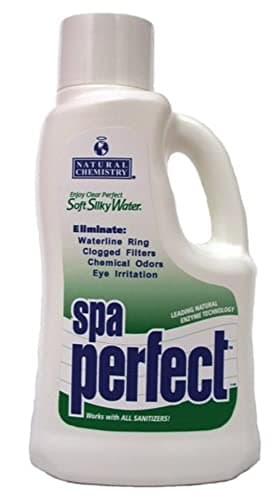
#1 · Best for treating the cause of foam and scum
Natural Chemistry Spa Perfect
Natural Chemistry · scored 7.6/10
Enzymes eat the oils that make foam and scum lines. Slower than defoamer, and actually a fix.
Foam, scum lines and that dull film on the waterline are all the same problem: organic load the sanitizer has not oxidized. Enzymes work continuously on that load, which is why a tub dosed weekly develops far less of a scum line.
The trade-off is patience and running cost. This is a weekly maintenance product, so budget for it as a monthly cost rather than a one-off purchase.
What the maker states
- Type
- Enzyme concentrate
- Targets
- Body oils, lotions, organic residue
- Dosing
- Weekly, per the label
- Compatible with
- Chlorine and bromine, per the maker
How it scored
- Immediate effect
- 3.0
- Duration
- 8.5
- Treats the cause
- 8.5
- Value
- 7.0
- Availability
- 8.5
Skip this one if: you want an instant result. Enzymes work across days, not seconds, and they will not clear a foaming tub before guests arrive.
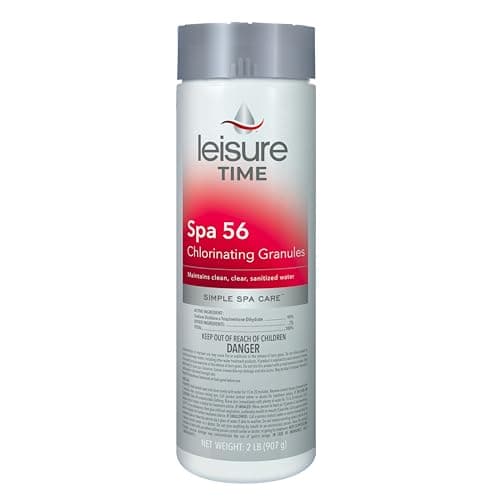
#2 · Best for chlorine users and fast recovery
Leisure Time Spa 56 Chlorinating Granules
Leisure Time · scored 8.1/10
Dichlor granules: dissolve fast, act fast, gone fast. The right tool after a heavy soak.
Dichlor is the granular chlorine hot tubs are dosed with, because it dissolves at spa temperature without pre-mixing and it is close enough to pH-neutral not to wreck your balance every time you add it. After a soak with four people in the tub, a measured dose of dichlor is the fastest way to get free chlorine back where the CDC says it should be.
The catch is cyanuric acid. Dichlor is stabilized, so every dose adds CYA that never leaves except by draining. Across a full water cycle that CYA accumulates and progressively blunts your chlorine, which is one of the real arguments for changing the water on schedule rather than topping up forever.
What the maker states
- Chemistry
- Sodium dichlor granules
- Dissolving
- Fast, no pre-mixing required per the label
- Target residual
- CDC gives at least 3 ppm free chlorine in hot tubs
- Adds cyanuric acid
- Yes, dichlor is stabilized
How it scored
- Stability at 104F
- 6.0
- Ease of dosing
- 8.5
- Odor and skin feel
- 8.0
- Cost per month
- 8.5
- Availability
- 9.5
Skip this one if: you only use the tub every couple of weeks. Dichlor burns off quickly at spa temperature, so an unattended chlorine tub goes unsanitized far sooner than a bromine one.
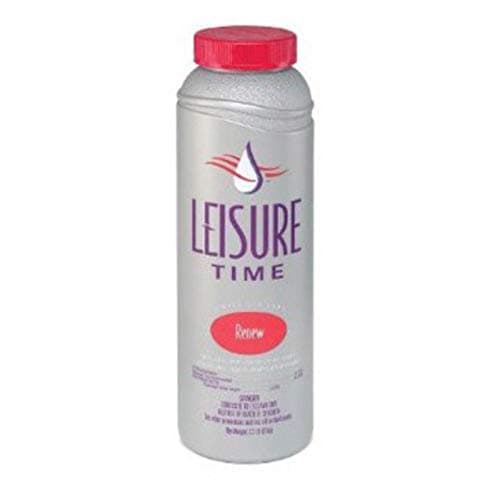
#3 · Best for the weekly oxidize
Leisure Time Renew Non-Chlorine Shock
Leisure Time · scored 8.6/10
The shock you can use and get back in the water quickly. Oxidizes; does not sanitize.
Non-chlorine shock does one job well: it oxidizes the organic load a soak leaves behind, which is what turns water dull and gives it that flat, used smell. On a bromine tub it does a second job for free, converting spent bromide back into active bromine.
Understand what it is not. MPS is an oxidizer, not a sanitizer. If the problem is biological rather than organic, this will not fix it and the tub will stay exactly as cloudy as it was.
What the maker states
- Chemistry
- Potassium monopersulfate (MPS)
- Job
- Oxidizes body oils, lotions and sweat
- Reactivates bromine
- Yes, on a bromine tub
- Wait before soaking
- Per the label, typically about 15 minutes
How it scored
- Oxidizing power
- 8.0
- Ease of dosing
- 9.5
- Odor and skin feel
- 9.0
- Cost per month
- 8.0
- Availability
- 9.0
Skip this one if: you are dealing with an actual contamination event. MPS burns off organics, it does not kill what a chlorine shock kills, and reaching for it instead is a common reason a cloudy tub stays cloudy.
Questions people actually ask
Frequently asked questions
Can you use enzymes instead of chlorine in a hot tub?
No. Enzymes break down body oils and organic residue; they do not kill germs and they hold no measurable residual. A tub running enzymes alone is an unsanitized tub. They are an addition to a sanitizer, not a replacement for one.
Do hot tub enzymes reduce chlorine use?
Yes, and that is the real benefit. Chlorine spent oxidizing body oils is chlorine unavailable to sanitize, so removing those oils by another route means the residual holds better and you dose less.
How often should you add enzymes to a hot tub?
Weekly, per the product label. Enzymes are a maintenance product that works over days rather than a rescue product that works in minutes, so budget for them as a recurring monthly cost rather than a one-off purchase.
Are enzymes safe with bromine?
Reputable enzyme products state compatibility with both chlorine and bromine, and the routine is simply your normal one with a weekly enzyme dose added. Check the specific label, as always.
Will enzymes get rid of hot tub foam?
Over days, yes, because they digest the surfactants causing it. They will not clear a foaming tub before guests arrive, which is what defoamer is for. Defoamer treats the appearance; enzymes treat the cause.
Where the numbers come from
Sources
- CDC, Model Aquatic Health Code (2023, 4th edition) - the source for the pH 7.2-7.8 range and the hot-tub disinfectant levels quoted on this site
- CDC, Controlling Legionella in Hot Tubs - the primary reference for the health and disinfection guidance quoted here
- CDC, Preventing Hot Tub Rash - the source for the 4-8 ppm bromine figure, the prevention steps, and the guidance on when to see a healthcare provider
Read next
Related on Float & Filter
- The best hot tub clarifiers and defoamers
Where the enzyme sits against the products that treat symptoms.
- The hot tub scum line
The most visible thing an enzyme fixes.
- Hot tub chlorine and bromine levels
The residual enzymes make easier to hold, and never replace.
- Salt water vs mineral vs traditional sanitizing
The other set of products sold as alternative water care.
- Hot tub ozonators
The same supplemental-versus-sanitizer distinction, on the equipment side.
- The best hot tub scum absorbers
The physical way to remove the same organic load, at a fraction of the price.