Buyer's guide
Inflatable Hot Tub Chemicals
Same chemicals as a hard tub, half the water, twice the bathers per gallon and a vinyl liner instead of acrylic. Everything that is different follows from those four facts.
By Scooter M. · Published · How we pick

How this page is funded: the buy buttons below are Amazon affiliate links. If you buy through one we earn a commission at no extra cost to you. It does not change what we recommend, and where the better answer is a retailer we earn nothing from, we say so. The full version.
The short answer
Top pick
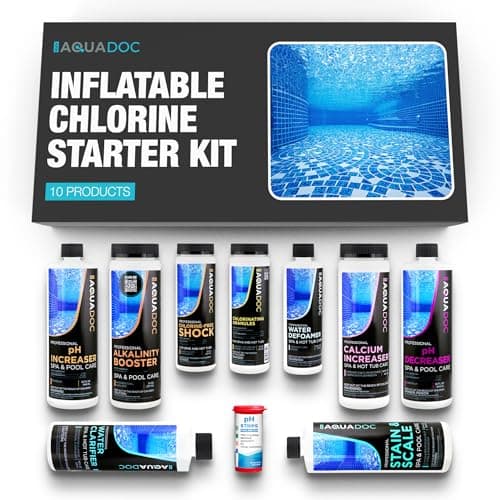
AquaDoc inflatable hot tub chemical kit, chlorine
The only kit here actually sold for inflatables, and it contains the whole list rather than most of it.
Quick picks
Tap a row to jump to the full write-up. Prices come from the live price layer, never from memory.
| # | Product | Best for | Score | Price |
|---|---|---|---|---|
| 1 | AquaDoc inflatable hot tub chemical kit, chlorineThe only kit here actually sold for inflatables, and it contains the whole list rather than most of it. | A first inflatable, in one box | 7.8out of 10 | $91.99 · View on Amazon#ad how this is funded · price as of October 17, 2026 |
| 2 | 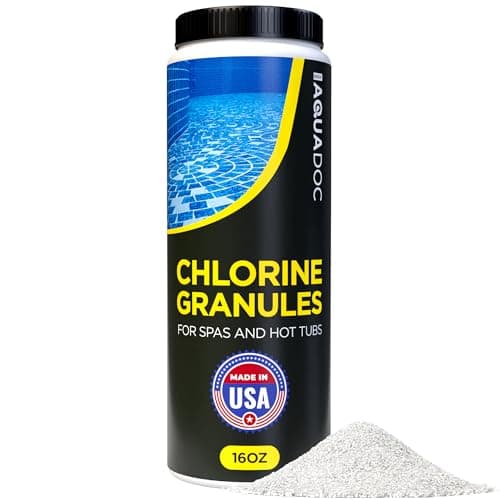 AquaDoc hot tub chlorine granules, 1 lbA pound of fast-dissolving granules, which is the right size for a tub this small. AquaDoc hot tub chlorine granules, 1 lbA pound of fast-dissolving granules, which is the right size for a tub this small. | Buying the sanitizer on its own | 7.6out of 10 | $24.99 · View on Amazon#ad how this is funded · price as of October 17, 2026 |
| 3 | 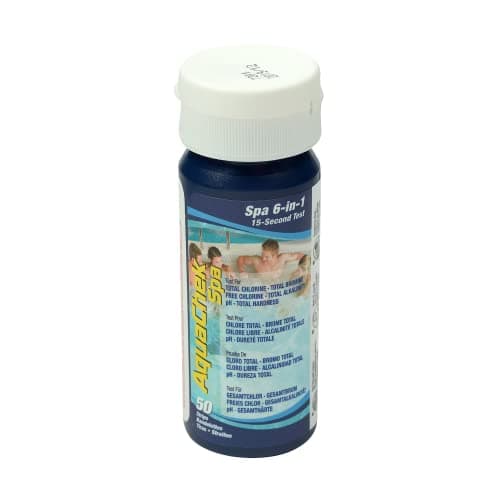 AquaChek Spa 6-in-1 Test StripsSix readings in fifteen seconds. Not precise, but precise enough to catch drift early. AquaChek Spa 6-in-1 Test StripsSix readings in fifteen seconds. Not precise, but precise enough to catch drift early. | The weekly check | 8.4out of 10 | $11.99 · View on Amazon |
| 4 | 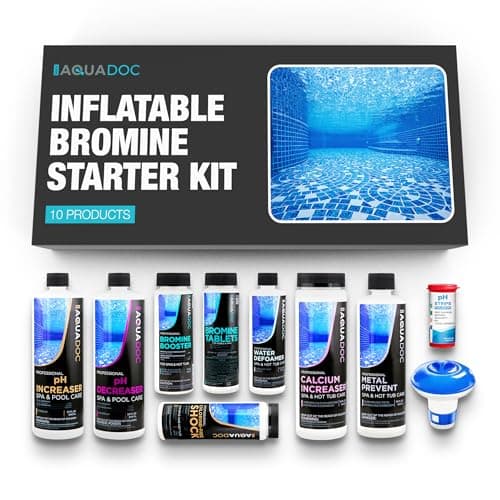 AquaDoc inflatable hot tub chemical kit, bromineThe bromine version, and it includes both the booster and the floater — the two things people forget. AquaDoc inflatable hot tub chemical kit, bromineThe bromine version, and it includes both the booster and the floater — the two things people forget. | Leaving it alone between soaks | 7.7out of 10 | $91.99 · View on Amazon#ad how this is funded · price as of October 17, 2026 |
| 5 | 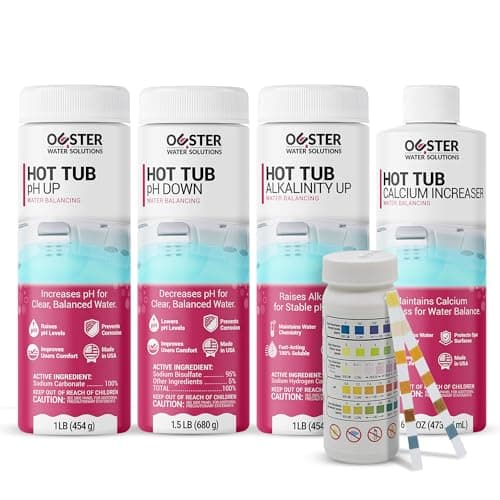 Bio Ouster hot tub water balancing kitAll four balancers and strips in one box. Buy it alongside a sanitizer, never instead of one. Bio Ouster hot tub water balancing kitAll four balancers and strips in one box. Buy it alongside a sanitizer, never instead of one. | Balancers without a sanitizer | 7.5out of 10 | $44.97 · View on Amazon#ad how this is funded · price as of October 17, 2026 |
| 6 | 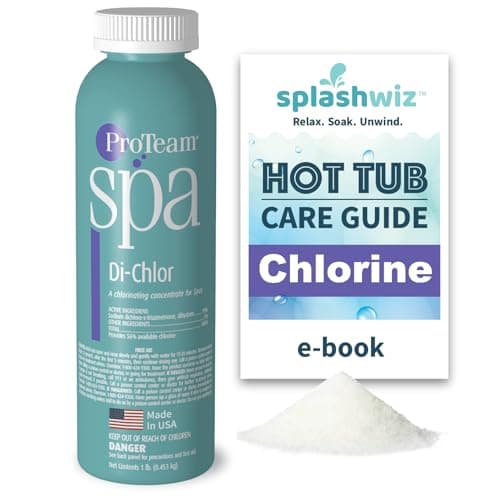 ProTeam Spa DiChlor chlorine granules, 1 lbGood granules with an unusually specific label — including a target residual we would not follow. ProTeam Spa DiChlor chlorine granules, 1 lbGood granules with an unusually specific label — including a target residual we would not follow. | Dichlor with the percentage printed | 7.0out of 10 | $29.99 · View on Amazon#ad how this is funded · price as of October 17, 2026 |
Scores are our own, from the published scoring method on how we pick. They are an editorial judgment of published specifications, not a test result, and they are deliberately kept out of the page’s structured data.
The verdict, up front. There is no such thing as an inflatable-specific chemical. The sanitizer, the balancers and the shock are the same products a hard tub uses, and any bottle marketed as “for inflatable spas” contains the same actives as the one next to it.
What changes is everything around the chemical: your tub holds roughly half the water, carries far more people per gallon, blows air through itself constantly, and is lined with vinyl rather than acrylic. Those four facts are why an inflatable swings faster and forgives less, and they are what this page is actually about.
The four differences that matter
| Difference | Why it changes your chemistry | What to do about it |
|---|---|---|
| Much smaller volume | Dosing instructions are written per 500 gallons. An inflatable often holds less than half that, so a full scoop is a large overdose. | Find your tub’s gallons and scale every dose to it |
| More bathers per gallon | Four people in 210 gallons is a far heavier organic load than four people in 450. | Shock after use, not on a fixed day of the week |
| Constant aeration | The bubble blower strips carbon dioxide out of the water, which drives pH upward every time you run it. | Expect to correct pH down, not up, most weeks |
| Vinyl liner, not acrylic | An undissolved tablet or a pile of granules sits against a bladder you cannot buff out. | Nothing solid touches the liner, ever |
Volume is the whole story
This is the single most useful thing on the page. Most spa chemical labels give a dose per 500 gallons, because that is roughly a mid-size hard tub. Popular inflatable tubs hold substantially less — check the figure printed in your own manual rather than guessing, because it varies a lot between models and between the four-person and six-person versions of the same tub.
Once you know your number, every dose becomes arithmetic. If the label says one capful per 500 gallons and your tub holds 250, you are using half a capful. People who skip this step spend their first month bouncing between a chlorine reading of zero and a chlorine smell that drives everyone back indoors, and conclude the tub is faulty.
Write your gallons on a piece of tape stuck to the pump housing. It is the number you will reach for every single time.
The bubbles are doing something to your pH
Worth its own section because it is genuinely specific to these tubs and almost nobody explains it. Running air through water strips dissolved carbon dioxide out of it, and removing carbon dioxide raises pH. An inflatable’s air blower is a very effective aerator, so a tub that gets used with the bubbles on will drift upward week after week.
The practical consequences: you will reach for pH decreaser far more often than increaser, and a tub that will not hold its pH is usually being aerated rather than being badly dosed. Correct alkalinity first, because alkalinity is what resists that drift — the full order is on pH and total alkalinity.
This also matters for sanitizer effectiveness. Chlorine gets progressively weaker as pH climbs, so a tub sitting at the top of the range is getting less out of the same dose.
How we judged these
| Criterion | Why it matters here |
|---|---|
| Covers the whole list | A first-time owner needs a sanitizer, four balancers, a shock and strips. A bottle that covers one of those is not a starting point. |
| Sized for a small tub | A 5 lb tub of granules is a worse buy than a 1 lb bottle when your tub holds 250 gallons and the product absorbs moisture. |
| Cost vs buying separately | Kits carry a premium. It is worth paying once and not worth paying twice. |
| Beginner clarity | Whether the labeling helps or misleads someone dosing their first tub. |
| Nothing wasted | Bottles you will never open are not a bargain, however complete the kit looks. |
The list, for an inflatable
- A sanitizer. Chlorine granules if you use the tub often and want to dose on demand; bromine tablets in a floater if it sits between soaks. The full comparison is on bromine vs chlorine.
- Test strips. Non-negotiable, and the cheapest item here. You cannot dose a small volume by eye.
- pH decreaser, and probably increaser. The blower means you will mostly be going down.
- Alkalinity increaser. Fix this before pH, every time.
- Non-chlorine shock. After heavy use rather than on a schedule — see shocking a hot tub.
- A floater, if you run tablets. Most inflatables have nowhere to put one otherwise.
Calcium hardness increaser is the one item that depends entirely on your fill water rather than your tub, and it is genuinely optional on hard water. See hot tub calcium hardness.
Never put a tablet straight in the water
On an acrylic tub this rule exists because a tablet resting against the shell bleaches a permanent pale patch. On an inflatable the stakes are higher: the same tablet is resting against a vinyl bladder, and concentrated sanitizer sitting on vinyl degrades it. A leak in the liner is not a cosmetic problem.
The same logic applies to granules. Add them with the pump circulating so they disperse in the water column rather than settling on the floor, which is exactly why the fast-dissolving products are worth preferring here. If you are running tablets, they go in a floating dispenser — the options are on the floating dispenser roundup.
The targets do not change
A smaller tub does not get a smaller standard. The figures are the same ones this site uses everywhere: pH 7.2 to 7.8, at least 3 ppm free chlorine, or 4 to 8 ppm bromine.[source][source]
If anything an inflatable makes holding them more important, not less. It is hot, it is heavily loaded per gallon, and it is aerated constantly — which is the exact combination the public health guidance on hot tubs is written about.[source] Be wary of any product label quoting a lower target residual than that; one of the picks below does, and we have marked it.
What people get wrong in the first month
- Dosing to the label instead of to the volume. The most common error and the easiest to avoid.
- Treating the filter as an afterthought. An inflatable’s cartridge is tiny relative to the water it serves and blinds off in days, not months. When it does, sanitizer demand climbs and the water goes cloudy — see the best inflatable hot tub filters.
- Assuming there is an ozonator helping. Almost no inflatable has one, so the sanitizer is doing all of the work on its own. Ozonators explains what you are not getting.
- Chasing foam with defoamer. Small volume plus soft water plus lotions foams readily. Defoamer hides it for an evening; the cause is on why your hot tub foams.
- Leaving the water too long. The usual interval rule divides volume by three and then by daily bathers, so a small tub reaches the end of its water far sooner than a hard tub does — how often to change hot tub water.
Kit or separate bottles?
Buy the kit for a first fill. You will not know what your water needs until you have tested it, and a kit means one order instead of discovering on a Saturday that you have no alkalinity increaser.
Buy separately from the second fill onward. By then you know which two bottles you actually reach for, and kits are never the cheapest route once your cupboard is stocked. That is the same conclusion as the starter kit roundup reaches for hard tubs, and it holds here.
On prices, and on what these scores are
A season of chemicals for an inflatable is a modest cost — comfortably less than the tub, and less than most people expect. Every button reads the live price where our price layer has one; anything we cannot verify, we do not print. The reasoning is on how we pick.
The scores are an editorial judgment of published kit contents, pack sizes and label quality against our published method. We have not tested these products or opened a kit — every content list above is quoted from the seller’s own listing — and there is no rating markup in this page’s structured data.
The honest summary
Find out how many gallons your tub holds, buy a kit for the first fill, halve the doses the label suggests, and test before you add anything. The chemistry is not harder than a hard tub’s — it is just less forgiving of a guess, because there is less water to absorb the mistake.
Every pick, in full
The picks in detail
Specifications below are the manufacturer’s own published figures, attributed as such. We have not tested these units and the scores are an editorial judgment of published data against the published method, not a test result.
#1 · Best for a first inflatable, in one box
AquaDoc inflatable hot tub chemical kit, chlorine
MAV AquaDoc · scored 7.8/10
The only kit here actually sold for inflatables, and it contains the whole list rather than most of it.
Most spa starter kits are written for a 400-gallon acrylic tub and sold to inflatable owners anyway. This one is listed specifically for inflatables, and more usefully it includes every category a new owner actually needs: a sanitizer, all four balancers, a non-chlorine shock and strips to read the result.
The honest cost note: a kit is never the cheapest way to buy chemicals once you know what your water does. It is the cheapest way to avoid three separate orders in your first fortnight, which for a first-time owner is usually the better trade. Two of the bottles are fill-water insurance rather than routine products, so expect them to last years.
What the maker states
- Contains
- Chlorine granules, pH increaser, pH decreaser, alkalinity increaser, calcium hardness increaser, chlorine-free shock, stain and scale remover, metal prevent, defoamer, test strips, per the listing
- Sanitizer
- Chlorine granules
- Sold for
- Inflatable hot tubs and spas, per the listing
- Test strips
- Included, per the listing
How it scored
- Covers the whole list
- 9.5
- Sized for a small tub
- 8.0
- Cost vs buying separately
- 6.5
- Beginner clarity
- 9.0
- Nothing wasted
- 6.0
Skip this one if: your fill water is soft municipal water. You are paying for a stain-and-scale bottle and a metal remover that your water may never need.
#2 · Best for buying the sanitizer on its own
AquaDoc hot tub chlorine granules, 1 lb
MAV AquaDoc · scored 7.6/10
A pound of fast-dissolving granules, which is the right size for a tub this small.
One pound is the right unit for an inflatable. The 5 lb tubs that suit a hard tub are a poor buy here, because chlorine granules absorb moisture over time and a small tub will not get through five pounds before that starts to matter.
Fast dissolving is not marketing fluff on a vinyl-lined tub. Granules that sit on the floor before dissolving are sitting on a liner rather than on acrylic, so add them with the pump running and never tip them into still water.
What the maker states
- Form
- Chlorinating granules
- Size
- 1 lb, per the listing
- Dissolve speed
- Quick-dissolving, per the listing
- Method
- Add while the water is circulating, per the listing
How it scored
- Covers the whole list
- 3.0
- Sized for a small tub
- 9.5
- Cost vs buying separately
- 9.0
- Beginner clarity
- 7.5
- Nothing wasted
- 9.0
Skip this one if: you have nothing else. Granules alone are not a routine — you still need strips and something to move pH with.
#3 · Best for the weekly check
AquaChek Spa 6-in-1 Test Strips
AquaChek · scored 8.4/10
Six readings in fifteen seconds. Not precise, but precise enough to catch drift early.
Strips get an unfair reputation because people compare them to a reagent kit and call them inaccurate. That is the wrong comparison. The right one is against not testing at all, which is what happens when the routine takes ten minutes. A strip you actually use weekly beats a reference kit in a cupboard.
Two habits make strips far more reliable: keep the container sealed and out of the humid room the tub is in, and read them in daylight rather than under a yellow bulb. Most strip complaints trace back to one of those two.
What the maker states
- Reads
- Hardness, total chlorine, free chlorine, bromine, pH, alkalinity
- Method
- Dip-and-read colorimetric strip
- Time
- Seconds, per the label
- Storage
- Sealed container, away from humidity
How it scored
- Accuracy
- 6.5
- Speed
- 10.0
- Parameters covered
- 9.0
- Cost per test
- 9.0
- Availability
- 9.5
Skip this one if: you need an exact free chlorine number to diagnose a problem. Strips read in color bands; a drop-based kit reads in numbers.
#4 · Best for leaving it alone between soaks
AquaDoc inflatable hot tub chemical kit, bromine
MAV AquaDoc · scored 7.7/10
The bromine version, and it includes both the booster and the floater — the two things people forget.
Two inclusions make this worth the kit premium on a bromine tub. The bromine booster is sodium bromide, and without it tablets will not hold a reading on a fresh fill — it is the single most common reason a new bromine tub tests zero for a week. The floater matters because most inflatables ship with nowhere to put a tablet.
Note what is missing against the chlorine version: there is no alkalinity increaser in the listed contents. If your fill water is low on alkalinity you will be buying that separately, so test the water out of the hose before you decide this kit is complete.
What the maker states
- Contains
- Bromine tablets, bromine booster, pH increaser, pH decreaser, calcium hardness increaser, chlorine-free shock, metal prevent, defoamer, test strips and a floater, per the listing
- Sanitizer
- Bromine tablets
- Bromide bank
- Booster included, per the listing
- Floater
- Included, per the listing
How it scored
- Covers the whole list
- 9.0
- Sized for a small tub
- 8.0
- Cost vs buying separately
- 6.5
- Beginner clarity
- 8.5
- Nothing wasted
- 6.5
Skip this one if: you use the tub most evenings. Bromine suits a tub that sits between soaks; a daily-use tub is better on chlorine you can dose on demand.
#5 · Best for balancers without a sanitizer
Bio Ouster hot tub water balancing kit
Bio Ouster · scored 7.5/10
All four balancers and strips in one box. Buy it alongside a sanitizer, never instead of one.
This is the sensible second purchase for someone who bought granules on their own and then discovered that chlorine alone does not keep water comfortable. Getting all four balancers in one order is genuinely easier than working out which of them your water needs first.
Be clear about what it is not. There is no sanitizer in this box, and the included strips read pH, alkalinity and calcium rather than a chlorine or bromine residual. You still need a sanitizer and you still need strips that read one, which is why it sits below the full kits here.
What the maker states
- Contains
- pH up, pH down, alkalinity increaser, calcium hardness increaser, 50 test strips, per the listing
- Sanitizer
- None — this kit contains no sanitizer
- Sold for
- Acrylic, inflatable and wood tubs, per the listing
- Strips read
- pH, alkalinity and calcium, per the listing
How it scored
- Covers the whole list
- 6.0
- Sized for a small tub
- 8.0
- Cost vs buying separately
- 7.5
- Beginner clarity
- 8.0
- Nothing wasted
- 8.0
Skip this one if: you bought a full starter kit. You will already own every bottle in this box and a second set will outlive your tub.
#6 · Best for dichlor with the percentage printed
ProTeam Spa DiChlor chlorine granules, 1 lb
SplashWiz · scored 7.0/10
Good granules with an unusually specific label — including a target residual we would not follow.
Credit where it is due: this listing publishes its available chlorine percentage and states plainly that it is not for bromine or salt systems. That is more specificity than most of this category offers, and the 1 lb size is right for an inflatable.
The reason it ranks last is the dosing guidance, not the chemical. The listing describes maintaining a 1.0 to 2.0 ppm chlorine residual. The CDC figure for hot tubs is at least 3 ppm free chlorine, and a hot, heavily loaded, constantly aerated inflatable is the last place to run a pool-grade residual. Buy it if you like, dose it to the CDC number, and score its beginner clarity accordingly.
What the maker states
- Form
- Dichlor granules
- Available chlorine
- 56%, per the listing
- Size
- 1 lb, per the listing
- Not for
- Bromine-only or salt-generator spas, per the listing
How it scored
- Covers the whole list
- 3.0
- Sized for a small tub
- 9.5
- Cost vs buying separately
- 8.0
- Beginner clarity
- 5.5
- Nothing wasted
- 9.0
Skip this one if: you intend to dose to the number on the bottle. Its stated 1 to 2 ppm target sits below the CDC figure for hot tubs, and the CDC figure is the one we use.
Questions people actually ask
Frequently asked questions
What chemicals do I need for an inflatable hot tub?
A sanitizer (chlorine granules or bromine tablets), test strips, pH decreaser and increaser, alkalinity increaser, and a non-chlorine shock. Add a floating dispenser if you use tablets. Calcium hardness increaser depends on your fill water and is often unnecessary.
Are inflatable hot tub chemicals different from regular hot tub chemicals?
No. The actives are identical, and a bottle labeled for inflatable spas contains the same chemistry as the one beside it. What differs is the dose, because your tub holds far less water than the 500 gallons most labels assume.
How much chlorine do I put in an inflatable hot tub?
Enough to hold at least 3 ppm free chlorine, which is a test result rather than a fixed scoop. Work out your tub’s gallons from the manual and scale the label dose to it — most labels are written per 500 gallons, which is roughly double a typical inflatable.
Why does the pH in my inflatable hot tub keep rising?
The air blower. Running bubbles through the water strips out dissolved carbon dioxide, and that pushes pH up. It is normal on these tubs. Correct total alkalinity first, since that is what resists the drift, then bring pH down.
Can you put chlorine tablets directly in an inflatable hot tub?
No. A tablet resting against a vinyl liner degrades it, and a damaged bladder is not a cosmetic problem. Use a floating dispenser for tablets, and add granules with the pump running so they disperse instead of settling on the floor.
Where the numbers come from
Sources
- CDC, Model Aquatic Health Code (2023, 4th edition) - the source for the pH 7.2-7.8 range and the hot-tub disinfectant levels quoted on this site
- CDC, Preventing Hot Tub Rash - the source for the 4-8 ppm bromine figure, the prevention steps, and the guidance on when to see a healthcare provider
- CDC, Controlling Legionella in Hot Tubs - the primary reference for the health and disinfection guidance quoted here
Read next
Related on Float & Filter
- The best inflatable hot tub filters
The other half of inflatable water care, and the faster-moving consumable.
- What hot tub chemicals do you actually need?
The same list for a hard tub, without the volume arithmetic.
- The best hot tub chemical starter kits
Kits for full-size tubs, and when a kit stops being worth it.
- Hot tub pH and total alkalinity
Why the blower pushes pH up, and what to fix first.
- Hot tub leak repair
Patching an inflatable tub, and why a pour-in sealer is the wrong tool.
- The best inflatable hot tub covers
Replacing the lid, which fails sooner than anything else on these tubs.