Worth it?
Are Digital Hot Tub Water Testers Worth It?
For most single-tub households, no. A photometer fixes reading error, which is a real problem — but it is not the problem most people actually have.
By Scooter M. · Published · How we pick
How this page is funded: the buy buttons below are Amazon affiliate links. If you buy through one we earn a commission at no extra cost to you. It does not change what we recommend, and where the better answer is a retailer we earn nothing from, we say so. The full version.
The verdict, up front. For most people with one hot tub and no pool, a digital tester is not worth it. Not because photometers are bad — they are excellent, and they solve a genuine problem — but because the problem they solve is rarely the one holding your water back.
The problem they solve is reading error. The problem most owners actually have is testing frequency, and a costlier meter does nothing for a habit. A strip you use every week beats a photometer you use monthly, every time.
What a photometer actually does
Strips and drop kits both end the same way: a human looks at a color and decides which square on a chart it matches. That works, and it is also where most bad readings come from — a faded chart, a yellow kitchen bulb, dusk light on the patio, or simply the fact that the difference between 3 ppm and 5 ppm is two shades of the same pink.
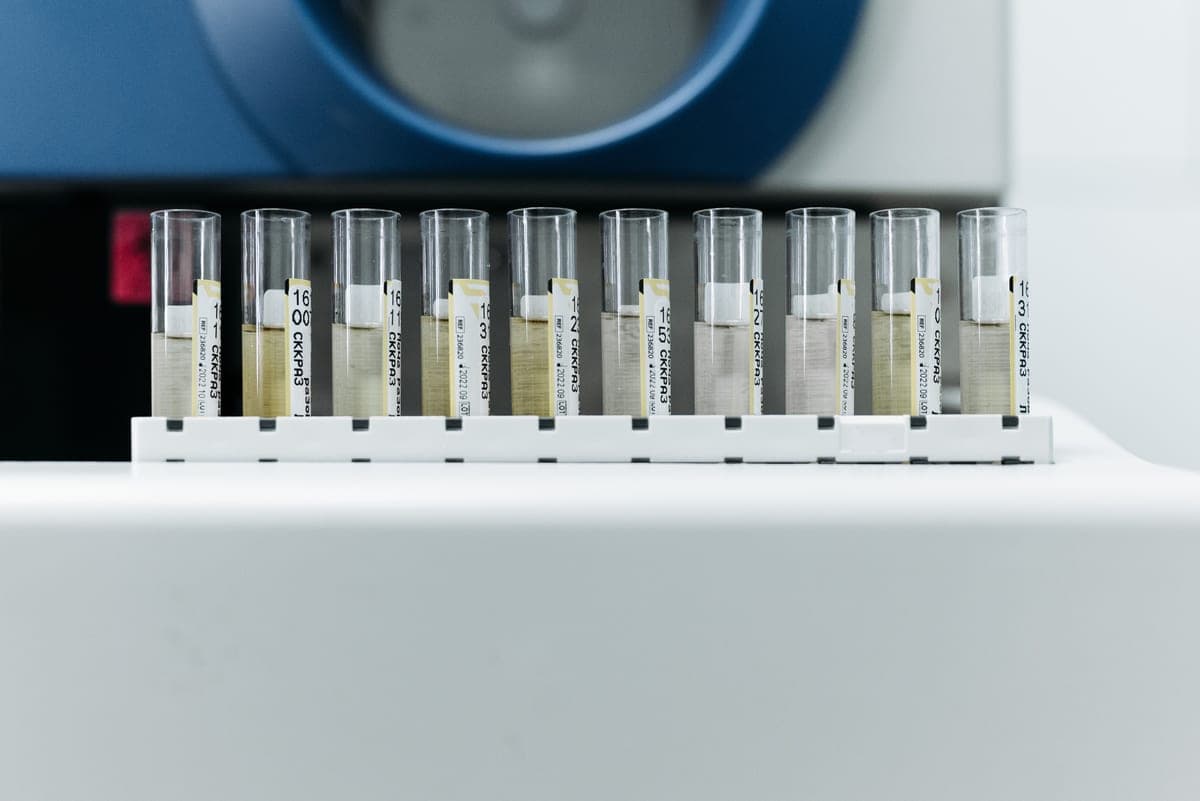
A photometer removes you from that step. It shines light through the sample, measures the absorbance, and returns a number. The number is repeatable in a way a human eye is not, and if two people in the same household have been disagreeing about the water for months, this is what settles it.
The honest cost picture
| Test strips | Drop kit (titration) | Photometer | |
|---|---|---|---|
| Up-front cost | Lowest | Moderate | Highest by a wide margin |
| Ongoing cost | Low | Low | Reagents, and not trivial |
| Time per test | Seconds | Several minutes | A minute or two |
| Removes reading error | No | No — you judge a color change | Yes |
| Reads cyanuric acid | Usually not | Yes, on the right kit | Yes, on the right model |
| Likely to be used weekly | Yes | Rarely | Sometimes |
Read the last row against the first. The cheapest option is the one people actually keep using, and consistency matters more to water quality than precision does. That is the whole argument in one line.
When a digital tester genuinely pays
- You also own a pool. The economics change completely. A meter serving a pool and a tub is amortized across far more water and far more testing, and the pool-scoped models read more parameters for a small increment.
- You are color-vision impaired. This is the clearest case of all. If matching pinks against a chart is not reliably possible for you, a photometer is not a luxury — it is the thing that makes testing work.
- You are chasing a persistent, unexplained problem. Water that will not hold a residual, or that looks wrong while testing fine, is a case where the precision is worth having because you are trying to distinguish small differences that matter.
If none of those describe you, the money is better spent elsewhere — a second filter cartridge, a cover cap, or simply a fresh pot of strips more often.
What no tester improves
- Sampling technique. Water scooped from the surface next to the floater is not representative. Collect elbow-deep, away from the jets and the dispenser, with the pump having run. A three-hundred-dollar meter reading an unrepresentative sample gives you a precise wrong answer.
- Testing frequency. Nothing about a meter makes you test more often. If anything, the extra setup makes it slightly less likely.
- Acting on the result. The reading is not the point — the dose is. See the dosage and levels chart.
- Reagent age. Photometer reagents degrade like any other. An out-of-date reagent produces a confident wrong number, which is arguably worse than an uncertain right one.
The targets do not change
Whatever you read them with, you are aiming at the same numbers: pH 7.2 to 7.8, at least 3 ppm free chlorine or 4 to 8 ppm bromine.[source][source] A better instrument does not move the target; it tells you more confidently where you are against it. Full detail on chlorine and bromine levels.
The middle option most people should consider first
Before a photometer, the upgrade that helps most owners is a drop-based titration kit used occasionally alongside weekly strips. It costs a fraction of a meter, it reads cyanuric acid, which most strips do not, and it gives a far more exact free chlorine figure when you need one to diagnose something.
The pattern that works: strips weekly because you will actually do it, drops monthly or when something looks wrong. That covers the precision gap for a small fraction of the cost, and it is what we would recommend to almost everyone reading this page. The options are on the test strips and test kits roundup.
If you are buying one anyway
- Match the scope to your water. A spa-scoped meter is cheaper and reads what a tub needs. A pool kit is worth it only if you have a pool.
- Check the reagent format. Strip-based reagents are faster and less fiddly than pipetting liquids, which matters because a test you can do standing at the tub is a test you will repeat.
- Price the refills before you buy the meter. This is the cost that surprises people, and it recurs.
- Logging is genuinely useful. Seeing that alkalinity has drifted for three weeks explains most “sudden” pH problems, and no single reading ever reveals it.
On prices, and on what these scores are
Photometers are the most expensive items on this site by a wide margin, which is precisely why we lead with the case against them. Every button reads the live price where our price layer has one; anything we cannot verify, we do not print. The reasoning is on how we pick.
The scores are an editorial judgment of published parameters, reagent format and up-front and ongoing cost, against our published method. We have not tested these meters, we have not compared their readings against a reference standard, and there is no rating markup in this page’s structured data. Note that the up-front cost scores are deliberately harsh and are the reason the most capable instrument ranks last.
The honest summary
Buy a photometer if you have a pool as well, if color matching does not work for you, or if you are diagnosing something stubborn. Otherwise buy strips you will use weekly and a drop kit for the arguments, and put the difference toward something that changes your water rather than something that measures it more precisely.
What fixes it
The products for this job
Named because they do the specific job this page describes, not because they are the only options. Specifications are the manufacturer’s published figures.
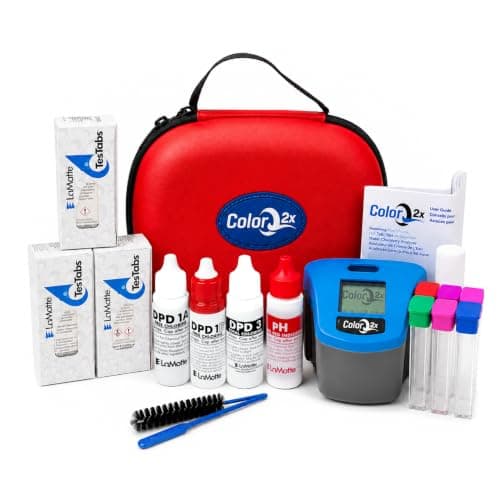
#1 · Best for the one to buy if you are buying one
LaMotte ColorQ 2X Pro 7 digital water tester
LaMotte · scored 7.4/10
A real photometer that reads seven parameters and removes color-matching from the process entirely.
The genuine case for a photometer is that it takes your eyes out of the loop. Strips and titration both end in a human judging a color, and in poor light against a faded chart that is where most bad readings come from. A meter reads the sample optically and gives you a number.
Two costs deserve to be stated plainly. The meter is expensive against every other way of testing this water, and the reagents are a recurring cost that is not trivial. It scores 3.5 on up-front cost for that reason, and that score is the argument against it.
What the maker states
- Type
- Photometer, liquid and tablet reagents
- Parameters
- 7, per the listing
- Model
- ColorQ 2X Pro 7 (2086), per the listing
- Ongoing cost
- Reagent refill kits, sold separately
How it scored
- Removes reading error
- 9.5
- Parameters covered
- 9.0
- Speed
- 6.5
- Up-front cost
- 3.5
- Ongoing reagent cost
- 5.0
Skip this one if: your problem is that you do not test often enough. A costlier meter does not fix a habit, and strips you actually use beat a meter in a drawer.
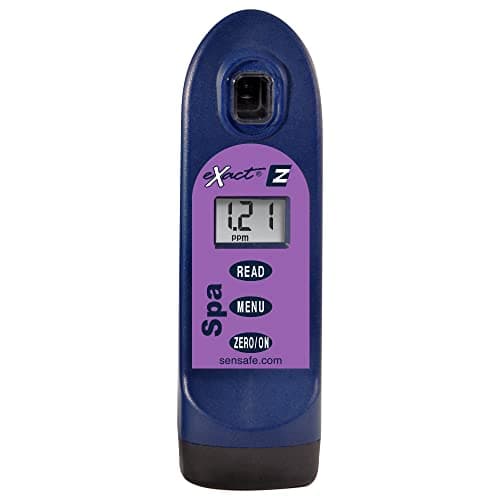
#2 · Best for a spa-specific meter, not a pool one
eXact Spa EZ photometer starter kit
Industrial Test Systems · scored 7.3/10
A photometer scoped to spa parameters rather than a pool kit you use two thirds of. Uses strip reagents.
The strip-reagent approach is faster and less fiddly than pipetting liquid reagents, which matters more than it sounds: a test you can do in a minute standing at the tub is a test you will actually repeat.
It is scoped to a spa, which is both the point and the limitation. If a pool is also in your life, buying the spa-only version is a false economy, and the pool kits from the same range read more parameters.
What the maker states
- Type
- Photometer, strip reagents
- Reads
- Alkalinity, bromine, calcium and more, per the listing
- Model
- 486202 Spa EZ, per the listing
- Ongoing cost
- Reagent strips, sold separately
How it scored
- Removes reading error
- 9.0
- Parameters covered
- 7.5
- Speed
- 8.0
- Up-front cost
- 4.5
- Ongoing reagent cost
- 6.0
Skip this one if: you also look after a pool. The pool-scoped versions of this meter cover more parameters for not much more money.
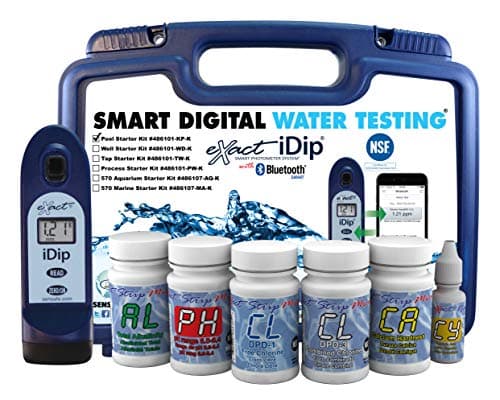
#3 · Best for a pool and a tub in the same garden
eXact iDip photometer pool starter kit
Industrial Test Systems · scored 7.0/10
The phone-connected one. Genuinely capable, and the most expensive way to test a hot tub on this page.
Logging matters more than it looks. A meter that keeps a history lets you see that alkalinity has been sliding for three weeks, which is the kind of drift that no single reading ever reveals and that explains most 'sudden' pH problems.
It ranks last here on purpose, and the score for up-front cost is why. It is the best instrument on the page and, for a household with one hot tub and no pool, the hardest to justify. We would rather tell you that than sell you the most expensive thing on the shelf.
What the maker states
- Type
- Bluetooth photometer, strip reagents
- Model
- 486101-KP-K pool starter kit, per the listing
- App
- Phone-connected logging, per the listing
- Ongoing cost
- Reagent strips, sold separately
How it scored
- Removes reading error
- 9.5
- Parameters covered
- 9.5
- Speed
- 8.0
- Up-front cost
- 2.5
- Ongoing reagent cost
- 5.5
Skip this one if: you only own a hot tub. This is far more meter than a single 350-gallon tub will ever justify.
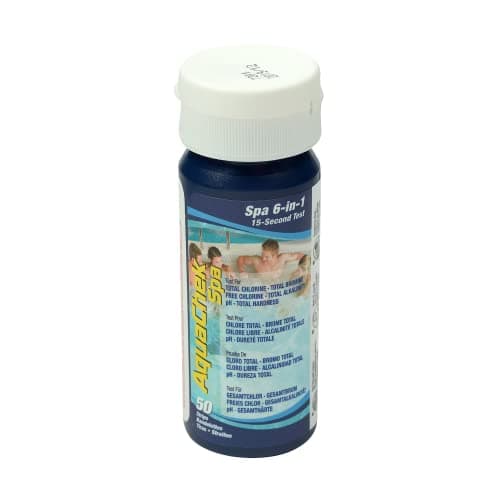
#4 · Best for the weekly check
AquaChek Spa 6-in-1 Test Strips
AquaChek · scored 8.4/10
Six readings in fifteen seconds. Not precise, but precise enough to catch drift early.
Strips get an unfair reputation because people compare them to a reagent kit and call them inaccurate. That is the wrong comparison. The right one is against not testing at all, which is what happens when the routine takes ten minutes. A strip you actually use weekly beats a reference kit in a cupboard.
Two habits make strips far more reliable: keep the container sealed and out of the humid room the tub is in, and read them in daylight rather than under a yellow bulb. Most strip complaints trace back to one of those two.
What the maker states
- Reads
- Hardness, total chlorine, free chlorine, bromine, pH, alkalinity
- Method
- Dip-and-read colorimetric strip
- Time
- Seconds, per the label
- Storage
- Sealed container, away from humidity
How it scored
- Accuracy
- 6.5
- Speed
- 10.0
- Parameters covered
- 9.0
- Cost per test
- 9.0
- Availability
- 9.5
Skip this one if: you need an exact free chlorine number to diagnose a problem. Strips read in color bands; a drop-based kit reads in numbers.
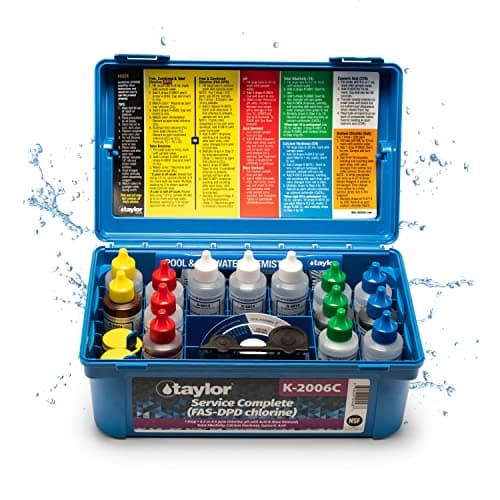
#5 · Best for getting a real number
Taylor K-2006C FAS-DPD Complete Test Kit
Taylor Technologies · scored 8.4/10
The reference kit. Overkill for a weekly check, decisive when something is wrong.
When a tub is misbehaving and the strips insist everything is fine, this settles the argument. FAS-DPD titration gives free and combined chlorine as separate numbers rather than a color band, and it reads cyanuric acid, which is often the invisible reason a chlorine tub feels under-sanitized.
It is a chlorine kit. Bromine owners who want the same rigor want the bromine variant instead. Either way, buy replacement reagents rather than a whole new kit when they expire.
What the maker states
- Method
- FAS-DPD titration for free and combined chlorine
- Also reads
- pH, alkalinity, calcium hardness, cyanuric acid
- Resolution
- 0.2 or 0.5 ppm by sample size, per the manual
- Reagents
- Replaceable, dated
How it scored
- Accuracy
- 9.8
- Speed
- 4.0
- Parameters covered
- 9.5
- Cost per test
- 6.5
- Availability
- 8.5
Skip this one if: you want a fast routine test. This takes minutes and uses reagents that expire; it is a diagnostic tool, not a daily one.
Questions people actually ask
Frequently asked questions
Are digital hot tub water testers accurate?
Yes — more repeatable than strips or drop kits, because they remove the step where a human judges a color. That accuracy is real, but it is undermined completely by an unrepresentative sample or out-of-date reagents, both of which produce a confidently wrong number.
Is a digital tester better than test strips for a hot tub?
More precise, yes. Better in practice, usually not for one tub. Water quality depends more on testing consistently than on testing precisely, and strips are the option people actually use every week. A strip habit beats a meter in a drawer.
How much do hot tub photometers cost to run?
Reagents are a recurring cost and not a trivial one — price the refills before you buy the meter, because this is what surprises people. Reagents also degrade, so an infrequently used meter can end up giving confident readings from expired chemistry.
What should I buy instead of a digital tester?
Strips for the weekly check and a drop-based titration kit for the occasions you need an exact number. That combination covers the precision gap for a fraction of a photometer’s cost and reads cyanuric acid, which most strips do not.
When is a digital water tester worth it for a hot tub?
Three cases: you also own a pool, so the cost is spread across far more water; color matching is not reliable for you; or you are chasing a persistent problem where small differences in reading actually matter to the diagnosis.
Where the numbers come from
Sources
Read next
Related on Float & Filter
- The best hot tub test strips and test kits
The strips and drop kits we recommend to most people instead.
- Hot tub chlorine and bromine levels
The targets no instrument changes.
- Hot tub chemical dosage and levels chart
What to do with the reading once you have it.
- The hot tub maintenance schedule
Testing frequency, which matters more than testing precision.