Guide
How Many Hot Tub Filters Do You Need?
Two. One in the tub, one drying. It costs the price of a cartridge once and roughly doubles how long each one lasts.
By Scooter M. · Published · How we pick

How this page is funded: the buy buttons below are Amazon affiliate links. If you buy through one we earn a commission at no extra cost to you. It does not change what we recommend, and where the better answer is a retailer we earn nothing from, we say so. The full version.
Own two cartridges. One is in the tub, the other is soaking or drying. It is the single most cost-effective habit in hot tub care, it is mentioned in passing on half the pages of this site, and it has never had a page of its own — so here is the whole argument in one place.
The problem it solves
Cartridges fail from oil, not from dirt. Body oils, lotion and sunscreen coat the pleats in a film that water alone does not remove, and once that film is established the filter restricts flow even though it looks perfectly clean. Removing it takes a chemical soak, and a proper soak takes hours.
Which creates the trap. Soaking means the tub has no filter in it overnight, so people put off the soak, rinse instead, and keep rinsing. A rinse-only cartridge is finished in months. A rinsed-and-soaked cartridge routinely lasts a year. The gap between those two outcomes is not diligence — it is whether you own a spare.
The rotation
- Week one. Cartridge A is in the tub. Rinse it during the weekly check.
- End of the month. Pull A, drop it in the soak bucket, fit cartridge B. The tub is never without a filter and the swap takes two minutes.
- Next morning. Rinse A thoroughly, until the run-off is completely clear, then leave it somewhere sheltered to dry.
- Next month. Swap again. A goes back in, B goes in the bucket.
That is it. No calendar, no reminders — the swap is the reminder, and it lands on the same monthly slot as the rest of the routine on the maintenance schedule.
Why drying matters more than people expect
A cartridge that gets a chance to dry between uses is easier to clean the next time, because dried-on residue lifts more readily than residue that has stayed permanently wet. That benefit is only available if a second cartridge is holding the fort, which is a second, quieter argument for the rotation.
There is a hygiene angle too. Cartridges live in warm water and are exactly the kind of permanently damp surface that grows a film. A cycle of use, clean, dry, rest is materially better than continuous immersion, and it works in the same direction as everything else on this site: holding a sanitizer residual is easier when less of the system is working against it.[source]
Does it actually pay?
Run the arithmetic yourself rather than taking our word for it. The variables are your cartridge price and how long yours currently lasts.
- One cartridge, rinse only: replaced roughly twice a year on typical household use. Annual cost = two cartridges.
- One cartridge, rinsed and soaked: replaced roughly annually. Annual cost = one cartridge, plus the friction that makes people skip the soak.
- Two in rotation: each lasts well past a year because each spends half its life clean and dry. Annual cost falls below one cartridge after the first year, and the second cartridge is a one-off.
The break-even is inside the first year for most owners on a rinse-only routine today. It is longer if you are already diligent about soaking — but if you were, you would already have found the overnight problem annoying.
This is also why the aftermarket multipacks earn their place. Two cheaper cartridges in rotation will outlast one premium cartridge used alone, which is covered in the cartridge roundup.
Buying the second one
It has to be the same part. Confirm the number printed on the cartridge you already have, or measure it, using the filter finder — diameter, media-body length excluding any handle, the bottom fitting and whether the top is open, a handle, or closed with a loop.
Buying a second cartridge is also the natural moment to switch brand if you want to, since Pleatco, Unicel and Filbur numbers cross-reference to each other. Running one of each is perfectly fine and tells you nothing useful about which is better, so do not treat it as a test.
What the rotation does not fix
A dead cartridge. If the pleats no longer spring back or the end caps have deformed, no amount of rotating helps. See when to replace a filter.
Too little filtration time. A clean cartridge that only runs two hours a day on a large tub is still not turning the volume over enough. That is a settings question — filter cycle settings has the turnover arithmetic.
Bad chemistry. Filtration and sanitizer do different jobs. A spotless cartridge does not compensate for a sanitizer level below the CDC’s hot tub figure.[source]
An oily household. If everyone rinses before getting in, both cartridges last longer. The rotation buys you slack; habits decide how much slack you need.
Three cartridges?
Rarely worth it. A third helps only if your tub takes multiple cartridges at once, or if you run heavy enough bather loads that a month is too long between soaks. In that second case the honest answer is usually to soak more often rather than to buy more hardware.
What fixes it
The products for this job
Named because they do the specific job this page describes, not because they are the only options. Specifications are the manufacturer’s published figures.

#1 · Best for buying two at a time
Guardian Filtration 413-212-01 cartridge
Guardian Filtration · scored 8.0/10
Aftermarket equivalents that make sense when you want a spare in rotation.
The strongest argument for aftermarket cartridges is not the unit price, it is that cheap multipacks make a two-cartridge rotation affordable. Swapping a clean cartridge in while the dirty one soaks overnight is the single biggest improvement most owners can make to their filtration.
Expect a shorter service life than the majors. That is the trade, and in a rotation it matters much less than it does when one cartridge has to survive a whole year.
What the maker states
- Range
- Aftermarket equivalents to major part numbers
- Sold as
- Singles and multipacks
- Cross-reference
- Listed against Pleatco, Unicel and Filbur numbers
- Fit
- Determined by your tub
How it scored
- Build quality
- 7.0
- Catalog coverage
- 7.5
- Cleanability
- 8.0
- Value
- 9.5
- Availability
- 8.5
Skip this one if: your tub does not take this size. This is the PRB50-IN / C-4950 class, the most common spa cartridge but far from the only one -- confirm your part number on the filter finder before ordering.
#2 · Best for buying the safe option
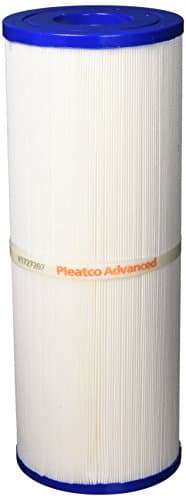
Pleatco PRB50-IN replacement cartridge
Pleatco · scored 8.6/10
The reference line. If a cartridge exists for your tub, Pleatco almost certainly makes it.
Filter cartridges are one of the few categories where the brand matters less than the part number, because fit is dictated by your tub. Pleatco earns its place by having the broadest catalog and a numbering scheme that cross-references cleanly to the other two majors.
Where the money goes is the end caps and the pleat count. Cheap cartridges usually fail at the cap rather than the media, by deforming after a few hot cleaning cycles, and a deformed cap lets water bypass the pleats entirely.
What the maker states
- Range
- Catalog covers most OEM spa cartridges
- Media
- Pleated polyester, antimicrobial in the M lines
- Part numbering
- P-prefixed, cross-referenced to Unicel and Filbur
- Fit
- Determined by your tub, not by brand
How it scored
- Build quality
- 9.0
- Catalog coverage
- 9.5
- Cleanability
- 8.5
- Value
- 6.5
- Availability
- 9.5
Skip this one if: your tub does not take this size. This is the PRB50-IN / C-4950 class, the most common spa cartridge but far from the only one -- confirm your part number on the filter finder before ordering.
#3 · Best for the monthly deep clean
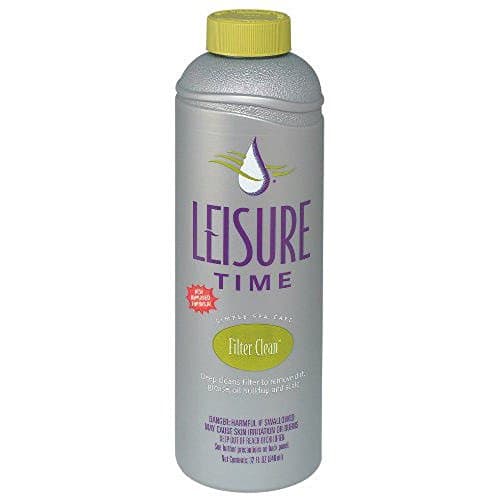
Leisure Time Filter Clean
Leisure Time · scored 8.4/10
A proper cartridge cleaner, which is a different product from a rinse.
The reason a rinsed filter still restricts flow is that the load is oil, not grit, and water does not remove oil. A dedicated cartridge cleaner is a surfactant designed to release exactly that, and the difference in flow after a proper soak is obvious at the jets.
Rinse harder afterwards than you think you need to. Cleaner left in the pleats goes straight into your water and is a very common cause of foaming that owners then blame on the tub.
What the maker states
- Format
- Concentrate for soaking
- Targets
- Body oils, lotions, light scale
- Soak time
- Per the label, commonly overnight
- Rinse
- Thoroughly, before refitting
How it scored
- Oil removal
- 9.0
- Scale removal
- 7.5
- Ease of use
- 8.0
- Cost per clean
- 8.0
- Availability
- 9.0
Skip this one if: your filter is only ever lightly loaded. A hose rinse handles surface debris; this is for the oils a rinse cannot shift.
Questions people actually ask
Frequently asked questions
How many filters should a hot tub have?
Two of whatever your tub takes: one in the water and one soaking or drying. It means you never have to choose between a proper overnight chemical soak and having a usable tub tomorrow, which is the reason most cartridges only ever get rinsed and die early.
Does having a spare hot tub filter save money?
For most owners, yes, and usually inside the first year. Each cartridge in a rotation spends half its life clean and dry, so both last materially longer than one cartridge used continuously. The second cartridge is a one-off cost.
How often should you swap between two hot tub filters?
Monthly, at the same point in the routine as the chemical soak. Pull the used one into the soak bucket, fit the spare, rinse the soaked one thoroughly the next morning and let it dry until the following month.
Can you mix filter brands in a rotation?
Yes, as long as they are the same part number. Pleatco, Unicel and Filbur cross-reference to each other, so running one of each is fine. It tells you nothing useful about which brand is better, though, so do not treat it as a comparison.
Where the numbers come from
Sources
Read next
Related on Float & Filter
- How to clean a hot tub filter
The soak the rotation exists to make practical.
- Hot tub filter finder by size
Confirm the part number before buying the second one.
- The best hot tub filter cartridges
Two cheaper cartridges beat one premium one used alone.
- When to replace a hot tub filter
Rotation extends life; it does not resurrect a dead cartridge.
- Pleatco vs Unicel vs Filbur
Choosing the brand once you have the part number.
- Hot Spring filters: Tri-X and alternatives
Reusable ceramic changes the arithmetic on keeping a spare set.
- Sundance spa filter replacements
A 75 square foot cartridge takes a long time to dry properly.