Guide
How to Install a Hot Tub Cover Lifter
Two measurements decide whether this goes well: clearance around the tub, and bracket height. Get either wrong and you drill the cabinet twice.
By Scooter M. · Published · How we pick
How this page is funded: the buy buttons below are Amazon affiliate links. If you buy through one we earn a commission at no extra cost to you. It does not change what we recommend, and where the better answer is a retailer we earn nothing from, we say so. The full version.
Fitting a cover lifter is a straightforward job that people get wrong in two specific, expensive ways: buying a design that cannot physically open in the space available, and mounting the brackets at the wrong height so the cover fouls the rim on its way over. Both are avoidable with a tape measure and twenty minutes of reading.
Everything on this page assumes you have already chosen a model. If you have not, the clearance question decides that too — see the cover lifter roundup.
Before you order: the four measurements
- Behind the tub. Cabinet face to the nearest wall, fence or obstruction. This is the figure most lifters are specified against, and the one that rules models in or out.
- Both sides. Some designs mount to a side rather than the back, and pivoting designs need room on the pivot side.
- Above the rim. For anything overhead — a pergola, a low roof, a branch. The cover has to swing through that space.
- The cover itself. Length, width and folded thickness. A thick, well-insulated cover folds far bulkier than a thin one, and folded height is what low-clearance designs trade away.
Then check those against the manufacturer’s stated clearance for the specific model, not for the product line. Low-clearance variants exist precisely because standard ones need more room than many installations have.
What you need on the day
- A drill, and the bit size the template specifies.
- A tape measure and a pencil.
- A level. Brackets mounted out of level bind the mechanism.
- A second person, for the fitting and testing stages.
- The template that came in the box, if there is one.
Set aside an hour. It is a thirty-minute job that becomes a two-hour job if you rush the marking.
The install, in order
- Read the instructions completely first. Not a formality: bracket height varies between models and is the thing that decides whether the cover clears the rim.
- Take the cover off and put it somewhere clean. Not leaning against a fence where it can slide, and not flat on grass.
- Establish bracket height from the template, measuring from the top edge of the cabinet rather than from the ground. Ground level is rarely as even as it looks and a base that slopes will put your two brackets at different heights relative to the rim.
- Mark both sides, then check them against each other. Measure the same reference on each side and compare. Brackets that differ by even a small amount will bind.
- Check what is behind the panel before drilling. Hot tub cabinets have plumbing, wiring and structural framing behind them in places. If you cannot see behind the panel, take it off. This is the step where an hour of care prevents a very expensive afternoon.
- Drill and mount, but leave the fixings slightly loose.
- Fit the bar and the cover, and test the full travel with two people before final tightening. The cover should clear the rim without touching, fold cleanly, and sit stable in the open position.
- Adjust, then tighten fully and re-test.
- Check the cover still latches. A lifter that stops the cover seating properly has traded a safety function for convenience, which is a bad trade.
The two mistakes that mean drilling twice
Bracket height. Too low and the cover drags on the rim as it goes over; too high and it sits proud and does not seal. Both produce a second set of holes in a cabinet that is now visibly drilled twice.
Assuming the ground is level. Measuring bracket height from the ground rather than from the cabinet top is the usual cause of mismatched sides.
The hardware, and why budget models fail
The saving on a cheap lifter is in the brackets and the fixings: thin brackets, short screws, soft washers. The mechanism is rarely the problem; the fastening into a relatively thin cabinet panel is.
If you have bought a budget model, consider upgrading the screws to something longer and better-rated from a hardware store before you fit it. It costs very little and it addresses the actual failure point. Do not go so long that you hit what is behind the panel — measure the panel thickness first.
When not to do this yourself
- You cannot see behind the panel and cannot remove it. Drilling blind into a hot tub cabinet risks plumbing and wiring.
- The cabinet is damaged or soft where the brackets need to go. Fixings into compromised material will pull out under load.
- Your tub has no conventional cabinet to bracket to, which is where undermount designs come in and where the load path depends on the tub base.
- The cover is already too heavy to handle safely. That is a cover problem rather than a lifting problem — work through replace or repair before spending on hydraulics for a cover that is failing anyway.
After it is fitted
The lifter folds the cover at the same hinge line every single time, and that fold is exactly where vinyl cracks first. Give the fold deliberate attention when you condition the cover rather than treating it as part of the general surface — the cover care roundup has the products and the interval.
Check the fixings once a season. They live outdoors, they take load every time the cover moves, and a bracket working loose is much easier to fix than a bracket that has torn out.
And keep the cover latching. The water underneath sits at spa temperature, commonly up to 104F, and a cover that latches is part of running a tub sensibly rather than an optional extra.
What fixes it
The products for this job
Named because they do the specific job this page describes, not because they are the only options. Specifications are the manufacturer’s published figures.
#1 · Best for tight side clearance
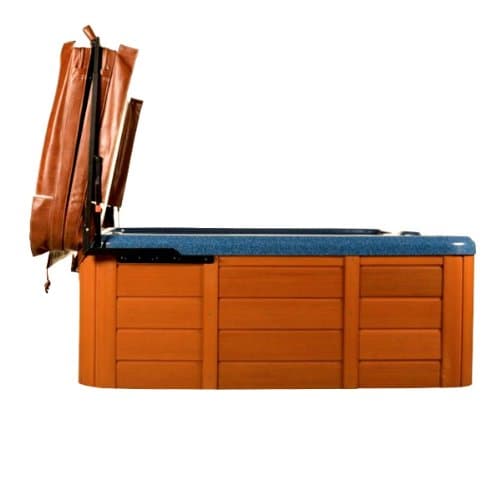
Cover Valet cover lifter
Cover Valet · scored 8.0/10
Lifts and pivots rather than sliding back, so it needs less room behind the tub.
A cover lifter is the accessory people are most likely to call life-changing, and the reason is mundane: a wet foam cover is heavy and awkward, and a two-person job becomes a one-person one.
Measure your clearances before ordering, on every side. The most common return in this category is not a faulty lifter, it is a lifter that physically cannot open in the space available.
What the maker states
- Type
- Pivoting lifter
- Mounting
- Bracket to the cabinet, per the instructions
- Clearance needed
- Behind the tub, per the maker
- Fits
- Most square and rectangular tubs, check the spec
How it scored
- Effort saved
- 9.0
- Clearance required
- 8.5
- Build quality
- 8.0
- Installation
- 7.0
- Value
- 7.0
Skip this one if: your tub is against a wall on the mounting side. Every lifter needs clearance somewhere; check which side before you buy.
#2 · Best for keeping the hardware out of sight
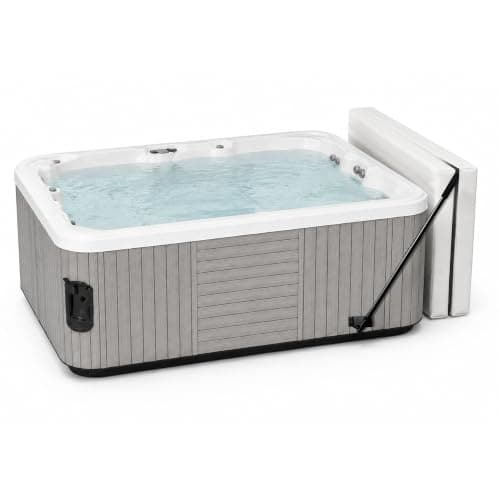
Heatwave Low Mount spa cover lift
Blue Wave · scored 7.4/10
Brackets under the lip instead of proud of the cabinet, so the tub keeps its lines. A 1-inch profile.
The under-mount idea is the appeal: the bracket sits below the spa's lip rather than standing off the cabinet, so there is no visible frame bolted to the side of the tub. The listed profile is one inch, and it swings the cover back and clear rather than stacking it on top.
Read the clearance line before anything else. Two feet on all sides is a real requirement and it is the opposite of a tight-space solution, so measure first. The frame is powder-coated steel and ships as a complete kit with brackets, adjustable spacers and hardware.
What the maker states
- Type
- Under-mount bracket lifter
- Profile
- 1 in, per the listing
- Fits
- Square or rectangular spas up to 8 ft wide, per the listing
- Clearance needed
- 2 ft on all sides, per the listing
How it scored
- Effort saved
- 8.0
- Clearance required
- 6.0
- Build quality
- 8.0
- Installation
- 7.0
- Value
- 8.0
Skip this one if: your tub is tight against a wall or a fence. The listing asks for 2 ft of clearance on all sides, which is more than most lifters here want.
#3 · Best for trying the idea cheaply
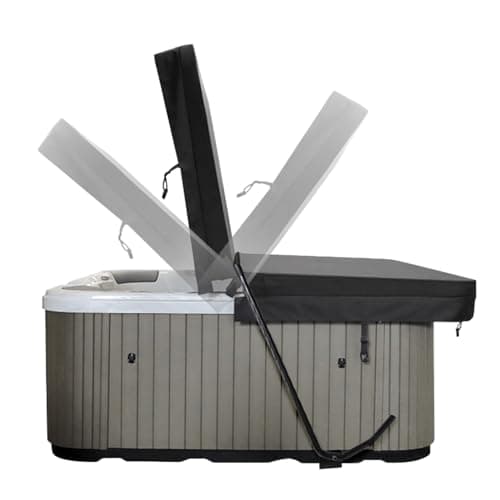
Budget bar-style cover lifter
Generic · scored 7.1/10
Does the job on a light cover. Hardware quality is where the savings come from.
If you are not sure a lifter will change your life, a cheap one answers that question for a fraction of the price. Plenty of owners find out it does and upgrade later with no regrets about the first purchase.
Inspect the mounting hardware when it arrives. Thin brackets and short screws into a thin cabinet panel are the failure point, and both are fixable with better fasteners from a hardware store.
What the maker states
- Type
- Bar-style lifter
- Mounting
- Cabinet brackets
- Hardware
- Varies widely by seller
- Fits
- Marketed as universal, verify dimensions
How it scored
- Effort saved
- 7.5
- Clearance required
- 7.0
- Build quality
- 5.5
- Installation
- 6.5
- Value
- 9.0
Skip this one if: your cover is already waterlogged and heavy. Budget brackets and straps are the first things to give under real weight.
Questions people actually ask
Frequently asked questions
How hard is it to install a hot tub cover lifter?
It is a thirty-minute job for most people, plus the time to measure properly. The two things that make it go wrong are getting bracket height wrong, so the cover fouls the rim, and drilling without knowing what is behind the cabinet panel.
Do you have to drill into a hot tub to fit a cover lifter?
Most bracket-mounted designs do require drilling the cabinet. Check what is behind the panel first, and take the panel off if you cannot see, because hot tub cabinets carry plumbing and wiring in places.
How much clearance does a cover lifter need?
It varies by design, which is why you measure before ordering. Standard bar-style lifters need the most room behind the tub; low-clearance models exist specifically for installations that do not have it. Check the stated clearance for the exact model, not the product line.
Should I pay someone to install a hot tub cover lifter?
Worth it if you cannot inspect behind the cabinet panel, if the cabinet is damaged where the brackets need to go, or if your tub has no conventional cabinet to bracket to. Otherwise it is a straightforward two-person job.
Where the numbers come from
Sources
Read next
Related on Float & Filter
- The best hot tub cover lifters
Choosing the design your clearances actually allow.
- Replace or repair a waterlogged cover
If the cover is too heavy, that is the problem to fix first.
- The best cover conditioners and cleaners
A lifter folds the cover at the same line every time. Condition it.
- Hot tub cover size guide: how to measure
Fold direction and skirt depth both depend on the lifter position.